
Short Answer
The USS Saratoga was a 26-gun corvette that served as the flagship of Master Commandant Thomas Macdonough during the Battle of Lake Champlain on September 11, 1814. Fought in Plattsburgh Bay, New York, this naval engagement was part of a larger British invasion attempt and resulted in a decisive American victory, securing control of the lake and contributing to the end of the War of 1812. The battle is often considered one of the most significant naval actions of the conflict, demonstrating the importance of naval superiority on inland waterways.
Historical Context
Lake Champlain, lying between New York and Vermont and extending north into Canada via the Richelieu River, had long served as a strategic invasion corridor. During the War of 1812, control of the lake was vital for moving troops and supplies. After the American victory on Lake Erie in 1813, the British focused on Lake Champlain as a viable route to sever New England from the rest of the United States. In 1814, following Napoleon’s defeat in Europe, Britain dispatched experienced troops to Canada, and Governor-General Sir George Prévost assembled a large army for an invasion southward. At the same time, both sides embarked on a shipbuilding race to gain naval dominance on the lake. Master Commandant Thomas Macdonough, commanding the American naval forces, established a base at Vergennes, Vermont, and oversaw the rapid construction of warships, including the Saratoga, launched in just 40 days in April 1814.
What Happened
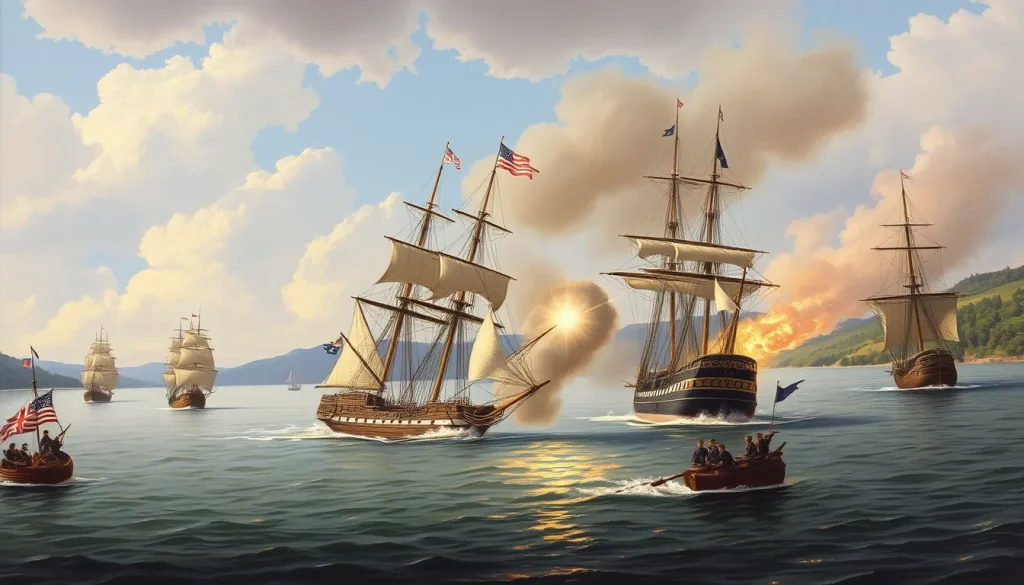
The British squadron, under Captain George Downie, entered Plattsburgh Bay on the morning of September 11, 1814, intending to support the army advancing on Plattsburgh. Macdonough had deliberately anchored his fleet across the bay, using springs on his anchor cables allow his ships to swivel and bring broadsides to bear. The British attacked from the north, and the battle soon centered on a duel between the Saratoga and the British flagship Confiance. After more than two hours of intense cannonading, during which the Saratoga swung on her springs to present a fresh broadside, the Confiance surrendered. The rest of the British squadron also struck their colors, while several gunboats escaped. The American victory effectively destroyed British naval power on Lake Champlain.
Why It Matters
The Battle of Lake Champlain stopped Prévost’s invasion and forced the British army to retreat to Canada. It also strengthened the American position at the peace negotiations in Ghent. Historians generally agree that the victory, by securing the northern frontier, played a crucial role in shaping the Treaty of Ghent, which ended the war in December 1814. The battle is remembered for Macdonough’s tactical skill, particularly his use of springs, which allowed him to overcome a heavier British firepower. In the broader context, it demonstrated the strategic importance of naval control on lakes and rivers during the war.
Prelude
In the spring of 1814, Macdonough’s rapid shipbuilding at Vergennes gave the Americans a temporary edge on Lake Champlain. British forces at Isle aux Noix responded by constructing the frigate Confiance, launched in August. By late summer, Prévost’s army advanced toward Plattsburgh, while Downie’s squadron prepared to support a coordinated attack. Macdonough, anticipating the British approach, moved his fleet to Plattsburgh Bay and anchored in a line across the entrance, using springs to enable rapid maneuvering. He deliberately chose a position that maximized his short-range carronades and forced the British to attack against the wind and current.
Forces and Commanders
The American squadron, commanded by Master Commandant Thomas Macdonough, comprised the corvette Saratoga (flagship), the brig Eagle, the schooner Ticonderoga, the sloop Preble, and ten gunboats. The British force, under Captain George Downie, included the frigate Confiance, the brig Linnet, the sloops Chubb and Finch, and twelve gunboats. The Saratoga carried eight 24-pounder long guns and eighteen carronades (six 42-pounders and twelve 32-pounders), while the Confiance mounted about thirty guns, including 24-pounders. Downie was under pressure to complete the Confiance and attack before the weather deteriorated.
Battlefield and Map Context
Plattsburgh Bay lies on the western shore of Lake Champlain, about 25 miles south of the Canadian border. The bay opens to the south, and its entrance is partially shielded by Cumberland Head to the east and Crab Island to the southwest. Macdonough anchored his line from north to south, close to the western shore, with his flagship in the center. The British fleet rounded Cumberland Head and approached from the north, with the wind from the northeast, forcing them to sail close to the American line. The narrow channel and varying winds made the British approach difficult, granting Macdonough a positional advantage.
Battle Chronology
The battle began at about 9:00 a.m. when the British ships came within range. The Eagle opened fire first, but her shots fell short. The Confiance then engaged the Saratoga, and both ships exchanged heavy broadsides. Within an hour, the Saratoga lost several guns and suffered damage, but Macdonough maneuvered his ship using springs to bring fresh guns to bear. By 10:30 the Eagle cut her cable and repositioned, leaving the Saratoga exposed to the British brig Linnet. Macdonough then let go a stern anchor, cut the bower cable, and swung the Saratoga around to fire a new broadside into the Confiance. This move proved decisive; the Confiance surrendered shortly after. The Linnet and other British vessels followed, while several gunboats escaped. The entire action lasted about two and a half hours.
Casualties and Losses
American casualties on the Saratoga were severe: reports indicate roughly 28 killed and 40 wounded among the ship’s company. Overall, the American squadron sustained about 50 killed and 58 wounded. The British losses were heavier, particularly on the Confiance, which suffered more than 100 casualties. The Confiance was described as a wreck, and the Linnet and other captured vessels were taken as prizes. Several British gunboats were sunk or damaged beyond repair. Exact numbers vary among sources, but the battle was clearly costly for both sides.
Result
The Battle of Lake Champlain was a decisive American victory. The entire British squadron was captured, and Captain Downie was killed early in the action. The defeat forced Prévost to abandon his invasion and retreat to Canada, ending the British threat to the northern United States. The victory also secured American control of the lake for the remainder of the war.
Strategic Consequences
The American victory at Plattsburgh Bay had immediate strategic significance. It prevented a British invasion that could have disrupted the heart of the northern theater and perhaps influenced the peace negotiations. When the Duke of Wellington was offered command in Canada, he reportedly declined, citing the lack of naval control on the lakes as a decisive obstacle. Historians often cite the battle as a key factor in the Treaty of Ghent, which established the status quo ante bellum. The victory also burnished Macdonough’s reputation and demonstrated the effectiveness of American naval tactics.
Primary Accounts
Macdonough’s dispatch to Secretary of the Navy William Jones, dated September 13, 1814, provides a detailed and authoritative account of the battle. The letter describes the engagement, the British disposition, and the successful use of springs. Other primary sources include the after-action reports of British officers, although many were written from captivity. The U.S. Navy Department published Macdonough’s dispatch and related documents in the congressional record, providing a comprehensive official account. These documents are accessible at the National Archives and through digitized Congressional Serial Set collections.
Battlefield Today
Plattsburgh Bay is part of the larger Lake Champlain basin, now a popular recreational area. The site of the battle is marked by a state historical sign and a monument at Plattsburgh, New York. The U.S. Navy named a later aircraft carrier USS Saratoga (CV-3) in honor of the ship and the battle. The original Saratoga was sold in 1825 after the war, and no hull survives. The Battle of Plattsburgh Association maintains a museum in Plattsburgh that includes artifacts and exhibits related to the battle, including a panoramic painting by Julian Davidson.
Primary Sources
The most important primary source is Macdonough’s detailed report of September 13, 1814, which is printed in American State Papers: Naval Affairs. This document provides the American perspective on the battle, including ship movements and tactical decisions. Another useful source is the letter from Secretary Jones to the Senate, dated October 3, 1814, transmitting the dispatches. British records, such as the court-martial of surviving officers after their exchange, offer a contrasting viewpoint, though they are often defensive in tone. These documents are available at the National Archives and in printed editions of naval documents.
Further Reading
- Theodore Roosevelt, The Naval War of 1812 (1882) – includes a detailed analysis of the battle.
- David Curtis Skaggs, Thomas Macdonough: Master of Command (2010)
- Patrick A. Wilder, The Battle of Plattsburgh: A Naval and Military History (1994)
- National Park Service, Saratoga National Historical Park resources on the ship and battle.
References
- Macdonough, Thomas. Dispatch to William Jones, September 13, 1814. In American State Papers: Naval Affairs, vol. 1.
- Jones, William. Letter to the Senate, October 3, 1814. In American State Papers: Naval Affairs, vol. 1.
- Roosevelt, Theodore. The Naval War of 1812. G.P. Putnam’s Sons, 1882.
- Skaggs, David Curtis. Thomas Macdonough: Master of Command. Naval Institute Press, 2010.
- Wilder, Patrick A. The Battle of Plattsburgh: A Naval and Military History. McFarland, 1994.
- U.S. Navy, Histories of Ships named Saratoga, Naval History and Heritage Command.
FAQ
What role did the USS Saratoga play in the Battle of Lake Champlain?
The USS Saratoga was the American flagship under Thomas Macdonough. She dueled the British flagship Confiance and used springs to swing her broadside, forcing the Confiance to surrender.
How did Macdonough's use of springs affect the battle?
Springs allowed Macdonough to rotate his ship to bring undamaged guns to bear, a key tactical move that turned the tide against the British.
Why was the Battle of Lake Champlain strategically important?
The American victory stopped a British invasion of New York, secured American control of the lake, and influenced the Treaty of Ghent that ended the War of 1812.



Leave a Reply