
Short Answer
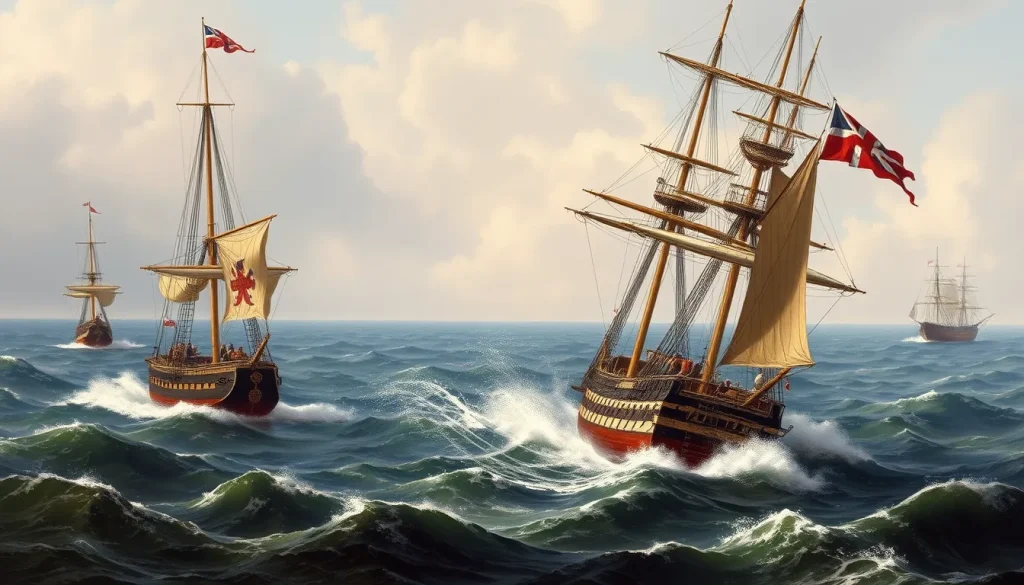
USS President was one of the six original heavy frigates of the United States Navy, launched in 1800. During the War of 1812, she became the flagship of Commodore Stephen Decatur and was the scene of one of the final naval actions of the conflict, culminating in her capture by a British squadron on 15 January 1815. This article focuses on the frigate USS President and her wartime career; a separate vessel also named President, a sloop purchased on Lake Champlain in 1812, is a distinct ship and not the subject of this article.
Historical Context
By 1814, the Royal Navy had imposed a tight blockade on the American coast, confining most U.S. Navy warships to port. The American frigates that had won early victories, such as USS United States and USS Macedonian, were blockaded at New London, Connecticut. USS President, a fast and heavily armed frigate, remained at New York, but she too was under blockade. Commodore Stephen Decatur, who had captured HMS Macedonian in 1812, had transferred his flag to President. The British squadron blockading New York consisted of the razee HMS Majestic (56 guns) under Commodore John Hayes, and the frigates HMS Endymion (40), HMS Pomone (38), and HMS Tenedos (38). Decatur planned to break out and raid British commerce in the Indian Ocean, but the blockade made departure perilous.
What Happened
On the night of 14 January 1815, a strong northwest gale blew the British blockaders offshore, giving Decatur his opportunity. President slipped down the East River and through the Narrows, but as she attempted to cross the sandbar at the harbor entrance, she grounded. Pounded by heavy seas for nearly two hours, the frigate was badly damaged before she worked free. The grounding stripped copper from her hull, twisted her masts, and racked the hull, reducing her speed.
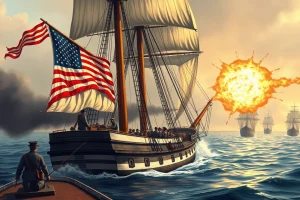
Despite the damage, Decatur continued to sea. On the morning of 15 January, the British squadron was sighted. The fastest ship, HMS Endymion, under Captain Henry Hope, closed and opened fire. A running battle ensued, lasting several hours. President’s crew fought stubbornly, but the other British ships were approaching. After suffering severe casualties and with his ship increasingly unmanageable, Decatur struck his colors. President was taken by the British, later sailed to England, and eventually broken up. The engagement cost President 35 killed and 70 wounded (including 3 lieutenants), while Endymion suffered 11 killed and 14 wounded.
Why It Matters
The capture of USS President brought the Atlantic naval war to a decisive conclusion. It demonstrated the effectiveness of the British blockade in eliminating the last major American frigate from the sea. The Royal Navy studied President’s design, which influenced later British frigates. For the United States, it was a humbling end to a war that had seen dramatic frigate victories earlier. Decatur’s reputation suffered temporarily, but he remained a national hero. Historians view the action as the final significant naval engagement of the war, occurring just before the Treaty of Ghent was ratified.
Type and Construction
President was a 44-gun frigate, one of the six original frigates authorized by the Naval Act of 1794. Designed by Joshua Humphreys, she was built at New York and launched on 10 April 1800. She displaced approximately 1,576 tons and measured 175 feet on the gun deck. Her hull was not fitted with diagonal riders, which made her prone to hogging and twisting under stress.
Nation
United States of America
Armament
In 1815, President carried 30 long 24-pounder cannons on her gun deck and 20 42-pounder carronades on her spar deck, for a total of 50 guns. Some sources note that six carronades were removed earlier, but by the final action she likely carried this armament.
Crew
President’s crew during the breakout numbered approximately 450 officers and men. Among the fifteen midshipmen was George Hollins, later a notable American naval officer. The ship was considered one of the most powerful American frigates afloat.
Commander
Commodore Stephen Decatur commanded President from December 1814 until her capture. Decatur was renowned for his earlier exploits, including the burning of USS Philadelphia at Tripoli and the capture of HMS Macedonian.
Engagements
President’s only major engagement was the action of 15 January 1815, when she was caught by the British squadron and fought a running fight with HMS Endymion before surrendering. Earlier in the war, she had not seen combat while under Decatur’s command due to the blockade, though she had been involved in a diplomatic incident with HMS Little Belt in 1811.
Fate
After her capture, President was taken to Bermuda and then to England. She was never recommissioned in the Royal Navy and was broken up in 1818. Her lines were copied by British shipbuilders for later frigates.
Primary Sources
Contemporary accounts of the capture include the official dispatch of Commodore Stephen Decatur to the Secretary of the Navy, dated 15 January 1815, which describes the action and his reasons for surrender. The British side is documented in the logbooks and after-action reports of Commodore John Hayes and Captain Henry Hope of HMS Endymion. The naval historian William James published a detailed account in “The Naval History of Great Britain” (1824), based on official records. Midshipman George Hollins left a memoir of the events, and his recollections were later published in the Naval History Magazine (April 2003). These sources are available in the U.S. National Archives, the National Archives (UK), and the Naval History and Heritage Command.
Further Reading
- Leiner, Frederick C. “Leave Them the Ashes of the President.” Naval History Magazine, April 2003, Vol. 17, No. 2.
- James, William. The Naval History of Great Britain. London, 1824.
- Hickey, Donald R. The War of 1812: A Forgotten Conflict. University of Illinois Press, 1989.
- Roosevelt, Theodore. The Naval War of 1812. New York: G.P. Putnam’s Sons, 1882.
References
- James, William. The Naval History of Great Britain. 1824.
- Leiner, Frederick C. “Leave Them the Ashes of the President.” Naval History Magazine, April 2003.
- “Capture of USS President.” The War of 1812 Website, https://thewarof1812.org/battles/capture-of-uss-president/.
- “Capture of USS President.” Wikipedia, https://en.wikipedia.org/wiki/Capture_of_USS_President.
FAQ
Why did USS President ground on a sandbar during her breakout?
The pilot boats assigned to mark the safe channel failed to do so correctly, and the heavy winter sea made navigation difficult. President struck the bar and pounded for nearly two hours before working free, suffering severe damage.
How did USS President compare to HMS Endymion in armament?
President carried 30 long 24-pounder cannon and 20 carronades, totaling 50 guns, while Endymion was a 40-gun frigate with 18-pounder long guns. President was heavier and more powerful, but her grounding had reduced her sailing qualities and speed.
What was the outcome of the capture of USS President?
President was captured by the British squadron, taken to England, and broken up in 1818. The capture marked the end of significant American frigate operations in the War of 1812, just before the ratification of the Treaty of Ghent.


Leave a Reply