
Short Answer
The Federalist Party’s opposition to the War of 1812 (1812–1815) stands as the most sustained and institutionally entrenched anti-war movement in the early American republic. Rooted in New England’s commercial communities but reaching Federalists throughout the United States, the opposition rejected the Madison administration’s case for war, obstructed the mobilization of militia and funds, and culminated in a regional convention at Hartford, Connecticut, in late 1814. The party’s resistance reflected a coherent ideological worldview shaped by admiration for Britain as a bulwark against Napoleonic France, and by a conviction that the war served Republican partisan ambitions more than the national interest.
Historical Context
Since the end of the American Revolution, the United States and Great Britain had accumulated unresolved grievances over maritime trade, impressment of American seamen, and British assistance to Indigenous nations resisting American expansion in the Old Northwest. British restrictions on neutral commerce under the Orders in Council, enforced by the Royal Navy’s blockade of Europe, struck directly at American shipping carried by northern merchants. Federalist districts in New England and the Mid-Atlantic bore a disproportionate share of the commercial losses arising from these restrictions.
Domestic politics had hardened into two opposing visions. The Republican Party, dominant in the South and West, viewed Britain as the republic’s principal adversary, advocated territorial expansion, and favored a foreign policy of commercial coercion and, ultimately, armed resistance. Federalists, strongest in New England and commercially oriented states, regarded Britain and its empire as the indispensable partner for American trade and as a necessary check on the revolutionary ambitions of Napoleon Bonaparte, whom one prominent Federalist called the “arch-Fiend who has long been the curse and Scourge of the European World.” Thomas Jefferson’s and James Madison’s commercial embargoes (1807–1809) had devastated New England’s maritime economy and deepened Federalist hostility toward the Republican administration.
When Madison, pressured by young Republican “war hawks” in Congress, sent a war message to Congress on June 1, 1812, Federalists uniformly rejected the argument that war was necessary or justified. Their protest, however, went far beyond the floor of Congress.
What Happened
Federalist members of Congress voted against the declaration of war almost to a man, and the party opposed roughly 90 percent of war-related legislation during the conflict, according to research by the National Park Service. In the states, Federalist governors of Massachusetts, Connecticut, and Rhode Island refused to order their militias into federal service for offensive purposes, insisting that the Constitution permitted the militia only to repel invasion or execute the laws, not to carry out presidential war policy. Massachusetts Governor Caleb Strong became the most prominent symbol of this resistance, and the Massachusetts legislature advised citizens not to volunteer except in defense of the state.
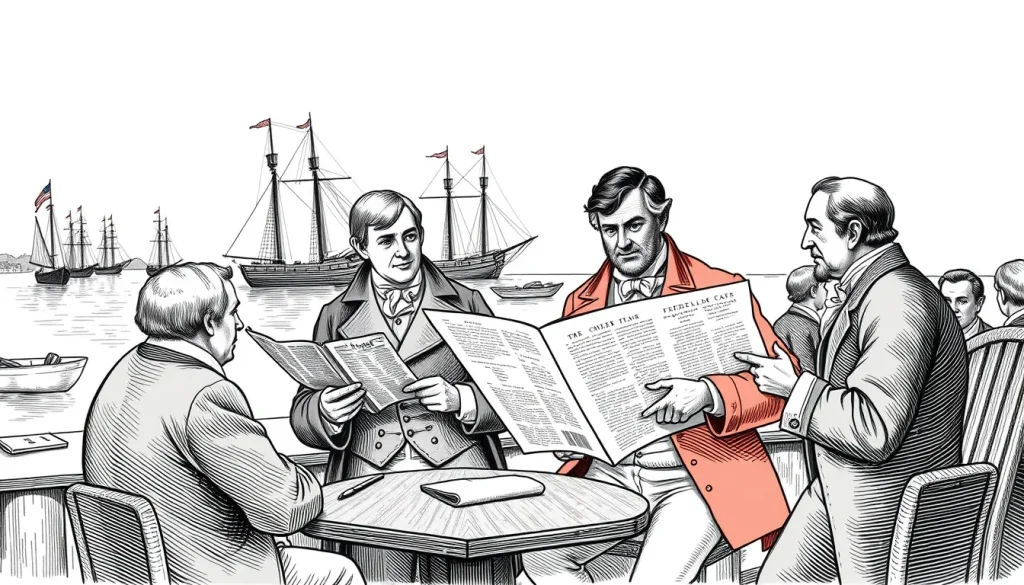
Federalist opposition extended to the press, the pulpit, and town meetings. Federalist newspapers, including the Boston Gazette and the Connecticut Mirror, denounced Madison’s policy in increasingly personal terms, branding the conflict “this most unnecessary, unjust, and disgraceful war” and attacking the president’s honesty and motives. Town meetings and county conventions across New England adopted memorials condemning the war and instructing representatives to vote against its funding.
Federalist merchants, meanwhile, continued to supply provisions to British forces in Canada through the border, a practice that both profited from the war and undermined the American war effort. At the level of state finance, New England banks and capitalists declined to purchase federal war loans, further straining the Treasury.
The most dramatic expression of Federalist opposition came in December 1814, when delegates from Massachusetts, Connecticut, Rhode Island, Vermont, and New Hampshire met at Hartford, Connecticut. The Hartford Convention’s final report, issued in January 1815, did not recommend secession—a proposal that was present in radical circles but rejected by moderate delegates—yet it called for constitutional amendments to reduce Southern and Western influence, and threatened to withhold New England’s resources from a war the region considered ruinous.
Why It Matters
The Federalist opposition affected the war’s military and diplomatic course. State refusals to provide militia hampered American offensives into Canada in 1812 and 1813. Domestic dissent weakened the negotiating position of American commissioners at Ghent, where Treasury Secretary and commissioner Albert Gallatin told Secretary of State James Monroe that New England’s “hostile attitude” gave the British “room to apprehend that a continuance of the war might prove vitally fatal to the United States.” Gallatin pressed for removing impressment as a sine qua non of peace, a demand the British themselves had already effectively dropped.
Historians disagree about the wisdom and loyalty of Federalist dissent. Some view it as a principled defense of minority rights against executive overreach; others, especially during and immediately after the war, branded it near-treason. The Hartford Convention’s association with secessionist talk, however exaggerated, seriously discredited the Federalist Party, and the arrival of the Treaty of Ghent just as the convention was finishing made the Federalists appear at best unpatriotic and at worst irrelevant. The party never again competed seriously for national power, and it had effectively dissolved as a national force by 1816.
Definition
The Federalist opposition to the War of 1812 was a coordinated political and civic resistance movement conducted primarily by members of the Federalist Party, its newspapers, and its state governments, directed against the Madison administration’s decision to wage war on Great Britain and against the manner in which that war was fought. It combined constitutional argument, legislative obstruction, gubernatorial refusal, financial noncooperation, and organized public protest.
Background
The intellectual roots of Federalist opposition lay in party ideology formed during the 1790s and hardened by the embargo years. Federalists saw Britain as the principal guardian of European civilization against the revolutionary and Napoleonic tyranny of France. They also understood American prosperity as dependent on Atlantic commerce, which Britain’s trade system largely regulated. When the Republican administration sought to coerce Britain through embargo rather than build a navy or negotiate a commercial agreement, Federalists saw deliberate destruction of their constituents’ livelihoods. By 1810–1811, several Federalist commentators had concluded that the Republican Party intended to use the crisis with Britain to consolidate its power at home by painting all critics as agents of the Crown. Rufus King, a Federalist senator and former minister to Britain, articulated this view when he described the war as “a war of party and not of country.”
How It Worked
Federalist opposition operated through multiple channels. In Congress, Federalist representatives and senators voted as a near-unbroken bloc against war taxes, military appropriations, and the suspension of habeas corpus. In the states, Federalist governors refused to provide militia for federal service, and legislatures declined to pass war-related measures. In the press, Federalist editors published scathing criticisms of the president, often in personal terms that one recent linguistic study characterizes as “aggravated impoliteness.” At the community level, town meetings and conventions memorialized grievances and encouraged citizens to refuse to volunteer. Financial obstruction was equally deliberate: New England capitalists avoided subscribing to federal war loans, and coastal merchants conducted a thriving trade with British forces in Canada, which simultaneously enriched Federalist communities and materially helped the enemy.
Competing Viewpoints
Federalists and Republicans disagreed both about the war’s justification and about the legitimacy of opposition itself. Republicans insisted that the war was necessary to vindicate national sovereignty and stop the impressment of American citizens, and they condemned Federalist dissent as disloyalty. Federalists countered that the war was a “most unnecessary, unjust, and disgraceful war” (in a phrase used by Federalist newspapers), that Britain’s struggle against Napoleon was of direct importance to American security, and that the Republicans’ insistence on making Britain rather than France the enemy proved the administration was pursuing factional interest rather than national interest. Within the Federalist Party, moderates like Harrison Gray Otis of Massachusetts sought to limit the opposition to constitutional protest and negotiation, while a radical minority, particularly in Essex County, Massachusetts, spoke openly of secession and a separate New England confederation.
Role in the War of 1812
The Federalist opposition shaped the war’s course in ways both concrete and intangible. Militia refusals in New England deprived American commanders of tens of thousands of potential troops for land offensives, contributing to the failure of several planned invasions of Canada. The continued British supply trade through New England and the lack of financial cooperation from the region reduced the resources available to the national government. Diplomatically, as Gallatin’s correspondence shows, Republican ministers at Ghent believed that visible domestic opposition encouraged British intransigence and prolonged the war. By the autumn of 1814, the government had reached the point where it was instructing its peace commissioners to give up its earlier demands on impressment, in part because it feared a longer war would destroy the Union rather than preserve it.
Consequences and Historical Interpretation
The immediate political consequence of Federalist opposition was the destruction of the Federalist Party. The Hartford Convention, though moderate in its actual proposals, was depicted by Republican editors as a secessionist conspiracy, and the peace of December 1814 made the entire enterprise appear groundless. Federalists lost the elections of 1814–1816 at virtually every level outside New England, and the party was effectively extinct as a national organization by 1820.
Historians have evaluated the Federalist opposition along a spectrum. Early historians such as Henry Adams emphasized New England’s recalcitrance as an episode of regional selfishness. Donald R. Hickey, in a careful revision of the historiography, demonstrated that Federalist opposition was not confined to New England; Federalists in the Middle and Southern states also voted against war measures and expressed dissent, contradicting the older claim that only New Englanders were disloyal. Alan Taylor, writing for the National Park Service, presents the Federalist position as a coherent, though commercially motivated, judgment that war with Britain was a military folly that would aid Napoleon and imperil the republic. More recent scholarship, such as Juhani Rudanko’s study of Federalist newspaper rhetoric, has examined the intensity of partisan language in the period, arguing that much of the criticism verged on delegitimizing the federal government—while also noting that the Madison administration did not prosecute dissenting editors, in large part because the First Amendment and the failure of the 1798 Sedition Act had established important limits on federal power.
Primary Sources
The most revealing contemporary sources for Federalist opposition include the letters and speeches of Rufus King, which articulate the “war of party” thesis; Massachusetts Governor Caleb Strong’s public messages refusing to comply with militia requisitions; the proceedings and final report of the Hartford Convention, published in 1815; and the Federalist press, especially the Boston Gazette and Connecticut Mirror, whose editorials and essays provide a running commentary on the war’s unpopularity in New England. Albert Gallatin’s letters to James Monroe, written during the Ghent negotiations, are essential for understanding how the administration perceived the domestic opposition’s diplomatic impact. Each source must be read with attention to its partisanship; Federalist statements were intended to persuade as much as to inform, and Republicans similarly exaggerated the scale and treasonous character of the dissent.
Further Reading
- Donald R. Hickey, “Federalist Party Unity and the War of 1812,” Journal of American Studies 12 (1978): 23–39.
- Donald R. Hickey, The War of 1812: A Forgotten Conflict (Urbana: University of Illinois Press, 1989).
- Alan Taylor, “Stark Alternatives: War or Compromise?”, National Park Service, 2015, https://www.nps.gov/articles/stark-alternatives.htm
- Samuel Eliot Morison, Harrison Gray Otis, 1765–1848: The Urbane Federalist (Boston: Houghton Mifflin, 1969).
- Richard Archer, “Dissent and Peace Negotiations at Ghent,” American Studies Journal, University of Kansas.
- Juhani Rudanko, “‘[T]his most unnecessary, unjust, and disgraceful war’: Attacks on the Madison Administration in Federalist Newspapers during the War of 1812,” Journal of Historical Pragmatics 12, no. 1-2 (2011): 82–103.
References
- U.S. National Park Service, “Federalists Oppose Madison’s War,” NPS.gov, 2016, https://www.nps.gov/articles/federalist-opposition-to-the-war.htm
- Alan Taylor, “Stark Alternatives: War or Compromise?”, National Park Service, 2015, https://www.nps.gov/articles/stark-alternatives.htm
- Donald R. Hickey, “Federalist Party Unity and the War of 1812,” Journal of American Studies 12 (1978): 23–39, https://www.cambridge.org/core/journals/journal-of-american-studies/article/abs/federalist-party-unity-and-the-war-of-1812/4FF6BC1443CDCCD922B960CBB53CB664
- Richard Archer, “Dissent and Peace Negotiations at Ghent,” American Studies Journal, University of Kansas, https://journals.ku.edu/amsj/article/download/2285/2244
- Juhani Rudanko, “‘[T]his most unnecessary, unjust, and disgraceful war’: Attacks on the Madison Administration in Federalist Newspapers during the War of 1812,” Journal of Historical Pragmatics 12, no. 1-2 (2011): 82–103, https://www.jbe-platform.com/content/journals/10.1075/jhp.12.1-2.04rud
FAQ
What were the main reasons Federalists opposed the War of 1812?
Federalists believed the war was unnecessary, likely to serve French interests by distracting Britain from Napoleon, and destructive to American commerce, especially New England's maritime trade. They also believed the Madison administration was waging a partisan war to consolidate Republican power.
Did all Federalists oppose the war equally?
No. Historian Donald R. Hickey has shown that Federalists in the Middle and Southern states also opposed the war, but the most intense and organized opposition was in New England. Within the party, moderates favored constitutional protest, while radical New Englanders spoke of secession.
What happened at the Hartford Convention?
In December 1814–January 1815, delegates from five New England states met at Hartford and issued a report condemning the war and proposing constitutional amendments to reduce Southern and Western political power. It did not recommend secession, but the arrival of peace made the convention appear unpatriotic and discredited the Federalist Party.



Leave a Reply