
Short Answer
Rifles used in the War of 1812 (1812–1815) included a diverse array of flintlock firearms, ranging from military-issue weapons like the U.S. Model 1803 and the British Baker rifle to civilian long rifles such as the Kentucky rifle. Although smoothbore muskets remained the standard infantry arm, rifles saw significant service with specialized rifle units, militia, and Indigenous allies, and their greater accuracy influenced skirmishing tactics and shaped the conflict’s military legacy.
Historical Context
The War of 1812 was fought between the United States and Great Britain over maritime rights, impressment, and territorial expansion. The U.S. military relied heavily on state militias and volunteer forces, many of whom brought their own weapons, while the British fielded regulars, Canadian militia, and Indigenous allies. Rifle technology was well established by then, but production remained limited. The U.S. had two national armories—Springfield and Harpers Ferry—and private contractors, yet most soldiers carried smoothbore muskets because they could be produced quickly and allowed bayonet use. Rifles were prized for accuracy but had slower rates of fire and were vulnerable to fouling, making them a specialized weapon rather than a standard-issue arm. The war also saw the use of older weapons from earlier conflicts, as well as trade guns supplied to Indigenous nations.
What Happened
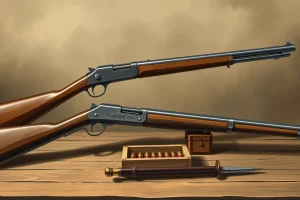
The most notable American rifle was the U.S. Model 1803, produced at Harpers Ferry from 1803 to 1819. It was a flintlock with a .54-caliber barrel, initially 33 inches long (later lengthened to 36 inches), and was issued to rifle regiments established in 1808. Approximately 19,700 were manufactured, and they saw action throughout the war. Civilian long rifles, often called “Kentucky rifles” (a name popularized by the 1824 song “The Hunters of Kentucky”), were carried by many frontier militia units. These rifles typically had smaller calibers, longer barrels, and could be exceptionally accurate. The British Army employed the Baker rifle, a .625-caliber weapon issued to the 95th Rifles and select light infantry. The Baker featured a shorter barrel and a brass powder pan, and it could accept a sword bayonet—an innovation. Canadian militia and Indigenous forces often used British trade muskets or older smoothbores, though some carried rifles. Rifles were used in key engagements, including the Battle of New Orleans (1815), where American riflemen took heavy tolls on advancing British infantry, and in skirmishes along the Canadian border, where they excelled at harassing enemy columns.
Why It Matters
Rifles demonstrated that accuracy could be decisive in certain tactical situations, but their slow reloading and inability to mount a bayonet prevented them from replacing muskets. The war influenced later developments, such as the adoption of rifled muskets in the mid-19th century. The legend of the Kentucky rifleman emerged, becoming a symbol of American frontier marksmanship. For the British, the Baker rifle proved its worth and remained in service for decades. The war also exposed the challenges of equipping armies with rifle technology and underscored the importance of industry and standardized production.
Definition
A rifle is a firearm with spiral grooves cut into the bore, known as rifling, which imparts a spin to the projectile for greater accuracy and range. In the War of 1812, rifles were muzzle-loading Flintlock firearms, typically single-shot, using a piece of flint to ignite the powder charge. They differed from smoothbore muskets, which had no rifling and were less accurate but faster to load and allowed bayonet attachment.
Background
Rifling had been known since the 16th century, but rifles were expensive and slow to load because the lead ball had to fit tightly into the grooves. The American long rifle evolved from European jäger rifles and was finely crafted by gunsmiths in Pennsylvania and other frontier regions. The U.S. government recognized the value of rifles for skirmishing and border defense, leading to the creation of the Model 1803. The British had experimented with rifles earlier, particularly during the Napoleonic Wars, and issued Baker rifles to elite light infantry units. Indigenous nations and militia often acquired rifles through trade or captured them.
How It Worked
A flintlock rifle operated by pulling the trigger, which released a hammer holding a piece of flint. The flint struck a steel frizzen, producing sparks that ignited gunpowder in the priming pan. The flash then traveled through a touch hole to ignite the main charge in the barrel, propelling the lead ball forward. Rifling, consisting of spiral grooves cut into the barrel, caused the ball to spin, stabilizing its flight and greatly increasing effective range—often to 200 yards or more, compared to muskets effective to 80 or 100 yards. Loading a rifle involved pouring powder, placing a patched ball, and ramming it down the barrel, a process that took longer than loading a musket. Over time, powder fouling accumulated in the grooves, eventually making loading impossible until cleaned—a major tactical drawback.
Competing Viewpoints
Military doctrine debated the merits of rifles versus muskets. Proponents of rifles emphasized accuracy and the ability to fire from cover, useful for skirmishing and sniping. Detractors argued that muskets could be loaded three times as fast, could mount bayonets, and produced greater volume of fire, which mattered in close-order combat. Some officers also believed that rifles required highly trained marksmen and that the average soldier would be less effective with them. These views shaped equipping decisions, with the U.S. creating dedicated rifle regiments while the British limited rifles to elite units.
Role in the War of 1812
Rifles were fielded by both sides but remained secondary to muskets. On the American side, the 1st Rifle Regiment and various militia rifle companies were active in campaigns along the Niagara frontier, the Northwest, and in the South. At the Battle of New Orleans, American riflemen, including Tennessee and Kentucky militiamen, inflicted heavy casualties on British regulars, showcasing the rifle’s potential in defensive positions. The British used Baker rifles primarily with the 95th Rifles, who fought at engagements like the Battle of Crysler’s Farm and the final assault on New Orleans. Canadian militia and Indigenous warriors used a mix of weapons, but rifles contributed to their effectiveness in forest warfare.
Consequences and Historical Interpretation
The war reinforced the rifle’s reputation among American frontiersmen and influenced the later adoption of rifled arms. However, it also demonstrated that the logistics and tactics of rifled weapons were not yet suited for line infantry. Historians have argued that the war’s experiences accelerated military experiments with percussion locks and rifled muskets, leading to the Springfield Model 1855 and similar weapons. The Kentucky rifle’s mythic status as a war-winning weapon grew in the 19th century, even though muskets were far more common. Modern scholarship emphasizes the limitations of rifles on the battlefield and the complex interplay of technology, terrain, and tactics.
Primary Sources
Primary sources for rifles used in the War of 1812 include ordnance inspection reports, quartermaster records, and personal letters of officers and soldiers. For example, the papers of Secretary of War Henry Dearborn reference the procurement and distribution of rifles. Military correspondence from commanders like Andrew Jackson and Winfield Scott occasionally mention rifle usage. However, many contemporary accounts do not distinguish rifle types in detail. The National Archives in Washington, D.C., holds army correspondence and ordnance returns, while the Library of Congress has period letters. These sources are often fragmentary and sometimes biased, reflecting the writers’ perspectives and the limited technical vocabulary of the time.
Further Reading
- Garry James, “Guns of the War of 1812,” American Rifleman, September 27, 2012.
- “Firearms of the War of 1812,” American Rifleman, January 11, 2013.
- “Equipment in the War of 1812,” American Battlefield Trust, updated July 9, 2024.
- Austin Gage Howell, “Weapons in the War of 1812,” NCpedia, 2013.
- “Harpers Ferry Model 1803 Flintlock Muzzle-Loading Rifle,” MilitaryFactory.com.
References
- Garry James, “Guns of the War of 1812,” American Rifleman, September 27, 2012, available online.
- “Firearms of the War of 1812,” American Rifleman, January 11, 2013, available online.
- “Equipment in the War of 1812,” American Battlefield Trust, updated July 9, 2024, available online.
- Austin Gage Howell, “Weapons in the War of 1812,” NCpedia, 2013, available online.
- “Harpers Ferry Model 1803 Flintlock Muzzle-Loading Rifle,” MilitaryFactory.com, available online.
FAQ
What was the most common rifle used by American forces?
The U.S. Model 1803 was the first standard-issue rifle produced by the U.S. government, though many militiamen carried civilian long rifles like the Kentucky rifle.
Why were rifles not the standard infantry weapon in the War of 1812?
Rifles had slower reload times, fouled quickly with black powder, and could not mount bayonets, making them less effective in close-order combat compared to smoothbore muskets.
Which battles featured significant rifle use?
Rifles were notably used at the Battle of New Orleans (1815) and in skirmishes along the Canadian frontier, including engagements at Crysler's Farm and Châteauguay.



Leave a Reply