
Short Answer
The Treaty of Ghent, signed on 24 December 1814, formally ended the War of 1812 between the United States and Great Britain, yet it conspicuously omitted the very issues that had driven the conflict. The treaty restored boundaries to their pre-war status (status quo ante bellum) but left unresolved key American war aims—impressment, neutral trading rights, and the future of Indigenous lands—while also deferring boundary disputes and fishing rights to later commissions. Its ambiguities would shape U.S.-British relations and North American geopolitics for decades.
Historical Context
The War of 1812 (1812–1815) grew from maritime disputes during the Napoleonic Wars. Great Britain’s Orders in Council restricted neutral American trade with France, and the Royal Navy’s practice of impressment—stopping U.S. ships and forcing sailors into service—outraged Americans. American expansionists, known as “War Hawks,” also sought to annex Canada and end British support for Indigenous nations resisting U.S. westward settlement. When Britain suspended the Orders in Council two days after the U.S. declaration of war in June 1812, the issue dissipated, but impressment remained a core grievance. By 1814, with Napoleon defeated, Britain could turn its full attention to the American front, while the United States, economically strained and politically divided, faced a formidable adversary. The Russian tsar’s offer to mediate in 1813 had failed, but direct negotiations began at Ghent (modern Belgium) in August 1814.
What Happened
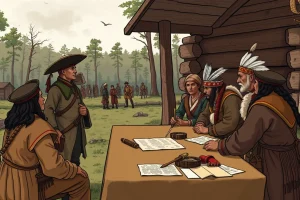
Negotiations at Ghent involved five American commissioners—John Quincy Adams, Albert Gallatin, Henry Clay, Jonathan Russell, and James A. Bayard—and British representatives including Admiral James Gambier, Dr. William Adams, and Henry Goulburn. The Americans initially demanded an end to impressment, but by the time talks opened, they had dropped this as unrealistic. The British, emboldened by victories such as the burning of Washington in August 1814, presented harsh terms: the creation of an Indigenous buffer state in the Northwest, U.S. territorial concessions in Maine and Minnesota, demilitarization of the Great Lakes, and acknowledgment of British maritime rights. The American delegation refused, and the British, under pressure from Wellington’s advice and financial strain, gradually retreated. They proposed uti possidetis—each side keeping captured territory—but the Americans insisted on status quo antebellum. The final treaty, signed on 24 December 1814, restored all boundaries, provided for the return of prisoners, established commissions to settle border disputes, and included Article IX, promising to restore to Indigenous nations the rights they had held in 1811. It said nothing about impressment, neutral rights, or the Orders in Council—the central causes of the war. Ratification was delayed; the treaty reached Washington after the Battle of New Orleans (8 January 1815), and it was ratified by the U.S. Senate unanimously on 16 February 1815.
Why It Matters
The treaty’s unresolved issues had immediate and long-term consequences. The end of the Napoleonic Wars rendered impressment moot, but the United States never secured a formal renunciation of the practice. Neutral trading rights remained a point of contention until the mid-1800s. Article IX’s protection for Indigenous lands was never enforced, and American westward expansion continued unabated, leading to further dispossession of Native peoples. The boundary commissions eventually resolved the Maine–New Brunswick border, but other disputes persisted. The treaty also fostered a sense of American national identity, despite the fact that not a single U.S. war aim was achieved. In Canada, the war’s outcome solidified British control and contributed to the growth of a distinct Canadian identity. Historians disagree over whether the war and treaty represented a draw, a British victory, or a U.S. diplomatic victory, but the treaty’s silences have been the subject of enduring debate.
Definition
The Treaty of Ghent was a bilateral agreement that ended the War of 1812. Its primary principle was the status quo ante bellum—restoring all territorial boundaries to their 1812 positions. The treaty established no provisions on impressment, neutral shipping rights, or the Indigenous buffer state—issues that had been central to the American declaration of war and remained unresolved.
Background
The war had arisen from British interference with American maritime trade and the impressment of sailors claimed as British subjects. The United States also sought to annex Canada and end British support for Indigenous resistance in the Northwest. While Britain had withdrawn the Orders in Council in June 1812, impressment continued, and American attempts to conquer Canada failed. By 1814, the war in Europe had ended, allowing Britain to reinforce its forces in North America, but American victories at Plattsburgh and Baltimore weakened British bargaining power. Both sides were weary, and negotiations at Ghent began on 8 August 1814.
How It Worked
The treaty’s eleven articles defined the terms of peace. Article I mandated the restoration of all territory captured during the war. Articles II–V established commissions to resolve the northeastern boundary and other disputed lines along the U.S.–Canada frontier. Article VI addressed the Great Lakes boundary, and Article VII created a commission for the northwestern boundary. Article VIII provided for the return of prisoners, and Article IX promised to restore to Indigenous nations the rights and possessions they held in 1811. The treaty was silent on impressment and neutral rights, effectively dropping these American demands. It also deferred the fishing rights issue to later commissions. The treaty’s ratification process, requiring both parties to approve before peace took effect, delayed the cessation of hostilities until February 1815.
Competing Viewpoints
Scholarly interpretations of the treaty’s outcome vary widely. Many American historians, emphasizing the country’s successful defense and the “Second War of Independence” narrative, regard the treaty as a draw. Others, such as British historian Andrew Lambert, argue that Britain achieved its core objectives—defending Canada, maintaining maritime supremacy, and preventing forced concessions on impressment—while the United States achieved none of its stated war aims. Indigenous perspectives highlight the treaty’s promise to restore lands and rights, a promise that was never kept, as the United States continued to dispossess Native nations. Some historians also stress that the treaty’s silence on impressment and neutral rights simply reflected the changed international situation after Napoleon’s fall, rather than a diplomatic failure.
Role in the War of 1812
The treaty ended the war without resolving the causes that had led to it. It did not prevent the Battle of New Orleans, which occurred after the signing but before ratification. The treaty’s terms nevertheless shaped the final military campaigns and the official end of hostilities. For the United States, the failure to secure any maritime concessions meant that the war’s primary objectives were abandoned; for Britain, the preservation of Canada and the royal prerogatives at sea satisfied its wartime goals. The treaty’s Article IX was a nominal attempt to address Indigenous rights, but without enforcement mechanisms, it had little effect. The unresolved issues thus influenced the development of U.S.–British relations, including the Rush-Bagot Agreement of 1817, which demilitarized the Great Lakes, and the eventual resolution of the Oregon boundary dispute.
Consequences and Historical Interpretation
The treaty’s long-term consequences include the shaping of the modern U.S.–Canada border, the growth of American nationalism, and the continued marginalization of Indigenous peoples. Historians have debated whether the treaty represented a diplomatic victory for either side. The status quo antebellum restored the pre-war situation, but the war’s impact on Indigenous nations was catastrophic—they lost land and influence, despite the treaty’s promises. The unresolved issues also contributed to the Monroe Doctrine and the eventual Anglo-American rapprochement. By the 1870s, the treaty’s remaining boundary disputes were settled through arbitration, and by the early twentieth century, the U.S. and Britain had become allies. The treaty’s significance lies not so much in what it resolved as in what it left undone.
Primary Sources
The Treaty of Ghent itself is the primary document, available at the U.S. National Archives and the UK National Archives. The American commissioners left firsthand accounts: John Quincy Adams’s diary offers a detailed narrative of the negotiations; Albert Gallatin’s letters to Secretary of State James Monroe describe the strategic debates. British sources include the official correspondence of Henry Goulburn and Viscount Castlereagh. A modern, accessible transcript appears in the American Battlefield Trust’s educational materials. These sources reveal the treaty’s deliberate omissions, but they must be read with an awareness that each negotiator had his own biases and interests.
Further Reading
- Donald R. Hickey, The War of 1812: A Forgotten Conflict, University of Illinois Press, 1989.
- Bradford Perkins, Castlereagh and Adams: England and the United States, 1812–1823, University of California Press, 1964.
- J.C.A. Stagg, Mr. Madison’s War: Politics, Diplomacy, and Warfare in the Early American Republic, 1783–1830, Princeton University Press, 1983.
- American Battlefield Trust, “Treaty of Ghent: Ending the War of 1812,” battlefields.org.
- U.S. National Archives, “The Treaty of Ghent,” archives.gov.
References
- Britannica, “War of 1812 – Final stages of the war and the aftermath,” https://www.britannica.com/event/War-of-1812/Final-stages-of-the-war-and-the-aftermath
- American Battlefield Trust, “The Treaty of Ghent: Ending the War of 1812,” https://www.battlefields.org/learn/articles/treaty-ghent-ending-war-1812
- Encyclopedia.com, “Treaty of Ghent,” https://www.encyclopedia.com/history/united-states-and-canada/us-history/treaty-ghent
- The War of 1812, “Treaty of Ghent,” https://thewarof1812.org/treaty/
- HISTORY.com, “Treaty of Ghent,” https://www.history.com/articles/treaty-of-ghent
FAQ
Did the Treaty of Ghent end impressment?
No, the treaty was silent on impressment. The practice ended with the Napoleonic Wars, but no formal concession was made.
Why is the Treaty of Ghent called a 'draw'?
The treaty restored pre-war boundaries, leading many to view it as a draw, but critics note the U.S. failed to achieve its stated war aims.
What did Article IX of the Treaty of Ghent promise?
Article IX promised to restore to Indigenous nations all possessions, rights, and privileges they held in 1811, but it was never enforced.

Leave a Reply