Short Answer
The War of 1812 in 1812 traces the opening year of the conflict between the United States and Great Britain, from the declaration of war on June 18, 1812, to the end of that year. This period saw the first American invasions of Canada, a series of dramatic single-ship naval duels, and the establishment of patterns that would define the war until 1815. The events of 1812 were critical because they set the tone for American military strategy, revealed weaknesses in U.S. forces, and produced iconic victories that shaped national morale.
Historical Context
By 1812, the United States and Great Britain were locked in a diplomatic crisis rooted in the Napoleonic Wars. Britain’s Orders in Council (1807) restricted American trade with France and its allies, while the Royal Navy’s practice of impressment—stopping American ships and removing suspected British deserters—angered the U.S. public. Britain also supported Native American resistance to U.S. expansion in the Northwest Territory, encouraging a confederacy led by the Shawnee leader Tecumseh. In the U.S., a faction of Democratic-Republicans known as the “War Hawks” advocated war to defend national honor, end impressment, and potentially annex Canada. President James Madison, pressured by these forces, delivered a war message to Congress on June 1, 1812. After heated debate, Congress declared war on June 18, with a vote of 79–49 in the House and 19–13 in the Senate. The decision was opposed by many Federalists, especially in New England, who feared damage to trade and preferred neutrality. On the international stage, Britain was deeply engaged in the Peninsular War against Napoleon, and Canada served as a base for British and Indigenous forces.
What Happened
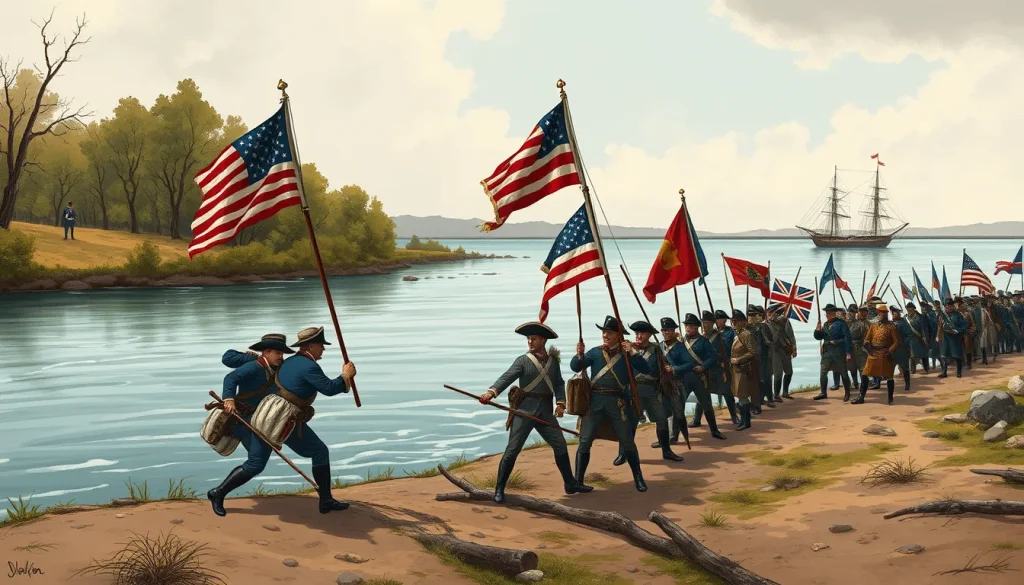
The United States began the war with a three-pronged invasion of Canada, aiming to seize territory and force a quick peace. The main thrust came from Brigadier General William Hull, who crossed from Detroit into Upper Canada on July 12, 1812, but quickly retreated to Fort Detroit after facing supply problems and threats from British forces and their Indigenous allies. Meanwhile, the British captured Fort Mackinac on July 17, a strategically vital post controlling the upper Great Lakes, and on August 15 they attacked Fort Dearborn (modern Chicago), where the garrison was massacred. Hull, fearing an onslaught, surrendered Detroit to British Major General Isaac Brock and the Shawnee leader Tecumseh on August 16, 1812, without a major fight. This surrender was a severe blow to American morale and ended U.S. operations in the Northwest for the year.
On the Niagara frontier, American forces under Major General Stephen Van Rensselaer attempted to invade Canada in October. At the Battle of Queenston Heights on October 13, a British and Indigenous force, despite the death of Major General Isaac Brock, repulsed the American invasion. American militia refused to cross the border, and more than 1,000 U.S. troops were killed, wounded, or captured. The defeat effectively ended the American attempt to secure the Niagara region for 1812.
At sea, however, the U.S. Navy achieved notable successes that boosted national pride. On August 19, the USS Constitution defeated the British frigate HMS Guerriere off Nova Scotia, earning the nickname “Old Ironsides” when cannonballs seemed to bounce off its hull. The Constitution then captured the HMS Java on December 29. Earlier, on October 25, the USS United States under Captain Stephen Decatur captured the HMS Macedonian. These victories demonstrated that the young American navy could match the Royal Navy in single-ship actions. American privateers also captured numerous British merchant ships during the year, disrupting British trade.
Other events in 1812 included the bombardment and burning of American towns: the British shelled and burned Buffalo, Lewiston, and other frontier communities after Queenston Heights. The U.S. also suffered a devastating defeat at the River Raisin in January 1813, but that falls outside the 1812 calendar year. In early 1812, before the declaration, the United States had passed the Army Expansion Act and embargoes, but these were preparatory. The year closed with the U.S. still reeling from land defeats but celebrating naval victories.
Why It Matters
The events of 1812 established the war’s initial momentum and revealed critical themes. The failure of the Canadian invasion exposed the poor training and leadership of the U.S. Army, as well as the reluctance of state militias to serve outside U.S. territory. The loss of Detroit and the stalemate on the Niagara frontier demonstrated that quick territorial gains were unlikely. In contrast, the naval victories of 1812 gave the United States a sense of maritime credibility and provided a rallying point for national identity, even as the British Royal Navy remained overwhelmingly dominant in numbers. The year also deepened the alliance between British forces and Indigenous nations, especially under Tecumseh, whose leadership became crucial in the Northwest. Strategically, 1812 showed that the war would be long and costly, prompting both sides to prepare for a more sustained struggle in 1813.
Definition
The War of 1812 in 1812 refers to the campaign year from the formal declaration of war by the United States on June 18, 1812, through December 31, 1812. It encompasses all military actions on land and sea during that period, including initial invasions, naval engagements, and the political and diplomatic events connected to the war’s first phase.
Background
The background to the 1812 campaigns lies in the unresolved grievances between the United States and Great Britain: impressment, trade restrictions, British support for Indigenous resistance, and American expansionist ambitions. The U.S. declaration of war came after years of escalating tensions, including the Chesapeake-Leopard Affair of 1807 and the Little Belt Affair of 1811. British leaders, focused on Europe, initially saw the war as a sideshow, but they sent reinforcements to Canada and stepped up naval operations. In the United States, the war was championed by War Hawks from the South and West, who hoped to annex Canada and end British influence in the Northwest.
How It Worked
In 1812, military operations were shaped by geography and logistics. The United States attempted invasions along three main corridors: the Detroit River, the Niagara River, and the Lake Champlain–Richelieu River. All three failed due to inadequate supplies, poor coordination, and strong British-Canadian-Indian defense. The Royal Navy, though busy in Europe, deployed squadrons to the North Atlantic and the Caribbean to intercept American shipping and enforce a blockade that would expand over time. American naval forces, though small, used fast frigates and sloops for commerce raiding and single-ship duels, exploiting superior gunnery and ship construction.
Competing Viewpoints
Historians have debated the significance of 1812. Some emphasize the failure of the U.S. strategy, attributing it to poor leadership and militia unwillingness to serve abroad. Others highlight the naval victories as evidence of American naval proficiency, though these did little to alter the strategic balance. A third viewpoint stresses the role of Indigenous peoples, arguing that their alliances with Britain were crucial to Canadian defense and that their actions—especially at Fort Detroit and Queenston—were not merely auxiliary but central to British success. Later interpretations have also examined the impact of 1812 on Canadian identity, as the successful defense reinforced a distinct British North American loyalty.
Role in the War of 1812
1812 served as the war’s opening act, shaping the course of the entire conflict. The losses on land forced the United States to reorganize its army, leading to the appointment of new commanders and a more professional officer corps by 1813. The naval victories encouraged Americans to invest in privateering and to challenge British maritime power, while also provoking a more aggressive British naval response. The Indigenous alliances formed in 1812, particularly with Tecumseh, became central to the war in the Old Northwest until Tecumseh’s death at the Battle of the Thames in 1813. The year thus set the stage for the more intense campaigns of 1813 and 1814.
Consequences and Historical Interpretation
The immediate consequences of 1812 were mixed: the U.S. lost territory in the Northwest and failed to gain any foothold in Canada, but it won several celebrated naval victories and maintained a public perception of fighting for national honor. In the longer term, the events of 1812 contributed to the eventual stalemate at the Treaty of Ghent in 1814. Historical interpretation has evolved: early American historians celebrated the naval triumphs, while later scholars have placed more emphasis on the Canadian defense and the role of Indigenous nations. The year 1812 is now often seen as a formative moment for all three nations—United States, Canada, and the Indigenous peoples—who experienced both loss and resistance.
Primary Sources
Key primary sources for 1812 include President James Madison’s war message of June 1, 1812, and the congressional debates leading to the declaration. Official military dispatches, such as General William Hull’s reports and those of British commanders, document the conduct and surrender of Detroit. The correspondence of Major General Isaac Brock and the journals of Tecumseh’s allies provide insight into British and Indigenous perspectives. Naval after-action reports, particularly from Captain Isaac Hull of the USS Constitution and Captain Stephen Decatur, detail the engagement with HMS Guerriere and HMS Macedonian. The British Admiralty records and American navy records are housed in national archives. Newspapers of the era, like the National Intelligencer and the London Gazette, offered contemporary narratives and must be used with awareness of their propaganda roles.
Further Reading
- Hickey, Donald R. The War of 1812: A Forgotten Conflict. University of Illinois Press, 1989.
- Stagg, J.C.A. The War of 1812: Conflict for a Continent. Cambridge University Press, 2012.
- Benn, Carl. The War of 1812. Osprey Publishing, 2002.
- American Battlefield Trust. “War of 1812 Timeline.” American Battlefield Trust. Accessed 2024. https://www.battlefields.org/learn/articles/war-1812-timeline.
- USS Constitution Museum. “War of 1812 Chronology (1812-1815).” USS Constitution Museum. Accessed 2024. https://ussconstitutionmuseum.org/major-events/war-of-1812-chronology/.
References
- American Battlefield Trust. “War of 1812 Timeline.” American Battlefield Trust. Accessed 2024. https://www.battlefields.org/learn/articles/war-1812-timeline.
- USS Constitution Museum. “War of 1812 Chronology (1812-1815).” USS Constitution Museum. Accessed 2024. https://ussconstitutionmuseum.org/major-events/war-of-1812-chronology/.
- History.com Editors. “War of 1812 begins | June 18, 1812.” HISTORY. Accessed 2024. https://www.history.com/this-day-in-history/war-of-1812-begins.
- “Timeline of the War of 1812.” Wikipedia. Accessed 2024. https://en.wikipedia.org/wiki/Timeline_of_the_War_of_1812.
- HistoryCentral. “The War of 1812.” Accessed 2024. https://www.historycentral.com/1812/Index.html.
FAQ
Why did the United States declare war on Britain in June 1812?
President James Madison cited impressment, trade restrictions from the Orders in Council, and British support for Indigenous resistance as grounds for war. A divided Congress voted for war on June 18, 1812.
What was the outcome of the U.S. invasion of Canada in 1812?
The invasion failed on all fronts: General Hull surrendered Detroit on August 16, and the Battle of Queenston Heights on October 13 ended in a British victory, repulsing American forces.
What were the major U.S. naval victories in 1812?
The USS Constitution defeated HMS Guerriere on August 19 and HMS Java on December 29; the USS United States captured HMS Macedonian on October 25. These victories boosted American morale.




Leave a Reply