Short Answer
The Federalist Party, once a dominant political force in the early United States, experienced an irreversible decline in the years immediately following the War of 1812. The war, particularly the controversial Hartford Convention of 1814–1815, discredited the party as unpatriotic and treasonable, leading to its collapse as a national organization. This article examines the causes, events, and consequences of that decline, and its significance for American political history.
Historical Context
The Federalist Party emerged in the 1790s under the leadership of Alexander Hamilton and John Adams, advocating a strong central government, a national bank, and close ties with Great Britain. After the election of Thomas Jefferson in 1800, the Democratic-Republican Party gained ascendancy, and the Federalists entered a long period of decline. By 1812, they retained significant support only in New England, where commercial interests resented the Republican embargoes and the war policy.
The War of 1812, declared on June 18, 1812, was fiercely opposed by most Federalists. They viewed it as a ruinous contest that favored France and threatened American commerce. As the war dragged on, United States forces suffered setbacks along the Canadian frontier and in the Chesapeake, while British naval blockades crippled New England trade. These conditions fueled sectional bitterness and led to calls for a regional convention.
What Happened
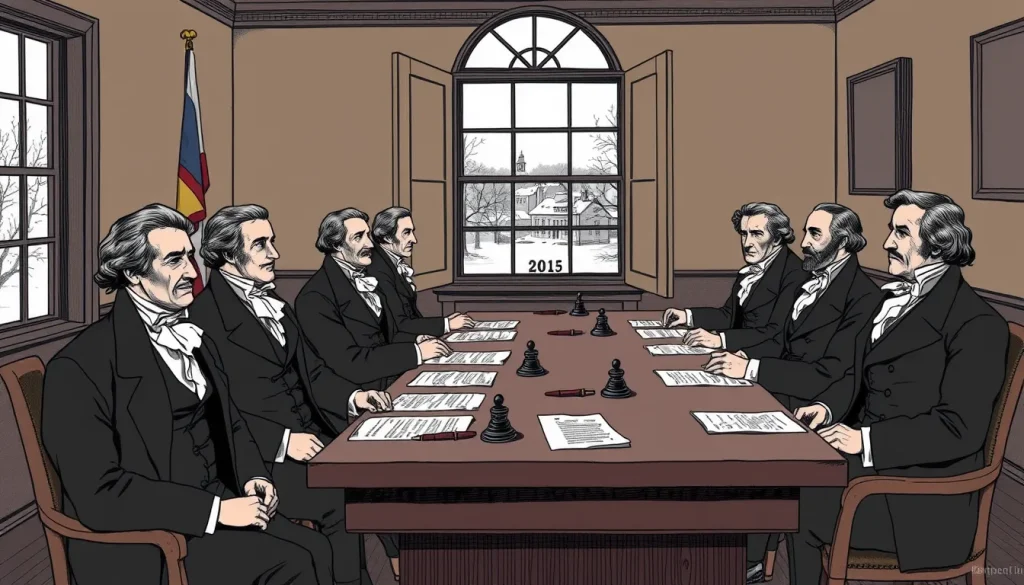
The Federalist opposition grew more vocal as the war progressed. In 1814, Massachusetts, Connecticut, and Rhode Island called for a convention to discuss their grievances. The Hartford Convention met from December 15, 1814, to January 5, 1815, in Hartford, Connecticut. Twenty-six delegates from five New England states attended. The convention’s report, issued in January 1815, stopped short of secession but recommended a series of constitutional amendments designed to limit federal power, protect the region’s interests, and weaken Republican influence. The report also asserted the right of states to interpose their authority to protect their citizens.
While the convention was still in session, news arrived of the Treaty of Ghent, signed on December 24, 1814, which ended the war. Shortly after, on January 8, 1815, Andrew Jackson’s victory at the Battle of New Orleans produced a wave of national pride. The Federalists were now widely perceived as having opposed a war that ended in perceived victory. The Hartford Convention was branded as a treasonable gathering, and the party’s reputation was irreparably damaged.
In the 1816 presidential election, Democratic-Republican James Monroe defeated Federalist Rufus King by a wide margin. The Federalists never again ran a presidential candidate. By 1820, the party had virtually disappeared from national politics. Many former Federalists drifted into the Democratic-Republican fold, while others later joined the Whig Party in the 1830s.
Why It Matters
The decline of the Federalist Party ended the first party system in the United States and inaugurated the Era of Good Feelings, a period of one-party dominance under the Democratic-Republicans. The Hartford Convention became a political symbol of disunion and treason, influencing the way Americans viewed political dissent during wartime. The party’s demise also removed a powerful voice for a strong federal government and commercial interests, although many Federalist policies were later adopted by the Democratic-Republicans, such as the national bank and protective tariffs. Historians debate the immediate causes, with some emphasizing the wartime opposition and others pointing to structural changes in the electorate. Nevertheless, the War of 1812 was the decisive factor that sealed the party’s fate.
Definition
The Federalist Party was a political faction in the United States that flourished from the 1790s to the 1810s. It championed a strong national government, a commercial economy, and a pro-British foreign policy. Its decline after the War of 1812 refers to the loss of its national influence and its eventual dissolution by the early 1820s.
Background
The Federalists came to power under George Washington and John Adams but lost the presidency in 1800 to Thomas Jefferson. They remained a powerful minority in Congress and controlled several New England states. Their stronghold was New England, where commercial interests opposed Jefferson’s Embargo Act of 1807 and later the war with Britain. The party was already weakened by internal divisions before the war, but it still hoped to regain power through opposition to Republican policies.
How the Decline Unfolded
The decline of the Federalist Party was not a sudden event but a gradual process accelerated by the war. During the war, Federalist leaders organized petition campaigns, held meetings, and used newspapers to denounce the conflict. The most significant manifestation of this opposition was the Hartford Convention, which was intended to propose constitutional amendments and unite New England’s grievances. However, the timing of the convention and the subsequent American victories turned public opinion against the Federalists. The party’s opposition was framed as disloyal, and its leaders were marginalized. After the war, the party could not recover its credibility, and its organizational structure collapsed.
Competing Viewpoints
Historians have offered different interpretations of the Federalist decline. Some, like Donald R. Hickey, emphasize that Federalist opposition to the war was united and sustained, yet it ultimately backfired because the war ended well for the United States. Others, like Robert A. Cooper and David A. Gelman, argue that demographic changes and the adoption of Federalist economic policies by the Republicans made the Federalists irrelevant. Still others point to the Hartford Convention as the decisive event, arguing that its association with treason sealed the party’s fate. The debate centers on whether the decline was inevitable or due to specific wartime events.
Role in the War of 1812
The Federalist Party’s opposition shaped the home front during the war. Federalists in New England refused to support the war effort fully, and some even discussed secession. Their resistance contributed to the perception of regional division and led to the calling of the Hartford Convention. The war itself, however, also directly contributed to the party’s downfall by exposing its anti-war stance at a time of nationalistic fervor.
Consequences and Historical Interpretation
The aftermath of the war saw the Federalist Party effectively cease to function at the national level. The Era of Good Feelings, during James Monroe’s presidency, reflected the lack of organized opposition. The party’s decline also had long-term implications, as it left the United States without a strong two-party system until the 1830s. Historians see the Federalist collapse as a pivotal moment in the development of American politics, showing how war and nationalism can undermine political opposition.
Primary Sources
Key primary sources for understanding the Federalist decline include the Report of the Hartford Convention, published in 1815, which contains the resolutions and grievances of the New England Federalists. This report is available in various archives, including the Library of Congress and the Massachusetts Historical Society. Contemporary Federalist newspapers such as the Columbian Centinel and the New England Palladium documented the anti-war stance and the reaction to the treaty. The Treaty of Ghent itself is a primary document that ended the war and shaped the political climate. Additionally, letters and speeches by Federalist leaders like Harrison Gray Otis reveal the party’s strategic thinking and concerns. Each source carries inherent biases—the Hartford Convention report sought to justify the delegates’ actions, while Republican newspapers condemned them—so they must be read critically.
Further Reading
- Hickey, Donald R. “Federalist Party Unity and the War of 1812.” American Studies 12, no. 1 (1971): 23–39.
- Clark, Olive Kottke. “The Hartford Convention: Its Effect Upon the Federalist Party.” MA thesis, Loyola University Chicago, 1942.
- Cooper, Robert A., and David A. Gelman. “The Party’s Over: Party Decline in the Era of Good Feelings.” Working paper, 2016.
- Hickey, Donald R. The War of 1812: A Forgotten Conflict. Urbana: University of Illinois Press, 1989.
References
- Hickey, Donald R. “Federalist Party Unity and the War of 1812.” American Studies 12, no. 1 (1971): 23–39. Accessed via https://patcosta.com/wp-content/uploads/2015/09/Federalist-Party-Unity-in-the-War-of-1812.pdf.
- Clark, Olive Kottke. “The Hartford Convention: Its Effect Upon the Federalist Party.” MA thesis, Loyola University Chicago, 1942. Accessed via https://ecommons.luc.edu/cgi/viewcontent.cgi?article=1101&context=luc_theses.
- Cooper, Robert A., and David A. Gelman. “The Party’s Over: Party Decline in the Era of Good Feelings.” Working paper, 2016. Accessed via https://davidagelman.com/wp-content/uploads/2016/05/egf_mpsa_2016_4_1_dag.pdf.
- “The Decline of Federalism.” In U.S. History: Jacksonian Democracy, 1820–1840, OER Commons. Accessed via https://oercommons.org/courseware/lesson/15445/student/?section=2.
FAQ
Why did the Federalist Party decline after the War of 1812?
The party's staunch opposition to the war, culminating in the Hartford Convention, was widely seen as disloyal after American victories. This destroyed its credibility, and it lost the 1816 election, never recovering.
What was the Hartford Convention?
A meeting of New England Federalists from December 1814 to January 1815 that proposed constitutional amendments to limit federal power. It was perceived as treasonable and hurt the party.
When did the Federalist Party cease to exist?
After 1816, the party never fielded a presidential candidate and effectively dissolved by the early 1820s, with many members joining the Democratic-Republican or later Whig parties.



Leave a Reply