
Short Answer
The Treaty of Ghent, signed on December 24, 1814, in Ghent, then part of the United Kingdom of the Netherlands (now Belgium), formally ended the War of 1812 between the United States and Great Britain. The treaty restored all conquered territory to its pre-war owner—a status quo ante bellum—and left unresolved the issues of impressment and neutral rights that had sparked the conflict. Its historical significance lies in its establishment of a durable peace between the two nations and its shaping of North American boundaries.
Historical Context
The War of 1812 arose from long-standing tensions: Britain’s maritime restrictions, the impressment of American sailors into the Royal Navy, and British support for Indigenous confederacies resisting American expansion. The United States declared war on June 18, 1812, aiming to defend its maritime rights and potentially annex Canada. The conflict saw early American failures, later successes, and devastating events such as the burning of Washington in August 1814. By late 1814, both sides faced exhaustion: Britain had just defeated Napoleon and was weary of prolonged global war, while the United States struggled with economic disruption and internal discord, including the Hartford Convention. The military situation was effectively a stalemate—neither side had achieved its war aims, but neither could force a decisive victory. These conditions made peace negotiations attractive to both governments.
What Happened
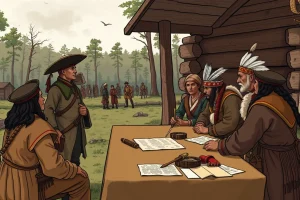
In July 1814, the American peace commissioners arrived in Ghent: John Quincy Adams, James A. Bayard, Henry Clay, Jonathan Russell, and Albert Gallatin. The British delegation consisted of Admiral James Gambier, Henry Goulburn, and William Adams. Formal negotiations opened in August 1814. The Americans initially demanded an end to impressment, protection of neutral trade, and restoration of all territory. The British countered with demands for an Indigenous buffer state in the Northwest, revisions to the Canadian boundary, and a naval disarmament on the Great Lakes. Over the next four months, the two sides exchanged drafts and modified positions. The British, influenced by their military setbacks at Plattsburgh and Baltimore and by the Duke of Wellington’s opinion that Britain could not demand territorial concessions, gradually abandoned their more extreme demands. The Americans, recognizing that impressment had effectively ceased, dropped that issue. The final treaty, consisting of eleven articles, was signed on December 24, 1814. It stipulated a cessation of hostilities, the restoration of all captured territories and properties, the return of prisoners, and the establishment of commissions to resolve boundary disputes. It also called on both parties to end hostilities with Indigenous nations and to restore their lands and rights to the status of 1811. News of the treaty did not reach North America until after the Battle of New Orleans (January 8, 1815), where American forces under Andrew Jackson defeated a British army, unaware that peace had been signed.
Why It Matters
The Treaty of Ghent ended the War of 1812 without addressing its original causes, yet it had significant and lasting consequences. It ensured that Canada would remain under British control, dashing American expansionist hopes. It also inaugurated a long era of peace between the United States and Great Britain, which never fought again. For Indigenous peoples, the treaty was disastrous: the proposed Indigenous buffer state was abandoned, and Article IX’s promise to restore lands and rights was never effectively enforced, leading to continued American expansion and dispossession. Historians have debated the treaty’s meaning. Many American accounts call it a “draw,” but revisionist scholars such as Donald Hickey argue that the United States achieved none of its stated war aims, while Britain achieved its core goal of defending its North American possessions. The treaty thus shaped Canadian national identity and contributed to a distinct American sense of having won respect, despite the lack of territorial gains. Its long-term significance lies in the peaceful resolution of Anglo-American disputes and the establishment of a stable border.
Document
The Treaty of Ghent is a parchment document containing eleven articles, signed and sealed by both delegations. Its full title is “Treaty of Peace and Amity between His Britannic Majesty and the United States of America.” The original is preserved at the National Archives in Washington, D.C., within Record Group 11, General Records of the United States Government.
Date
December 24, 1814. The treaty was signed at Ghent, in the United Kingdom of the Netherlands (now Belgium).
Author
The treaty was negotiated and signed by plenipotentiaries appointed by both governments. For Great Britain: Admiral James Lord Gambier, Henry Goulburn (Under Secretary of State), and William Adams (Doctor of Civil Laws). For the United States: John Quincy Adams, James A. Bayard, Henry Clay, Jonathan Russell, and Albert Gallatin.
Historical Context
The negotiations occurred during the final stages of the War of 1812. Britain’s recent victory over Napoleon freed military resources, but the cost of continued warfare and the lack of decisive success in North America led to a desire for peace. American commercial and financial distress also created urgency. The discussions took place in a neutral European city, Ghent, which provided a setting for back-channel diplomacy. Both delegations operated under instructions that evolved as military and political circumstances changed.
Transcript
The National Archives provides the full transcript. The following is an excerpt from the opening and Article the First (public domain):
“Treaty of Peace and Amity between His Britannic Majesty and the United States of America.
His Britannic Majesty and the United States of America desirous of terminating the war which has unhappily subsisted between the two Countries, and of restoring upon principles of perfect reciprocity, Peace, Friendship, and good Understanding between them, have for that purpose appointed their respective Plenipotentiaries, that is to say, His Britannic Majesty on His part has appointed the Right Honourable James Lord Gambier, late Admiral of the White now Admiral of the Red Squadron of His Majesty’s Fleet; Henry Goulburn Esquire, a Member of the Imperial Parliament and Under Secretary of State; and William Adams Esquire, Doctor of Civil Laws: And the President of the United States, by and with the advice and consent of the Senate thereof, has appointed John Quincy Adams, James A. Bayard, Henry Clay, Jonathan Russell, and Albert Gallatin, Citizens of the United States; who, after a reciprocal communication of their respective Full Powers, have agreed upon the following Articles.
ARTICLE THE FIRST. There shall be a firm and universal Peace between His Britannic Majesty and the United States, and between their respective Countries, Territories, Cities, Towns, and People of every degree without exception of places or persons.
All hostilities both by sea and land shall cease as soon as this Treaty shall have been ratified by both parties as hereinafter mentioned. All territory, places, and possessions whatsoever taken by either party from the other during the war, or which may be taken after the signing of this Treaty, excepting only the Islands hereinafter mentioned, shall be restored without delay…”
Modernized Transcript
A modernized rendering of the same excerpt:
“Treaty of Peace and Amity between His Britannic Majesty and the United States of America.
His Britannic Majesty and the United States of America, desiring to end the war that has unfortunately existed between the two countries, and to restore peace, friendship, and understanding on a basis of full reciprocity, have appointed their respective representatives: for Great Britain, the Right Honourable James Lord Gambier, an admired admiral; Henry Goulburn, a member of Parliament and Under Secretary of State; and William Adams, a Doctor of Civil Laws. For the United States, President James Madison appointed John Quincy Adams, James A. Bayard, Henry Clay, Jonathan Russell, and Albert Gallatin. After exchanging their full powers, they agreed to the following articles.
Article 1: There shall be a firm and universal peace between His Britannic Majesty and the United States, and between their countries, territories, cities, towns, and people of every rank, without exception. All hostilities by sea and land will cease as soon as both parties have ratified this treaty. All territory, places, and possessions captured by either side during the war, or after the signing of this treaty, with the exception of the islands mentioned below, shall be restored immediately, without destroying or removing any artillery or public property originally captured in those forts or places, and which remains there upon exchange of ratifications, or any slaves or other private property.”
What the Document Tells Us
The treaty reveals that both belligerents prioritized ending the conflict over achieving specific war aims. The language of restoration and reciprocity underscores a mutual desire to return to pre-war conditions. The omission of impressment and neutral rights indicates that these were no longer viable negotiating points in late 1814. The inclusion of Article IX on Indigenous rights shows that the issue was part of the negotiation, but the vague phrasing left enforcement to future commissions, which ultimately ignored Indigenous claims.
Limitations and Bias of the Source
As a diplomatic instrument, the treaty reflects the interests of the American and British governments. It does not represent Indigenous nations, who were not parties to the negotiations. The treaty’s language on restoration and Indigenous rights was never fully implemented, revealing the gap between legal promises and political will. Additionally, the treaty omits the underlying causes of the war, so it must be studied alongside other primary sources to understand the conflict fully. The legal style and formal wording can obscure the human costs and the political compromises involved.
Citation
Treaty of Ghent, December 24, 1814, Perfected Treaties, 1778–1945, General Records of the United States Government, Record Group 11, National Archives, Washington, DC.
Primary Sources
Beyond the treaty itself, key primary sources include:
- The diplomatic correspondence of the American commissioners, especially John Quincy Adams’s diary and letters, published in “The Writings of John Quincy Adams.”
- British Foreign Office records relating to the negotiations, held at the National Archives (UK) and available on microfilm.
- American state papers, including Madison’s war message and subsequent diplomatic instructions, in “American State Papers: Foreign Relations.”
- Accounts from military officers, such as Andrew Jackson’s report on the Battle of New Orleans, which occurred after the treaty was signed.
Further Reading
- Hickey, Donald R. The War of 1812: A Forgotten Conflict. University of Illinois Press, 1989.
- Stagg, J.C.A. The War of 1812: Conflict for a Continent. Cambridge University Press, 2012.
- Smith, Robert. The Treaty of Ghent: A Study in Diplomacy. Yale University Press, 1941.
- Library of Congress. “Treaty of Ghent: Primary Documents in American History.” Research guide, https://guides.loc.gov/treaty-of-ghent.
- National Archives. “Treaty of Ghent (1814).” Milestone Documents, https://www.archives.gov/milestone-documents/treaty-of-ghent.
References
- National Archives. “Treaty of Ghent (1814).” Accessed 2025. https://www.archives.gov/milestone-documents/treaty-of-ghent.
- Library of Congress. “Introduction.” Treaty of Ghent: Primary Documents in American History. Accessed 2025. https://guides.loc.gov/treaty-of-ghent/introduction.
- National Park Service. “Summer 1814: Americans and British open peace negotiations at Ghent.” Accessed 2025. https://www.nps.gov/articles/treaty-of-ghent-1.htm.
- Ridler, Jason. “Treaty of Ghent.” The Canadian Encyclopedia, last modified December 20, 2017. https://thecanadianencyclopedia.ca/en/article/treaty-of-ghent.
- Hickey, Donald R. The War of 1812: A Forgotten Conflict. University of Illinois Press, 1989.
FAQ
What were the main provisions of the Treaty of Ghent?
The treaty required a cessation of hostilities, restoration of all captured territories and properties, return of prisoners, and the creation of commissions to settle boundary disputes. It also called on both parties to restore Indigenous lands and rights to their 1811 status.
Why didn't the treaty address impressment or neutral rights?
By late 1814, impressment had effectively ceased, and both sides recognized that these issues were not worth continuing the war. The British were unwilling to formally concede, while the Americans dropped their demands in exchange for peace.
How did the Treaty of Ghent affect Indigenous peoples?
The treaty abandoned the British proposal for an Indigenous buffer state and only vaguely promised to restore Indigenous lands and rights. This provision was never enforced, leading to continued American westward expansion and dispossession of Indigenous nations.

Leave a Reply