
Short Answer
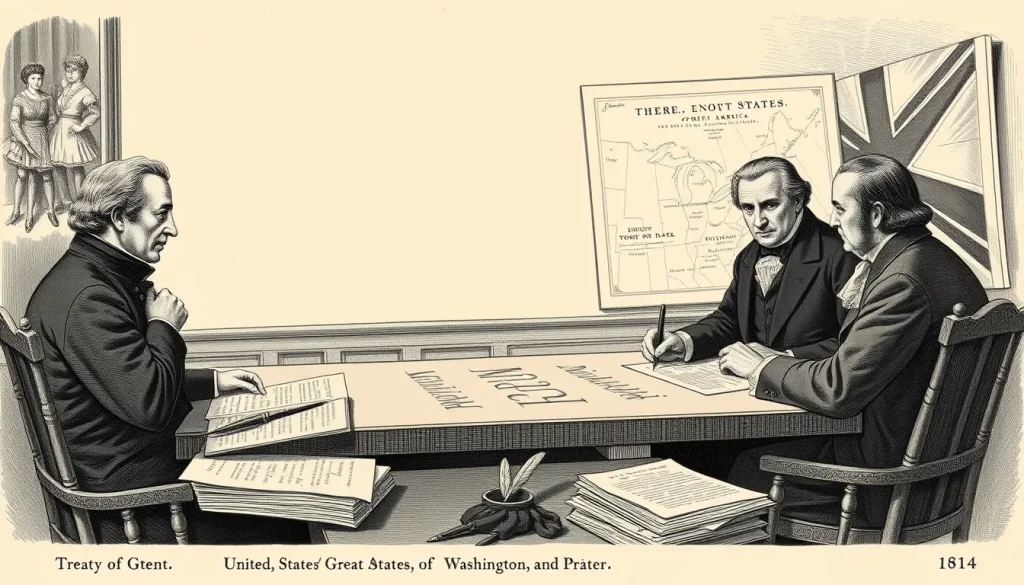
The aftermath of the War of 1812 unfolded between the signing of the Treaty of Ghent on December 24, 1814, and its ratification on February 17, 1815, extending through the subsequent decade as former belligerents absorbed the war’s costs and consequences. The conflict, fought primarily between the United States and Great Britain, with significant involvement from British North American colonists and numerous Indigenous nations, ended largely in a return to pre-war boundaries, yet its aftermath produced profound shifts in political, economic, and social life across North America. The period is historically significant because it set the stage for American westward expansion, the political decline of the Federalist Party, the emergence of a distinct Canadian identity, and the systematic displacement of Indigenous peoples.
Historical Context
The War of 1812 arose from long-standing tensions over impressment, trade restrictions, and American ambitions to expand into British-held territory and Indigenous lands. By 1814, the United States had suffered significant defeats, including the burning of Washington, D.C., in August, but had also secured notable victories at Baltimore and Plattsburgh. Exhausted by years of conflict, both sides were open to peace negotiations, which began in Ghent (in modern Belgium) in August 1814. The British, having defeated Napoleon in Europe, initially pressed for territorial concessions and an Indigenous buffer state, but American diplomats refused. The Treaty of Ghent, signed on December 24, 1814, essentially restored the status quo ante bellum, with no territorial changes and vague provisions on Indigenous lands. Word of the treaty did not reach the United States before the Battle of New Orleans on January 8, 1815, where Andrew Jackson’s forces achieved a decisive victory, shaping later perceptions of the war.
What Happened
The formal end of the war came when the U.S. Senate unanimously ratified the Treaty of Ghent on February 17, 1815. The treaty’s provisions included the cessation of hostilities, the return of prisoners, and a commitment to resolve future disputes through arbitration. It created a commission to settle boundary disputes between the United States and British North America, though these were not fully resolved until the 1840s. The treaty said nothing about impressment or neutral rights, the original causes of the war—a fact that American leaders chose to interpret as a diplomatic victory, while British officials considered it a minor episode in their larger struggle against Napoleon.
The immediate aftermath saw the rapid demobilization of American forces and the reassertion of civilian authority. The federal government, burdened by war debt, faced economic dislocation as the wartime boom in privateering and munitions ended. In 1815, President James Madison proposed a national bank and internal improvements, beginning the so-called Era of Good Feelings. The Federalist Party, which had opposed the war and convened the Hartford Convention in late 1814 to discuss secession, collapsed nationally, leaving the Democratic-Republican Party dominant. This political realignment enabled a more assertive federal role in infrastructure and economic development, though it also facilitated rapid westward expansion and the dispossession of Indigenous nations.
For British North America (Canada), the war had been a defensive victory. The successful repulse of American invasions unified English-speaking and French-speaking colonists against a common enemy, fostering a nascent Canadian identity. The Crown increased investment in the Canadas, constructing new fortifications and infrastructure, and the colonial governments gained greater autonomy. However, for Indigenous nations, the aftermath was catastrophic. The Treaty of Ghent included an article requiring the restoration of lands to Indigenous peoples, but the British failed to enforce it, and the United States ignored it. Without British military support, Indigenous nations were unable to resist the surge of American settlers moving west after 1815, leading to forced removals and the loss of millions of acres.
For African Americans, the war’s end was equally complex. Several thousand enslaved individuals had escaped to British lines, and many were evacuated to Nova Scotia, Trinidad, and other British territories, where they gained freedom. In the United States, the institution of slavery continued to expand with the cotton boom and westward growth, hardening sectional divisions that eventually erupted in the Civil War.
Why It Matters
The aftermath of the War of 1812 is significant because it reshaped national identities and set long-term political directions. In the United States, the war’s end—especially the unexpected victory at New Orleans—was celebrated as a ‘second war of independence,’ even though no declared objective was achieved. This sense of national purpose fueled a period of territorial expansion, economic growth, and cultural self-confidence. The collapse of the Federalists opened a political consensus that lasted nearly a decade, during which the United States issued the Monroe Doctrine (1823) and concluded the Adams-Onís Treaty (1819) acquiring Florida. Internally, the war stimulated American manufacturing, transportation, and the development of a national infrastructure.
The war also had lasting consequences for Canada, where it is often regarded as a founding moment. The defense of Canadian soil against American invasion solidified a sense of colonial identity distinct from the United States, contributing to the eventual creation of the Canadian Confederation in 1867. For Great Britain, the war was a minor distraction from European affairs, but its conclusion improved Anglo-American relations, leading to the Rush-Bagot Agreement (1817) that demilitarized the Great Lakes and the later Treaty of Washington (1842) that settled boundaries.
Historians have interpreted the aftermath as a turning point for Indigenous peoples. The war destroyed Tecumseh’s confederacy and eliminated British military support, leaving no barrier to American expansion. The subsequent removals—such as the Trail of Tears—were enabled directly by the power vacuum created in 1815. For African Americans, the promise of freedom was partial and contested, with some gaining liberty via British evacuation and others remaining enslaved. The war’s legacy is therefore not a simple triumph but a complex mixture of national consolidation and human tragedy.
Definition
The aftermath of the War of 1812 refers to the period from the signing of the Treaty of Ghent in December 1814 through the following decade, when the political, economic, territorial, and social consequences of the conflict became apparent. It encompasses the military demobilization, the reestablishment of peace, and the reshaping of relations among the United States, Great Britain, Indigenous nations, and African American communities. The term also includes the cultural memory and historical interpretations that emerged in the years after the war.
Background
The war itself was fought over maritime rights, territorial ambitions, and Indigenous resistance. By 1814, the British were war-weary after two decades of conflict with France, and the U.S. faced economic crisis and domestic divisions. The peace negotiations at Ghent were driven by mutual exhaustion and the desire to end hostilities. The British negotiators, though initially demanding concessions such as an Indian buffer state, eventually settled for the status quo because of defeats at Baltimore and Plattsburgh and the cost of continued war. The treaty’s vagueness on impressment and Indian lands created a framework for later disputes.
How It Worked
The aftermath operated through a combination of formal treaty provisions and informal political processes. The treaty’s Article IX required both powers to restore lands and possessions to ‘all the tribes or Nations of Indians’ that had been in alliance with either side, but this was never enforced. Instead, the U.S. government pursued a policy of Indian removal, culminating in the Indian Removal Act of 1830. In the United States, the post-war peace allowed the federal government to pursue economic development, chart the Second Bank of the United States, and undertake internal improvements. The collapse of the Federalists enabled one-party rule, but also fostered internal sectional conflicts over tariffs, internal improvements, and slavery.
In British North America, the war’s successful defense led to increased British investment and a strengthened colonial administration. The colonies gained a sense of solidarity and self-confidence, which later fed the movement toward confederation. In Great Britain, the aftermath saw a general indifference toward American affairs, with the exception of the Rush-Bagot Agreement and later boundary negotiations. Britain also honored its promise to thousands of freed African American veterans, settling them in West Indian colonies and Nova Scotia.
Competing Viewpoints
Interpretations of the aftermath differ sharply among nations and ethnic groups. Americans traditionally viewed the war as a victory, celebrating the defense of Fort McHenry and the Battle of New Orleans, and using it to forge a national identity distinct from Europe. Canadian historians emphasize the war as a successful defense of Canadian soil, creating a heroic narrative involving figures like Laura Secord and Isaac Brock. British historians often treat it as a peripheral event, noting that it ended without achieving any of the U.S. objectives and that British naval superiority remained intact. Indigenous perspectives are starkly negative, highlighting the loss of land and autonomy that followed the war. African American perspectives are mixed, with some attaining freedom through escape and others remaining enslaved; the war also reinforced the institution in the South.
Role in the War of 1812
The aftermath directly shaped how the war itself was remembered and interpreted. The timing of the Battle of New Orleans—after the treaty signing—created a powerful myth of American martial prowess, overshadowing the defeats and failures of the war. This perception influenced U.S. military policy and national pride. For Canada, the war’s defense became a foundational myth, fostering a distinct national identity. The aftermath also affected the memory of Indigenous participation, as the British and Americans both downplayed or erased Indigenous contributions and sacrifices in their official histories.
Consequences and Historical Interpretation
The long-term consequences of the aftermath include the acceleration of American westward expansion, the entrenchment of slavery, and the eventual eruption of the Civil War. Historians such as Alan Taylor and Donald Hickey have argued that the war’s aftermath was a ‘second American Revolution’ that completed the break from Britain while also marginalizing Indigenous and African American communities. The ‘Era of Good Feelings’ proved temporary, as economic depression (Panic of 1819) and sectional disputes over Missouri exposed underlying tensions. The war also set the stage for the Monroe Doctrine, which declared the Western Hemisphere closed to European interference, and for the British-American diplomacy leading to the world’s longest undefended border. In Canada, the aftermath contributed to the development of responsible government and eventually independence. Scholarly debate continues over the war’s significance: some emphasize its role in shaping American nationalism, others point to its devastating impact on Indigenous peoples, and still others see it as a minor conflict that only became significant in retrospect.
Primary Sources
The most authoritative primary source is the Treaty of Ghent (December 24, 1814), which records the peace terms and is preserved in the U.S. National Archives and the National Archives of the UK. Its limitations include the absence of provisions on impressment and the ambiguous phrasing regarding Indian lands. Another key source is the Hartford Convention Report (January 1815), documenting Federalist grievances and proposals for constitutional amendments, which reveals domestic dissent. American and British military dispatches, such as those from the Battle of New Orleans, illustrate the military situation. For the experiences of African Americans, the Letters from the British Colonial Marines and evacuation records from the Royal Navy provide firsthand accounts, though they are filtered through military channels. The Journals of the British House of Commons and the American State Papers contain official correspondence and treaty ratification debates. These sources offer contemporary perspectives but must be read critically due to political bias and incomplete records.
Further Reading
- Donald R. Hickey, The War of 1812: A Forgotten Conflict (University of Illinois Press, 1989).
- Alan Taylor, The Civil War of 1812: American Citizens, British Subjects, Irish Rebels, & Indian Allies (Alfred A. Knopf, 2010).
- J. C. A. Stagg, The War of 1812: Conflict for a Continent (Cambridge University Press, 2012).
- Nicole Eustace, 1812: War and the Passions of Patriotism (University of Pennsylvania Press, 2012).
- National Park Service, ‘Legacies of the War of 1812’ and ‘War’s Impact’ (www.nps.gov).
- American Battlefield Trust, ‘Outcomes of the War of 1812’ (www.battlefields.org).
References
- National Park Service, ‘Aftermath – Star-Spangled Banner National Historic Trail’, U.S. National Park Service, accessed 2025, https://www.nps.gov/stsp/learn/historyculture/aftermath.htm.
- National Park Service, ‘Legacies of the War of 1812’, U.S. National Park Service, 2013, https://www.nps.gov/subjects/warof1812/legacies-of-the-war-of-1812.htm.
- David S. Heidler, ‘Final stages of the war and the aftermath’, Encyclopaedia Britannica, 2026, https://www.britannica.com/event/War-of-1812/Final-stages-of-the-war-and-the-aftermath.
- National Park Service, ‘War’s Impact – Star-Spangled Banner National Historic Trail’, U.S. National Park Service, 2020, https://www.nps.gov/stsp/learn/historyculture/war-s-impact.htm.
- American Battlefield Trust, ‘Outcomes of the War of 1812’, 2023, https://www.battlefields.org/learn/articles/outcomes-war-1812.
FAQ
What was the immediate result of the Treaty of Ghent?
The treaty ended the war with no territorial changes, restoring pre-war boundaries and requiring the return of prisoners. It did not address impressment or neutral rights.
How did the War of 1812 affect the Federalist Party?
The Federalists' opposition to the war, exemplified by the Hartford Convention, led to their political decline. By 1816 they were no longer a national force, and the Democratic-Republicans dominated.
What were the consequences for Indigenous nations after the war?
The treaty's promise to restore Indigenous lands was unenforced. Without British support, Indigenous nations faced increased American expansion, forced removals, and loss of territory.
Why is the War of 1812 considered significant for Canada?
The successful defense against American invasion unified British North American colonies, fostering a distinct Canadian identity and eventual Confederation.



Leave a Reply