
Short Answer
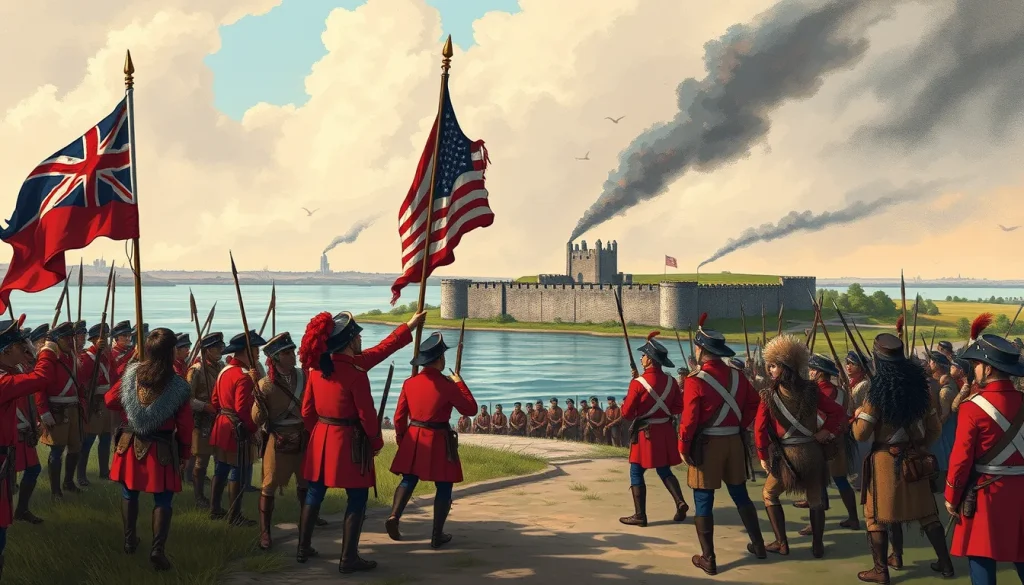
The Siege of Detroit, also known as the Fall of Fort Detroit, took place on 15–16 August 1812, during the early months of the War of 1812. A combined British and Indigenous force led by Major General Isaac Brock and the Shawnee leader Tecumseh forced the surrender of American Brigadier General William Hull and his army at Fort Detroit in the Michigan Territory. This remarkable victory, achieved more through deception and psychological pressure than direct combat, gave the British control of the Michigan Territory for over a year and significantly altered the course of the war in the Northwest.
Historical Context
In spring 1812, tensions between the United States and the United Kingdom were at a peak due to impressment of American sailors, trade restrictions, and British support for Indigenous resistance to American expansion. The American government, led by President James Madison, planned an invasion of Canada as a means of coercing Britain. The western front was one of four intended attack routes, with the goal of capturing the British post at Amherstburg (Fort Malden) and thus securing the Old Northwest.
Governor William Hull of the Michigan Territory was commissioned as a brigadier general and given command of the American force destined for Detroit. He assembled an army of Ohio militia and the 4th U.S. Infantry Regiment, marching from Dayton, Ohio, toward Detroit in late May 1812. Hull reached Detroit on 5 July after a difficult journey through the Great Black Swamp, unaware that Congress had declared war on June 18; the news reached him only on 2 July, after his supply schooner, Cayahoga, had been captured by the British. The British, having received word earlier, strengthened their posts and prepared for conflict.
What Happened
On 12 July, Hull, against his own misgivings, crossed the Detroit River and occupied Sandwich (present-day Windsor) in Upper Canada. He issued a proclamation urging Canadians to join the American cause, but he hesitated to attack Fort Malden, which was garrisoned by about 300 British regulars and roughly 400 Indigenous warriors. Hull’s supply lines from Ohio were threatened, and his militia was unreliable, many refusing to serve outside U.S. territory. When he learned that Fort Mackinac had fallen to the British on 17 July, and after a series of skirmishes including the ambush at Brownstown on 5 August and the Battle of Maguaga on 9 August, Hull decided to withdraw across the river back to Detroit on 8 August.
Meanwhile, Major General Isaac Brock, the administrator of Upper Canada, had raced from York (Toronto) to Amherstburg, arriving on 13 August. He conferred with Tecumseh, whose warriors had been key in harassing the Americans. Brock determined to attack Detroit without delay, despite being outnumbered. He dressed his militiamen in red coats to make them look like regulars and had Tecumseh’s warriors march in a loop through a clearing to exaggerate their numbers. A deliberately planted dispatch suggested that thousands of Indigenous warriors were approaching.
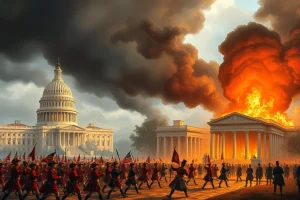
On 15 August, Brock sent Hull a summons to surrender, warning that he could not control his Indigenous allies once fighting began. Hull refused, and the British began an artillery bombardment from across the river. That night, about 600 Indigenous warriors crossed the river and took positions. At dawn on 16 August, Brock’s forces, consisting of roughly 330 regulars, 400 militia, and 600 Indigenous warriors, crossed the Detroit River and advanced on the fort. As they prepared to attack, a shell from a British battery struck the officer’s mess, causing casualties. Hull, fearing a massacre of the fort’s occupants, including his own daughter and grandchildren, raised a white flag and surrendered his entire army, despite having about 2,500 men. The Americans suffered 7 killed and the rest captured.
Why It Matters
The fall of Detroit was a catastrophic blow to the American war effort in the Northwest. It exposed the weakness of American leadership and the vulnerability of the entire frontier. The British and their Indigenous allies gained control of the Michigan Territory and a large quantity of supplies, artillery, and the brig Adams. The victory reversed the pessimism in Upper Canada, inspiring many Canadians and Indigenous peoples to support the British cause. For the Americans, it prompted a court-martial of Hull, who was sentenced to death but later pardoned. The loss also forced the United States to undertake a lengthy campaign to regain the territory, culminating in the Battle of Lake Erie in 1813 and the subsequent recapture of Detroit. Historians have long debated Hull’s conduct, with some arguing he acted rationally to avoid a massacre, while others view it as an act of cowardice. The siege demonstrated the importance of Indigenous alliances and the effectiveness of psychological warfare in the conflict.
Prelude
The prelude to the siege began with Hull’s invasion of Canada and his subsequent retreat. After crossing into Upper Canada on 12 July 1812, Hull faced challenges: his militia was deserting, his supply lines were raided, and his officers pushed for a decisive attack on Fort Malden that he refused to order. The capture of his dispatches on 2 July revealed his fears and plans. After the defeat at Brownstown and the inconclusive battle at Maguaga, Hull lost confidence and pulled back to Detroit on 8 August. British and Indigenous forces under Tecumseh continued to harass the Americans, cutting off supplies and intelligence. Brock’s arrival on 13 August with reinforcements from the east set the stage for the British assault.
Forces and Commanders
The American forces were commanded by Brigadier General William Hull, a Revolutionary War veteran and governor of Michigan Territory. His army consisted of approximately 1,600 Ohio militia and 589 regulars of the 4th U.S. Infantry, later reinforced by Michigan militia, totaling about 2,500 men. They possessed artillery and were fortified within Fort Detroit.
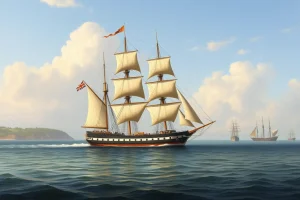
The British forces were commanded by Major General Isaac Brock, with Colonel Henry Procter as second-in-command. Brock had 330 regulars (mostly the 41st Foot), about 400 Ontario militia, and 30 Royal Artillery. Indigenous warriors, chiefly Shawnee under Tecumseh, numbered about 600 from various nations. Brock also had two ships on the river, HMS Queen Charlotte and HMS General Hunter, and a battery of five field guns.
Battlefield and Map Context
Detroit was a small town of about 700 people, surrounded by a palisade, with Fort Detroit on a hill overlooking the river. The fort had defensive walls and artillery but was vulnerable to fire from the British guns across the river at Sandwich. The river crossing was narrow, and the British artillery could bombard the town. The terrain around Detroit was wooded, with fields and an area that Brock used to conceal his forces and stage the deceptive movements.
Battle Chronology
- 15 August: Brock arrives at Amherstburg on the 13th, and on the 15th sends a surrender demand to Hull, which is refused. Brock then sets up artillery batteries across the river at Sandwich and opens fire in the evening. That night, Indigenous warriors cross the river and land below Detroit.
- 16 August: At dawn, Brock’s regulars and militia cross the river. The British column advances toward the fort, with Tecumseh’s warriors moving through the woods on their flanks. A shell hits the American mess, causing four killed. Hull, fearing a massacre, orders a white flag raised. Surrender negotiations follow, and the entire garrison capitulates.
Casualties and Losses
The British and Indigenous forces suffered very light casualties, with only two wounded. The Americans lost 7 killed and approximately 2,188 to 2,493 captured, including the Ohio militia and regulars. The surrender also yielded 33 to 39 cannon, thousands of muskets, military stores, and the unfinished brig Adams. The militia was paroled, while Hull and the regulars were taken to Quebec as prisoners of war.
Result
The battle was a decisive British and Indigenous victory. The entire Michigan Territory came under British control, and the American invasion of Canada was effectively halted in the Northwest. Hull was later court-martialed for cowardice and sentenced to death, but President Madison remitted the sentence in recognition of his revolutionary service. The surrender also elevated Brock and Tecumseh as heroes, inspiring further Indigenous participation in the British cause.
Strategic Consequences
Strategically, the loss of Detroit gave the British a firm foothold in the West and forced the United States to divert resources to retake the territory. It discouraged American recruiting and boosted British morale in Upper Canada. The victory also encouraged many Indigenous nations in the Old Northwest to ally with Britain, prolonging the border war and leading to campaigns such as the American attempt to recapture Detroit, which culminated in the Battle of Lake Erie and the Battle of the Thames in 1813.
Primary Accounts
Several contemporary accounts survive. Hull’s official report to Secretary of War Eustis, written on 20 August 1812, justifies his surrender. Brock’s letters and dispatches describe his plan and the decisive moments. Tecumseh’s actions are reported in British officers’ journals, including those of John Norton and Matthew Elliott. The memoir of Captain John Richardson, who served at Fort Detroit, provides a British perspective. These documents contain biases: Hull sought to vindicate himself, while British accounts emphasize Brock’s audacity and Indigenous loyalty. They must be read critically, but they are essential for understanding the events.
Battlefield Today
The site of Fort Detroit is now within the city of Detroit, Michigan. The original fort no longer stands; the area has been developed over two centuries. However, the historic importance is commemorated by markers and the Detroit Historical Society. The location of the crossing and the British position at Sandwich (now Windsor) are also marked. The fort site itself includes a historical marker at the corner of Fort Street and Washington Boulevard, though no original structures survive.
Primary Sources
Primary sources include:
William Hull to William Eustis, 20 August 1812 (Official Report) – Hull’s detailed justification with his reasoning for surrender.- Isaac Brock’s Dispatch to George Prevost, 17 August 1812 – Brock’s victory report, highlighting his strategy and the role of Indigenous allies.
- Tecumseh and Brock meeting accounts – Reported in later memoirs, notably by Brock’s aide John Macdonell and historian John Richardson.
- Diary or journal of Captain John Norton – A Mohawk leader’s account, giving an Indigenous perspective.
- American newspaper coverage – Accounts of the surrender in U.S. papers, often expressing outrage and disbelief.
These sources are useful but reflect the biases and limitations of their authors. Hull’s report is defensive; British accounts minimize any American resistance. Cross-referencing is necessary.
Further Reading
- Berton, Pierre. The Invasion of Canada, 1812–1813. McClelland and Stewart, 1980.
- Hickey, Donald R. The War of 1812: A Forgotten Conflict. University of Illinois Press, 1989.
- Latimer, Jon. 1812: War with America. Harvard University Press, 2007.
- Hitsman, J. Mackay. The Incredible War of 1812. University of Toronto Press, 1965.
- Edmunds, R. David. Tecumseh and the Quest for Indian Leadership. Little, Brown, 1984.
References
- Wikipedia, “Siege of Detroit,” accessed [current date]. https://en.wikipedia.org/wiki/Siege_of_Detroit.
- World History Encyclopedia, “Siege of Detroit,” accessed [current date]. https://www.worldhistory.org/article/2569/siege-of-detroit/.
- The Canadian Encyclopedia, “Capture of Detroit, War of 1812,” accessed [current date]. https://thecanadianencyclopedia.ca/en/article/capture-of-detroit-war-of-1812.
- History of War, “Battle of Detroit, 16 August 1812,” accessed [current date]. https://www.historyofwar.org/articles/battles_detroit.html.
- The Fall of Detroit – War of 1812, accessed [current date]. https://thewarof1812.org/battles/the-fall-of-detroit/.
FAQ
Why did General Hull surrender Detroit so quickly?
Hull later claimed he feared a massacre by Indigenous warriors, which was a threat Brock used in his ultimatum. He also faced supply shortages, desertions, and declining morale. However, historians debate whether he acted rationally or irrationally, and his decision remains controversial.
What was Tecumseh's role in the siege?
Tecumseh commanded several hundred Indigenous warriors from various nations. His forces crossed the river and maneuvered to create an impression of overwhelming strength, and he persuaded many Indigenous nations to ally with Britain, which was crucial to the British strategy.
What were the consequences of the Siege of Detroit?
The victory secured the Michigan Territory, raised British morale in Upper Canada, and encouraged Indigenous participation in the war. The Americans eventually recaptured Detroit after their naval victory at Lake Erie in 1813.
Leave a Reply