
Short Answer
The Federalist Party, the first organized opposition political party in the United States and the dominant political force of the 1790s, was the principal organized opponent of the War of 1812. From the declaration of war in June 1812 through the signing of the Treaty of Ghent in December 1814, Federalists in Congress, state governments, and the press challenged the conflict’s legitimacy, strategy, and conduct. Their opposition, concentrated most strongly in New England’s commercial and maritime communities, shaped wartime domestic politics and contributed to the party’s permanent decline after 1815.
Historical Context
The Federalist Party drew its greatest strength from New England, where maritime commerce, shipping, and the carrying trade dominated the economy. The party’s leaders and constituents were directly harmed by British and French trade restrictions during the Napoleonic Wars and by the Royal Navy’s practice of impressment, which seized American sailors, including naturalized citizens, for service on British warships. While Republicans under Thomas Jefferson and James Madison sought to counter these depredations through economic coercion—first the Embargo Act of 1807 and later the Non-Intercourse Act of 1809—Federalists favored a stronger navy, armed merchantmen, and diplomatic negotiation. The embargo in particular devastated New England’s ports, deepening Federalist resentment of Republican policy. By 1811–12, a group of younger Republican congressmen known as War Hawks argued that only war with Britain could vindicate American sovereignty and end British-supported Indigenous resistance on the frontier. Federalists saw this march to war as a partisan project that threatened the nation’s commercial prosperity and that served the interests of Napoleon Bonaparte, whom they regarded as the greater threat to civilization.
What Happened
President James Madison signed the declaration of war against Great Britain on June 18, 1812. The vote in Congress was sharply partisan: Republicans largely supported the declaration, while Federalists voted overwhelmingly against it. According to the U.S. National Park Service, Federalists in the House and Senate voted against war-related measures roughly ninety percent of the time. Senator Rufus King of New York, a former minister to Great Britain, stated that he regarded the war as “a war of party and not of country,” a view shared by many in the party. Federalist newspapers, such as the Columbian Sentinel of Boston, lamented the outbreak of war; the paper observed on June 24, 1812, that the war was an “overwhelming calamity” that had befallen the country.
Opposition extended beyond votes and editorials. In July 1812, a series of destructive riots in Baltimore targeted Federalist newspaper editors who had denounced the war, convincing many Federalists that the Madison administration and its supporters sought to intimidate dissent. The governors of the New England states—Massachusetts Governor Caleb Strong among them—refused to place their state militias under regular United States Army command for offensive operations, arguing that the militia could constitutionally be used only to repel invasion, not to carry out the administration’s plans to invade Canada. When Major General Henry Dearborn attempted to call out militia companies for service on the Canadian frontier, the governors of Connecticut, Rhode Island, and Massachusetts refused to provide the troops.
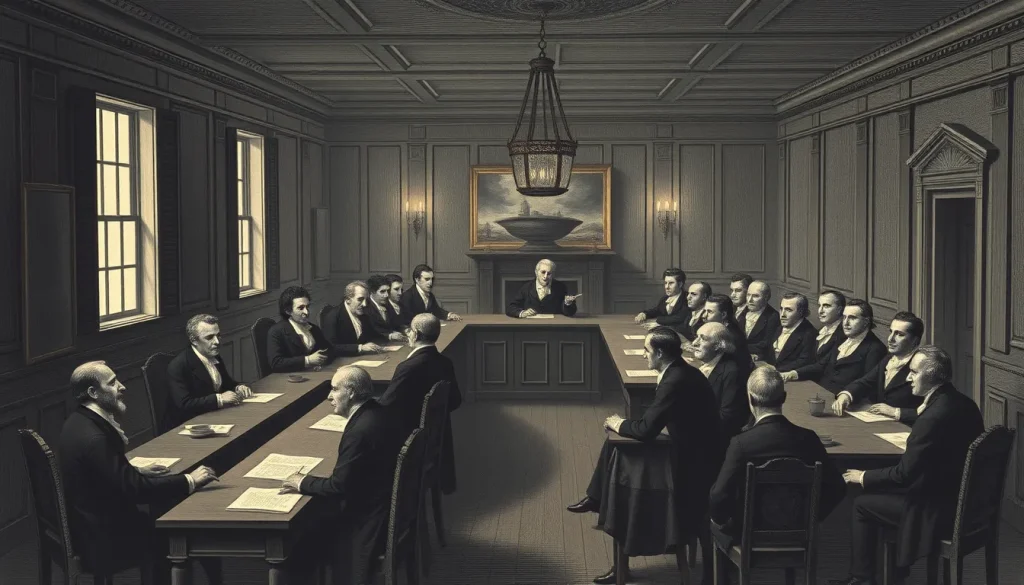
The most dramatic expression of Federalist discontent came in the winter of 1814–15. In December 1814, twenty-six Federalist delegates from Massachusetts, Rhode Island, Vermont, and New Hampshire met in Hartford, Connecticut, in a gathering that became known as the Hartford Convention. The convention met in secrecy and kept no formal records of its debates. Radical voices proposed the secession of New England from the Union, but moderates prevailed, and the convention instead issued a report of grievances and proposed a series of constitutional amendments. These included limiting any trade embargo to sixty days; requiring a two-thirds congressional majority for embargoes, declarations of war, and the admission of new states; abolishing the three-fifths clause that counted enslaved people for representation; and limiting the presidency to a single term while barring consecutive presidents from the same state. The convention’s emissaries arrived in Washington just as news arrived of Andrew Jackson’s victory at the Battle of New Orleans and of the Treaty of Ghent, which ended the war. The proposed amendments received no serious consideration in Congress, and the convention was widely depicted—not always fairly—as a near-treasonous assembly.
Why It Matters
The Federalist opposition to the War of 1812 had immediate and lasting consequences. During the war, it hampered recruitment, limited the administration’s ability to use militia forces, and contributed to the financial and logistical difficulties of American campaigns. It also encouraged smuggling between New England and British forces in Canada, as Federalist merchants, some of whom sympathized with Britain’s struggle against Napoleon, sought to profit from supplying British garrisons.
In the longer term, the opposition proved disastrous for the Federalist Party. The Hartford Convention was branded as disloyal, and the twin news of Jackson’s victory and the peace treaty stripped the convention’s grievances of their urgency. The Federalists lost the presidential election of 1816, and the party soon faded as a national force, ushering in the so-called “Era of Good Feelings” under President James Monroe. Historians have debated the nature of Federalist opposition. For much of the twentieth century, some scholars depicted a party divided between New England extremists and moderate, patriotic Federalists in the middle and southern states. Donald R. Hickey challenged this view, arguing in a 1978 study that Federalists across the country were far more unified in opposition than earlier accounts allowed. More recently, historians such as Alan Taylor have emphasized the severity of the political crisis, noting that some New England Federalists seriously contemplated secession and separate peace negotiations with Britain.
Definition
The Federalist opposition to the War of 1812 was the organized political resistance by the Federalist Party to the Madison administration’s declaration of war against Great Britain and to the administration’s wartime policies. It encompassed congressional opposition, state-level resistance, public protest, and, in its most radical form, proposals for constitutional reform and secession.
Background
The Federalist Party had been the governing party of the 1790s under George Washington and John Adams, but it lost the presidency to Thomas Jefferson in 1800 and never regained it. By 1812, Federalists were a permanent minority in national politics, dominant only in New England and with scattered strength elsewhere. Their economic and ideological interests—commerce, a strong navy, a cautious foreign policy, and suspicion of French revolutionary radicalism—placed them in direct conflict with the Republican Party’s agrarian, pro-French, and expansionist orientation. The embargo and the war crisis of 1809–12 widened the divide.
How It Worked
Federalist opposition operated through multiple channels. In Congress, Federalist representatives and senators voted in near lockstep against war taxes, military appropriations, and other war-related measures. At the state level, governors used their authority over the militia to obstruct federal recruiting and expeditions. In the press, Federalist editors published searing criticisms of the administration and its conduct of the war, sometimes at personal risk, as the Baltimore riots demonstrated. In commerce, some New England Federalists engaged in smuggling and trade with the enemy. And in December 1814, the Hartford Convention consolidated the party’s grievances into a formal program of constitutional amendments.
Competing Viewpoints
Federalists argued that the war was unnecessary, dangerous, and beneficial only to Napoleon, and that the United States lacked the military strength to fight Britain effectively. They favored negotiations, expanded naval defense, and the arming of merchant vessels. Republicans, in contrast, maintained that the war was a necessary defense of national honor, maritime rights, and frontier security, and that Federalist opposition endangered the republic by aiding the British. There were also divisions within the Federalist Party itself: some New Englanders supported secession, while moderates such as those who dominated the Hartford Convention preferred constitutional remedies. Historians continue to debate how unified the party actually was.
Role in the War of 1812
Federalist opposition shaped the war’s course in several ways. It undermined the Madison administration’s ability to mobilize the militia in the northeast, contributed to the failure of the invasion of Canada, and encouraged a thriving illicit trade with British forces. It also intensified the partisan bitterness of wartime politics, influencing Republican legislation such as the draft and tax measures. The opposition did not, however, prevent the war or force an early peace; the conflict continued until the Treaty of Ghent was signed in December 1814.
Consequences and Historical Interpretation
The most direct consequence of Federalist opposition was the party’s own collapse. The Hartford Convention, though moderate in its actual proposals, was portrayed by Republicans as evidence of treason, and the party never recovered. Historians have generally interpreted the opposition as both a sincere expression of regional and economic interest and a partisan maneuver aimed at discrediting the Republicans and returning the Federalists to power. The degree to which secession was a genuine threat remains a subject of scholarly debate.
Primary Sources
Key contemporary documents include the Columbian Sentinel editorial of June 24, 1812, which captured Federalist mourning at the declaration of war; the congressional roll-call votes on the declaration and on war measures, which record the party’s near-unanimous opposition; the correspondence of Massachusetts Governor Caleb Strong, whose refusal to mobilize the militia is documented in state records; and the report and proposed amendments issued by the Hartford Convention in January 1815. The Baltimore riots are documented in contemporary newspaper accounts and memoirs, including the recollections of participants. Each source must be read with its partisan context in mind: Federalist newspapers emphasized administration blunders, while Republican accounts stressed Federalist obstruction and disloyalty.
Further Reading
- Donald R. Hickey, The War of 1812: A Forgotten Conflict (University of Illinois Press).
- Donald R. Hickey, “Federalist Party Unity and the War of 1812,” Journal of American Studies 12 (1978).
- Samuel Eliot Morison, The Life and Letters of Harrison Gray Otis, Federalist (Houghton Mifflin, 1913).
- Alan Taylor, “Stark Alternatives: War or Compromise?” U.S. National Park Service, https://www.nps.gov/articles/stark-alternatives.htm.
- “The Hartford Convention,” American Battlefield Trust, https://www.battlefields.org/learn/articles/hartford-convention.
- “Federalists Oppose Madison’s War,” U.S. National Park Service, https://www.nps.gov/articles/federalist-opposition-to-the-war.htm.
References
- “Federalists Oppose Madison’s War,” U.S. National Park Service, https://www.nps.gov/articles/federalist-opposition-to-the-war.htm.
- Donald R. Hickey, “Federalist Party Unity and the War of 1812,” Journal of American Studies 12, no. 1 (1978): 23–39, https://www.cambridge.org/core/journals/journal-of-american-studies/article/abs/federalist-party-unity-and-the-war-of-1812/4FF6BC1443CDCCD922B960CBB53CB664.
- Ronald L. Hatzenbuehler and Robert L. Ivie, “The Federalists and the Coming of War, 1811–1812,” The SHAFR Guide Online (2017), https://doi.org/10.1163/2468-1733_shafr_sim030180056.
- “The Hartford Convention,” American Battlefield Trust, updated May 23, 2024, https://www.battlefields.org/learn/articles/hartford-convention.
- Alan Taylor, “Stark Alternatives: War or Compromise?” U.S. National Park Service, https://www.nps.gov/articles/stark-alternatives.htm.
FAQ
Why did Federalists oppose the War of 1812?
Federalists believed the war was unnecessary, risky, and beneficial to Napoleon. They preferred naval defense, negotiation, and peaceful trade. They also saw the conflict as a Republican party project to expand power and discredit the opposition.
What was the Hartford Convention?
A meeting of 26 New England Federalist delegates held in Hartford, Connecticut, from December 15, 1814, to January 5, 1815. It produced a report of grievances and proposed constitutional amendments, including a two-thirds majority requirement for war declarations and embargoes. It did not vote for secession.
How did Federalist opposition affect the war?
New England governors refused to commit state militia to offensive operations, hampering the invasion of Canada. Federalist congressional opposition slowed war funding, and some merchants traded with the British in Canada. The opposition did not prevent the war or force an early peace.
What happened to the Federalist Party after the war?
The party was widely blamed for the Hartford Convention, lost the 1816 presidential election, and quickly ceased to be a national force, giving way to the Democratic-Republican 'Era of Good Feelings.'



Leave a Reply