Short Answer
The Treaty of Ghent, signed on December 24, 1814, ended the War of 1812 between the United States and the United Kingdom by restoring the status quo ante bellum—the state that existed before the war. Both nations agreed to return all captured territory and revert to the pre-war boundary lines of June 1812, while key issues such as impressment and neutral trade rights were left unresolved. This article explains why the treaty took that shape, focusing on the military, diplomatic, and economic circumstances that compelled both sides to accept a return to the old order.
Historical Context
The War of 1812 grew out of long-standing American grievances against British maritime practices during the Napoleonic Wars. The Royal Navy’s impressment of American sailors, seizure of neutral ships and cargoes, and enforcement of the Orders in Council that restricted trade with France were primary causes. In addition, American expansionists looked northward to Canada as a target, and tensions with Indigenous peoples in the Northwest Territory were exacerbated by British support for native resistance. The United States declared war on June 18, 1812, expecting a quick conquest of Canada, but the campaign quickly stalled. Over the next two and a half years, neither side achieved a decisive advantage on land or sea. American invasions of Canada were repelled, while British raids along the Atlantic coast succeeded, most famously the burning of Washington in August 1814. Yet British offensives were also checked—at Plattsburgh on Lake Champlain in September 1814 and at the Battle of Baltimore, where the defense of Fort McHenry inspired the American national anthem. By late 1814, both nations were exhausted, and the defeat of Napoleon in April 1814 removed the main rationale for Britain’s maritime restrictions, making peace more attainable.
What Happened
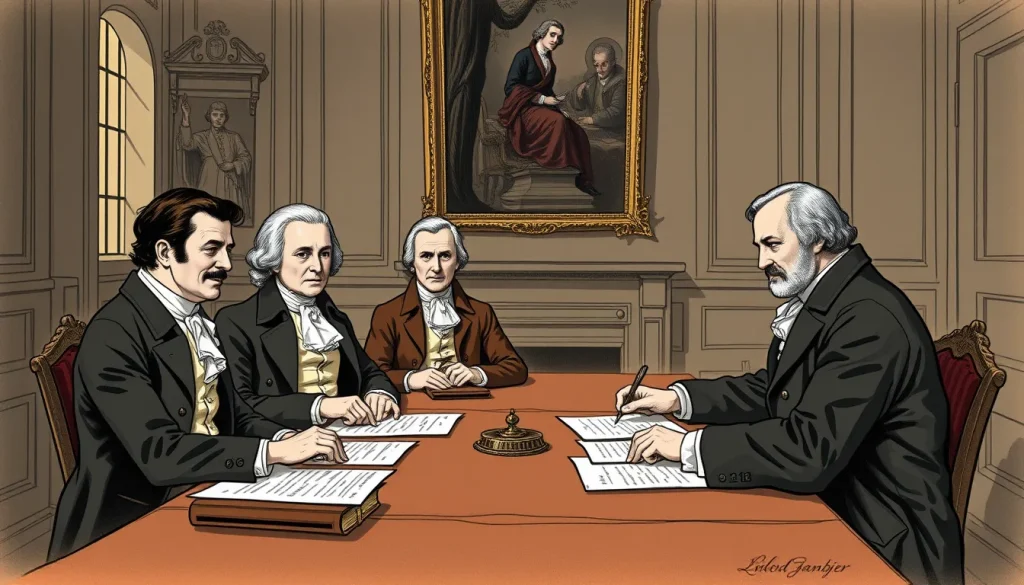
Peace negotiations began in Ghent, in the then-United Netherlands (now Belgium), in August 1814. The American delegation comprised five experienced statesmen: John Quincy Adams, Albert Gallatin, Henry Clay, James Bayard, and Jonathan Russell. The British delegation, led by Admiral James Lord Gambier, Henry Goulburn, and William Adams, was less senior and maintained close contact with London. Initially, the British, buoyed by the fall of Napoleon, demanded the creation of an Indigenous buffer state in the American Northwest to block further westward expansion—a proposal the Americans categorically rejected. The talks stalled until November, when the Duke of Wellington, consulted by the British government, advised that Britain had no right from the state of the war to demand any concession of territory. He also warned that continuing the war would be costly and unpopular. This counsel, together with mounting economic pressure at home and the success of the American defense at Plattsburgh, prompted Britain to abandon the buffer-state idea. The negotiators drafted a treaty of eleven articles, which both sides signed on December 24, 1814. The treaty provided for the restoration of all conquered territories, the return of archives and records, and the establishment of commissions to settle boundary disputes, including the fate of islands in Passamaquoddy Bay. It said nothing about impressment, neutral rights, or the Orders in Council, which had been the war’s original causes. Because news of the treaty took weeks to cross the Atlantic, the Battle of New Orleans was fought on January 8, 1815, after the signing but before ratification. The treaty was ratified by the U.S. Senate and exchanged with Britain on February 17, 1815, officially ending the war.
Why It Matters
The Treaty of Ghent’s restoration of the status quo ante bellum had far-reaching consequences. It secured the survival of British North America—later Canada—as a distinct entity, thwarting American annexationist ambitions. For the United States, the treaty was perceived as a kind of victory, especially after Andrew Jackson’s triumph at New Orleans, fostering a surge of nationalism and contributing to the collapse of the Federalist Party. The war also reshaped relations with Indigenous peoples: Article IX required the restoration of Indigenous rights and possessions to their 1811 status, but this was never enforced, and American westward expansion continued unabated. The treaty established a durable peace between the United States and Britain, leading to two centuries of mostly friendly relations. It also set a precedent for resolving disputes through commissions, which later helped settle boundary lines. For historians, the treaty remains a paradox: it ended a war while failing to resolve the issues that caused it, thus underscoring the war’s essentially stalemated character.
Definition
Status quo ante bellum is a Latin term meaning “the state before the war.” In the context of the Treaty of Ghent, it meant that all territory, ports, and possessions captured during the War of 1812 would be exchanged back, so that the international boundaries reverted to those that existed in June 1812, before the conflict began. This principle effectively negated any territorial gains either side might have made during the war, restoring the pre-war political map of North America.
Background
The War of 1812 arose from a complex interplay of maritime disputes, territorial ambitions, and Indigenous conflict. The United States, as a neutral nation, asserted the right to trade with any belligerent, but Britain’s naval blockade and the Orders in Council interfered with that trade. Impressment—the Royal Navy’s practice of stopping American ships and removing sailors claimed as British subjects—was the most inflammatory issue. Meanwhile, British support for Indigenous peoples resisting American expansion in the Northwest heightened frontier tensions. The United States declared war with the goal of securing maritime rights and potentially annexing Canada, but its military forces were unprepared and its strategic objectives were wildly unrealistic. The British, distracted by the Napoleonic Wars, initially adopted a defensive posture, but after Napoleon’s abdication in 1814, they were able to send experienced troops to North America. Yet the American victories at Baltimore and Plattsburgh, combined with a growing war-weariness among the British public and a desire to reopen trade, made continued conflict unattractive. Thus, the fundamental causes of the war—impressment and trade restrictions—had become moot by 1814, as the end of the European war made those practices unnecessary.
How It Worked
The restoration of the status quo ante bellum was achieved through a series of specific treaty articles. Article I ordered the cessation of hostilities and the restoration of all territories, places, and possessions taken by either party, with the exception of certain islands in Passamaquoddy Bay that remained under the occupying power until a boundary dispute was resolved. Article IV established a commission to decide the northeastern boundary. The treaty also provided for the return of prisoners of war and the restoration of archives and records. Nothing in the treaty addressed impressment or neutral rights, because the British refused to concede on these points, and the Americans, recognizing that these issues had been rendered obsolete by the end of the Napoleonic wars, did not insist on them. The diplomatic mechanism was simple: both sides wanted peace, and the easiest way to achieve it was to revert to the legal status quo. This outcome was also a reflection of the military balance—neither side could dictate terms, so they settled for a draw that favored preserving what already existed.
Competing Viewpoints
Historians and contemporaries have offered different interpretations of why the treaty restored the status quo. Some emphasize the military stalemate: the Americans failed to conquer Canada, while the British failed to dislodge the Americans from their defensive positions. Others point to British domestic concerns: the Liverpool ministry faced financial strain and public pressure to restore trade, making a prolonged war unpopular. Wellington’s advice that Britain had “no right, from the state of the war, to demand any concession of territory” is often cited as evidence that the military situation was genuinely balanced. On the American side, some historians, like Donald Hickey, argue that the United States achieved none of its stated war aims, and thus the treaty was not a victory but a return to the pre-war state—a fact often obscured by the postwar wave of nationalism. Another viewpoint stresses that Britain had actually achieved its defensive aims: protecting Canada, maintaining maritime supremacy, and preserving Indigenous buffer zones—though the latter was abandoned in the treaty. These differing views reflect the ambiguity of the war’s outcome: both sides claimed a measure of success, but the treaty itself institutionalized the pre-war situation, showing that neither power had the strength to impose a new order.
Role in the War of 1812
The Treaty of Ghent directly transformed the war’s conclusion into a formal restoration of the status quo. By returning all conquests, it meant that the numerous border raids, invasions, and occupations—such as the British occupation of Detroit, the American capture of York (now Toronto), and the British burning of Washington—were effectively nullified in legal terms. The treaty also recognized the pre-war borders as the legitimate boundaries, reaffirming the sovereignty of both nations over the territory they held in 1812. This provision was crucial for the British, as it secured Canada’s survival, and for the Americans, as it preserved their western territories. The war’s termination through a return to the status quo had a profound effect on the American political landscape: it allowed President Madison and the Democratic-Republican Party to present the war as a successful defense of national sovereignty, even though none of the original objectives were achieved. For Indigenous peoples, the treaty’s promise of restoring their rights was a significant rhetorical gesture, but it was soon broken, leading to further conflict and dispossession.
Consequences and Historical Interpretation
The restoration of the status quo ante bellum had lasting consequences for North America and beyond. It established a durable peace between the United States and Britain, which later matured into an alliance. It also solidified the border between the United States and British North America, eventually becoming the longest undefended boundary in the world. In the United States, the war’s conclusion, especially after the Battle of New Orleans, fostered a spirit of nationalism and self-confidence that propelled the nation into the Era of Good Feelings. The Federalist Party, which had opposed the war, collapsed after the Hartford Convention, leaving the Democratic-Republicans dominant. For Canada, the war became foundational to an emerging national identity, though the “militia myth” that citizen-soldiers were responsible for the victories would later be debunked by historians. Scholarly interpretation of the treaty has evolved; modern historians emphasize that the war was ultimately futile from the American perspective, as none of the declared causes were resolved. Yet the treaty’s success in establishing a lasting peace remains its most significant legacy. It demonstrated that even unresolved conflicts could be settled without permanent territorial changes, and it set a precedent for peaceful resolution of disputes through diplomacy and commissions.
Primary Sources
The treaty itself, formally titled “Treaty of Peace and Amity between His Britannic Majesty and the United States of America,” is the foundational primary source. It is available in the U.S. Statutes at Large (8 Stat. 218) and in various online collections. The treaty’s text reveals the deliberate silence on impressment and neutral rights, confirming that these issues were set aside. The private and official correspondence of the American negotiators, especially John Quincy Adams and Henry Clay, provides insight into the negotiations and the decision to accept the status quo. The Duke of Wellington’s letter to Lord Liverpool of November 9, 1814, in which he advised against continuing the war, is a critical document that explains the British decision to moderate their demands. Additionally, the memoir and diary of John Quincy Adams offer a detailed day-by-day account of the proceedings. These sources contain biases—Adams was promoting his own role, and Wellington was offering professional military opinion—but they are invaluable for understanding the motivations of the negotiators.
Further Reading
- Donald R. Hickey, The War of 1812: A Forgotten Conflict (University of Illinois Press, 1989) – standard military and political history.
- J.C.A. Stagg, Mr. Madison’s War: Politics, Diplomacy, and Warfare in the Early American Republic, 1783–1830 (Princeton University Press, 1983) – focuses on American policy.
- Donald E. Graves, Where Right and Glory Lead! The Battle of Lundy’s Lane, 1814 (Robin Brass Studio, 1997) – detailed study of a key battle.
- Alan Taylor, The Civil War of 1812: American Citizens, British Subjects, Irish Rebels, & Indian Allies (Alfred A. Knopf, 2010) – emphasizes the borderland perspective.
- John Quincy Adams, Memoirs of John Quincy Adams, edited by Charles Francis Adams (J.B. Lippincott, 1874–77) – primary source for negotiations.
References
- Treaty of Ghent, December 24, 1814, U.S. Statutes at Large, 8 Stat. 218. https://en.wikipedia.org/wiki/Treaty_of_Ghent
- Jason Ridler, “Treaty of Ghent,” The Canadian Encyclopedia, last edited December 20, 2017. https://thecanadianencyclopedia.ca/en/article/treaty-of-ghent
- “The Treaty of Ghent: Annotated,” JSTOR Daily. https://daily.jstor.org/the-treaty-of-ghent-annotated/
- Donald R. Hickey, The War of 1812: A Forgotten Conflict (University of Illinois Press, 1989).
- “Treaty of Ghent – War of 1812,” thewarof1812.org. https://thewarof1812.org/treaty/
FAQ
What did status quo ante bellum mean in the Treaty of Ghent?
It meant that all territory and possessions captured during the war would be returned, and the pre-war boundaries of June 1812 would be restored. No territorial changes were made.
Why did the treaty not address impressment and neutral rights?
The end of the Napoleonic Wars had made those issues obsolete, as Britain no longer needed to impress sailors or restrict neutral trade. Both sides agreed to omit them to achieve peace.
Did the United States achieve any of its war aims?
No. The treaty contained no American concessions from Britain on impressment, neutral rights, or the conquest of Canada. However, the United States survived intact and later claimed a 'win' based on the postwar nationalist mood.




Leave a Reply