
Short Answer
The British Campaign Against Maine (1814–1815) was a series of combined naval and military operations conducted by British forces from Halifax that occupied the eastern portion of the District of Massachusetts (present-day Maine) east of the Penobscot River during the final year of the War of 1812. Led by Lieutenant Governor Sir John Coape Sherbrooke of Nova Scotia, the campaign captured key towns including Castine, Hampden, and Bangor, established the short-lived colony of “New Ireland,” and demonstrated Britain’s ability to seize and hold American territory. The occupation lasted eight months and ended only after the Treaty of Ghent mandated a return to the pre-war status quo.
Historical Context
During the War of 1812, the northeastern frontier of the United States remained vulnerable to British attacks from Canada and Nova Scotia. The District of Maine, then part of Massachusetts, was bordered on the east by New Brunswick and on the north by Lower Canada, and its extensive coastline faced the powerful Royal Navy base at Halifax. Since the American Revolution, British strategists had contemplated annexing the region east of the Penobscot River as a new colony, reviving the name “New Ireland.” In 1814, with the war in Europe ending and Britain able to divert forces to North America, the Royal Navy and the army under Lieutenant Governor Sherbrooke launched an expedition to secure this territory, improve communications between Halifax and Quebec, and provide a bargaining chip for peace negotiations then underway at Ghent. The Federalist-dominated population of eastern Maine showed little enthusiasm for the war, and local defenses were virtually nonexistent, as the Jefferson administration had concentrated scarce fortification funds on Republican strongholds to the west.
What Happened
The campaign began with the capture of Eastport on 11 July 1814, when a British force took the town without resistance from a small militia garrison. The main expedition assembled at Halifax and sailed on 26 August, under the overall command of Sir John Coape Sherbrooke, with Rear Admiral Edward Griffith commanding the naval squadron and Major General Gerard Gosselin leading the army. The force comprised about 3,000 regulars, including elements of the 29th, 62nd, and 98th Regiments of Foot, plus Royal Artillery and Royal Marines, supported by a squadron that included two 74-gun ships of the line, HMS Dragon and HMS Bulwark. On 1 September, the British entered Castine at the mouth of the Penobscot River. The small American garrison spiked their guns and retreated, and the town was occupied without a fight. Sherbrooke issued a proclamation assuring residents who surrendered their weapons that they would be protected if they remained peaceful. A separate detachment occupied Belfast to secure the flank. Meanwhile, the American corvette USS Adams, commanded by Captain Charles Morris, had taken refuge upriver at Hampden for repairs. On 3 September, a British force under Captain Robert Barrie, consisting of about 750 sailors and marines from the squadron, landed near Hampden and advanced on the town. The Americans had gathered about 1,400 militia under Brigadier General John Blake, together with some regulars and the crew of the Adams, but the militia broke after a brief exchange of fire at Pitcher’s Brook. Morris, realizing the ship could not be saved, burned the Adams to prevent capture. The British occupied Hampden and then moved on to Bangor, where they demanded and received a $30,000 bond. They then controlled the entire Penobscot Bay region and the coast eastward to the New Brunswick border. The British established a civil administration at Castine, collecting customs duties and governing the territory as “New Ireland.” The occupation lasted through the winter; following ratification of the Treaty of Ghent, British forces withdrew in April 1815.
Why It Matters
The British Campaign Against Maine holds significant importance in the War of 1812 for several reasons. Militarily, it demonstrated the ability of British forces to launch a successful amphibious operation and occupy American territory with minimal casualties, exposing the weakness of United States defenses in the northeast. Strategically, the occupation provided Britain with a potential territorial concession in the Ghent negotiations, although the treaty ultimately restored the pre-war status quo. The customs revenue collected at Castine, known as the “Castine Fund,” amounted to over £10,000 and was used to endow Dalhousie College (now Dalhousie University) in Halifax, Nova Scotia, a lasting Canadian institution funded by American duties. Politically, the campaign deepened Federalist disillusionment with the war and contributed to the movement for Maine statehood, as residents concluded that Massachusetts could not defend them. The episode also challenges American popular memory of the war as a time of unyielding patriotic resistance; many locals in the occupied region cooperated with British authorities. Historians such as Donald Hickey and Jon Latimer have emphasized that the occupation was reversed not by military action but by diplomacy, underscoring the limits of American state capacity during the conflict.
Prelude
Prior to the 1814 campaign, British authorities in Nova Scotia and New Brunswick had long coveted the strategic region east of the Penobscot River. During the American Revolution, the British had established a short-lived colony of New Ireland there, which was ceded back after the Treaty of Paris. In 1814, with the collapse of Napoleon and the release of reinforcements, the British government authorized offensive operations along the American coast. Plans were drawn to secure the line between Halifax and Quebec and to create a new colony that would accommodate Loyalist settlers and strengthen British influence. The first overt move came on 11 July when a naval force captured Eastport and Moose Island, which controlled Passamaquoddy Bay. Following that success, Sherbrooke assembled a larger expedition, including troops from the Halifax garrison, to seize the Penobscot region.
Forces and Commanders
The British force, commanded by Lieutenant Governor Sir John Coape Sherbrooke, comprised approximately 3,000 regulars including the 29th, 62nd, and 98th Regiments of Foot, a company of Royal Artillery, and Royal Marines. Rear Admiral Edward Griffith commanded the naval squadron, which included the ships of the line HMS Dragon (74) and HMS Bulwark (74), frigates HMS Endymion (40) and HMS Tenedos (38), and several sloops, schooners, and transports. Captain Robert Barrie led the expedition up the Penobscot River. The American forces consisted of local militia under Brigadier General John Blake, augmented by a small contingent of U.S. regulars led by Lieutenant Andrew Lewis of the 40th Infantry, and the crew of USS Adams under Captain Charles Morris. The militia numbered around 1,400 at Hampden, but they were poorly armed and untrained.
Battlefield and Map Context
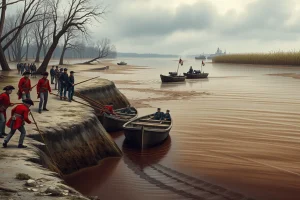
The campaign unfolded along the rugged coast and rivers of what is now Maine. Castine, on the Bagaduce Peninsula, commanded the entrance to Penobscot Bay and had been a fortified site since the colonial era. The Penobscot River runs approximately 30 miles inland from Castine to Hampden, where the river narrows and bends. Beyond Hampden lay the timber and shipbuilding town of Bangor, which was the target of the expedition after the Battle of Hampden. The terrain is hilly and forested, and the weather in early September was rainy and foggy on the day of the battle, which hindered visibility. The British landed at Bald Hill Cove and advanced along the main road; the American defensive line ran along a ridge south of Hampden, with the river on their right and a marsh on their left.
Battle Chronology
- 11 July 1814 – British capture Eastport and Moose Island without resistance.
- 26 August 1814 – Expedition sails from Halifax.
- 1 September 1814 – British arrive at Castine; the garrison spiked guns and fled; town occupied.
- 2 September – A detachment occupies Belfast; Barrie’s force proceeds upriver.
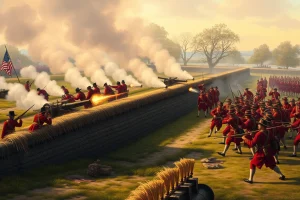
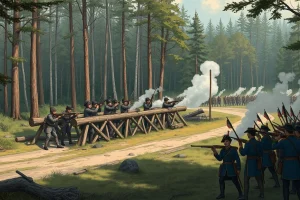
- 3 September – Battle of Hampden: American militia break after brief fight; USS Adams burned to prevent capture.
- 3–4 September – British occupy Hampden and Bangor; Bangor forced to pay $30,000 bond.
- April 1815 – British withdraw after news of the Treaty of Ghent.
Casualties and Losses
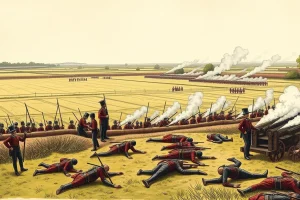
British casualties were remarkably light: two killed and eight wounded across the entire operation. American losses at Hampden included one killed, approximately seventy captured, and an unknown number wounded. The destruction of USS Adams, a 28-gun corvette, was a significant naval loss for the United States. The British also reported the capture or destruction of over seventeen American merchant ships during the campaign. In addition, the $30,000 bond extracted from Bangor represented a heavy financial burden on that town.
Result
The campaign was a decisive British victory. The entire eastern coast of Maine, from the Penobscot River to the St. Croix River, was occupied without any major engagement. The British established a functioning civil administration under the name “New Ireland,” collected customs duties, and controlled the region until the end of the war. The Treaty of Ghent, signed on 24 December 1814, required the mutual restoration of territories captured during the war, and British forces departed in April 1815 after the treaty was ratified.
Strategic Consequences
The occupation demonstrated British ability to project power along the American coast and to hold substantial territory. It secured the overland route between Nova Scotia and Quebec, eased pressure on British supply lines, and provided a powerful bargaining lever at Ghent, though the British ultimately did not insist on retaining the territory. The campaign’s success contributed to a sense of vulnerability in New England and bolstered calls for a stronger federal defense, while also reinforcing Federalist opposition to the war. The Castine Fund, later used to establish Dalhousie University, became a lasting legacy. For the United States, the episode revealed the limits of national power and the failure of state governments to provide for coastal defense, factors that accelerated the process of Maine statehood, which occurred in 1820.
Primary Accounts
Contemporary primary sources include the expedition’s official reports, published in the London Gazette, and Sherbrooke’s correspondence with the colonial office. The proclamation issued by Sherbrooke and Griffith on 1 September 1814, promising protection to inhabitants who surrendered their arms, is preserved in British archives. American accounts include Captain Charles Morris’s official report of the loss of USS Adams, printed in American newspapers. Local records from Castine and Hampden, including town meeting minutes and the bond agreement with Bangor, provide insight into civilian experiences. Many of these documents are held in the National Archives (UK), the Nova Scotia Archives, and the Maine Historical Society, and are available to researchers.
Battlefield Today
The sites of the campaign can be visited today. Castine retains Fort George, a Revolutionary-era earthwork that was rebuilt and strengthened by the British during the occupation; it is now a state historic site. The battlefield at Hampden is marked by a memorial and a small park along the old road near Reeds Brook. Bangor’s commercial district still contains buildings from the period. The towns of Eastport and Castine maintain museums that interpret the 1814 occupation. The wreck of USS Adams lies in the Penobscot River near Hampden, although its location is not marked. Historic trails and signs provide context for visitors.
Primary Sources
The most important primary sources for the British Campaign Against Maine include the official dispatches of Lieutenant Governor Sir John Coape Sherbrooke and Rear Admiral Edward Griffith, which detail the expedition’s planning and execution. The proclamation of 1 September 1814, issued at Castine, is a key document for understanding the British policy toward the occupied population. Captain Charles Morris’s report on the loss of USS Adams offers an American perspective. Local newspapers from 1814, such as the Eastern Argus (Portland) and Bangor Weekly, contain accounts of the occupation and reactions. The customs records from Castine, documenting the collection of tariffs, are preserved in the UK National Archives. It is essential to recognize that these sources were written by participants with their own biases; British reports emphasize success and restraint, while American accounts often criticize militia leadership and Federalist defeatism.
Further Reading
- Donald R. Hickey, The War of 1812: A Forgotten Conflict (University of Illinois Press, 1989).
- Jon Latimer, 1812: War with America (Harvard University Press, 2007).
- Andrew Lambert, The Challenge: Britain Against America in the Naval War of 1812 (Faber and Faber, 2012).
- Jeremy Black, The War of 1812 in the Age of Napoleon (University of Oklahoma Press, 2009).
- Barry J. Lohnes and Ronald Banks, “A New Look at the Invasion of Eastern Maine, 1814,” Maine History 15, no. 1 (1975): 4–29.
References
- Hickey, Donald R. The War of 1812: A Forgotten Conflict. University of Illinois Press, 1989.
- Latimer, Jon. 1812: War with America. Harvard University Press, 2007.
- Lambert, Andrew. The Challenge: Britain Against America in the Naval War of 1812. Faber and Faber, 2012.
- Black, Jeremy. The War of 1812 in the Age of Napoleon. University of Oklahoma Press, 2009.
- Lohnes, Barry J., and Ronald Banks. “A New Look at the Invasion of Eastern Maine, 1814.” Maine History 15, no. 1 (1975): 4–29.
- “The Maine Campaign – War of 1812.” thewarof1812.org. Accessed 2023. https://thewarof1812.org/campaigns/the-maine-campaign/.
- “Battle of Hampden and Capture of Castine.” thewarof1812.org. https://thewarof1812.org/battles/battle-of-hampden-and-capture-of-castine/.
- “Battle of Hampden.” Wikipedia. https://en.wikipedia.org/wiki/Battle_of_Hampden.
- “New Ireland (Maine).” Wikipedia. https://en.wikipedia.org/wiki/New_Ireland_(Maine).
FAQ
Why did the British launch a campaign against Maine in 1814?
The British aimed to secure the route between Halifax and Quebec, to occupy territory as a bargaining chip at the Treaty of Ghent, and to revive the planned colony of New Ireland.
What was the Battle of Hampden?
The Battle of Hampden was a brief skirmish on September 3, 1814, where British troops defeated poorly trained American militia and forced the crew of USS Adams to burn their own ship to avoid capture.
How did the British occupation affect Maine's statehood movement?
The occupation demonstrated that faraway Massachusetts could not defend the district, strengthening the popular sentiment in favor of separate statehood, which was achieved in 1820.


Leave a Reply