Short Answer
The Mohawk warriors who fought in the War of 1812 were members of the Haudenosaunee (Six Nations) confederacy, particularly from the Grand River settlement in Upper Canada, who allied with the British to resist American expansion. Their participation in battles such as Queenston Heights and Beaver Dams proved critical to the defence of British North America. Their story illustrates the central role of Indigenous peoples in a conflict often portrayed as a British-American affair.
Historical Context
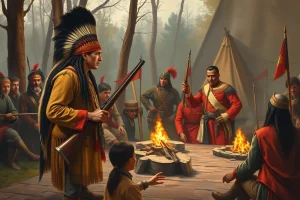
After the American Revolution, many Mohawks and other Six Nations had migrated to British territory in Upper Canada, settling on the Grand River. They maintained a close relationship with the British Crown, which recognized their land claim. However, by the early 19th century, American expansionism threatened Indigenous lands, and the British saw Indigenous allies as essential to defending Canada against invasion. The Mohawk warriors, led by figures like John Norton (Teyoninhokarawen), saw the war as an opportunity to protect their homeland and independence.
What Happened
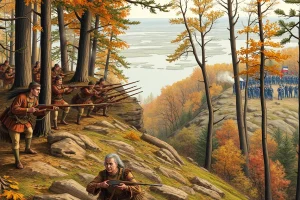
When war broke out in June 1812, John Norton organized warriors from the Grand River and other Six Nations communities to support the British. At the Battle of Queenston Heights (13 October 1812), Norton and about 80 warriors played a crucial role in holding off numerically superior American forces, allowing British reinforcements to counterattack and win the battle. In 1813, Mohawk warriors from Kahnawake, Akwesasne, and other communities joined in the defence of the Niagara frontier. At the Battle of Beaver Dams (24 June 1813), a force largely composed of Mohawk warriors ambushed an American column, leading to its surrender. Mohawk warriors also fought at Châteauguay, Stoney Creek, and in numerous raids and skirmishes.
Why It Matters
The contributions of Mohawk warriors were instrumental in several major British victories and helped maintain British control over Upper Canada, which eventually became the foundation of modern Canada. Yet, the war also had tragic consequences: the destruction of Tecumseh’s confederacy and the eventual loss of Indigenous lands as the United States ignored treaty provisions. Historians recognize that Indigenous participation changed the war’s course, even though their own sovereignty was undermined.
Definition
In the War of 1812, “Mohawk warriors” refers to fighting men of the Mohawk nation, one of the six member nations of the Haudenosaunee Confederacy. They fought on the British side, often in conjunction with other Indigenous allies and British regulars, employing traditional warfare techniques adapted to the North American frontier.
Background
The Mohawks had a long history of alliance with the British, dating back to colonial conflicts. After the American Revolution, the Grand River settlement in Upper Canada became the home to many Mohawk refugees. They were led by Joseph Brant and later John Norton, who had been adopted into the Mohawk nation. The British Indian Department maintained ties with the Mohawks, supplying them with goods and arms. As war approached, these alliances were renewed, and Mohawk warriors responded.
How It Worked
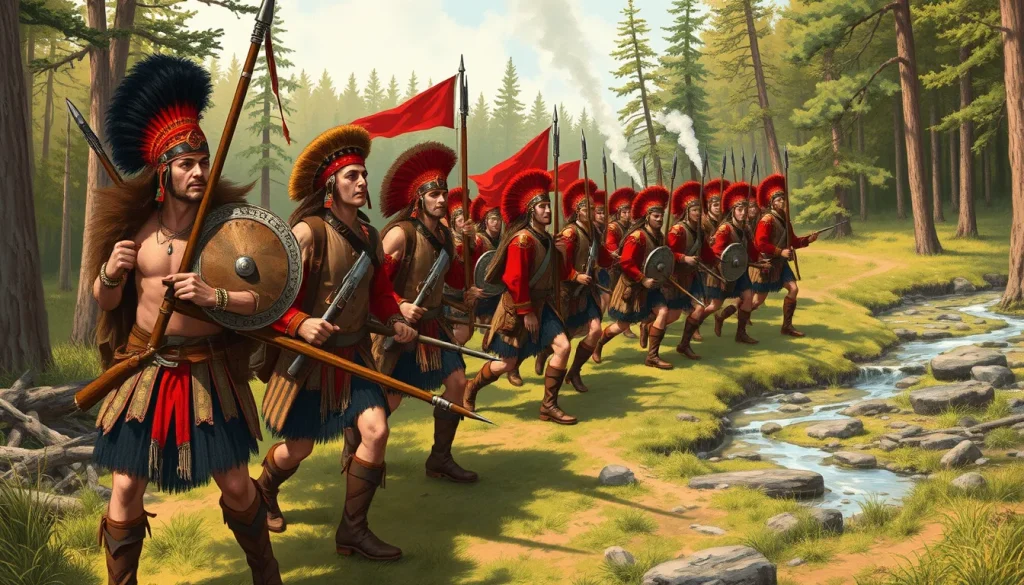
Mohawk warriors operated in independent war parties, often under their own chiefs, but coordinated with British officers. They excelled in scouting, reconnaissance, and irregular warfare, using the dense forests and terrain to their advantage. Their tactics included ambushes, sniping, and psychological intimidation, which proved highly effective against American regular troops. They were often integrated into mixed British-Indigenous forces, as seen at Queenston Heights where they held the American line while British forces regrouped.
Competing Viewpoints
Historians differ on the degree to which Mohawk warriors influenced the outcome of the war. Some, like Carl Benn, emphasize their military effectiveness and contribution to British victories. Others argue that the British ultimately used Indigenous allies for imperial purposes and then abandoned them at the Treaty of Ghent. There is also debate about the motivations of the warriors themselves: whether they fought primarily for their own interests, for the British, or for the protection of their lands. Contemporary documents, such as John Norton’s memoir, provide insight but carry their own biases.
Role in the War of 1812
Beyond Queenston Heights and Beaver Dams, Mohawk warriors were involved in the defence of the Niagara Peninsula, the St. Lawrence Valley, and even in fighting alongside Tecumseh in the west. John Norton recruited warriors from the Grand River and led them in numerous engagements. At Queenston Heights, his warriors, along with other Six Nations and Delaware men, pinned down the American forces, inflicting casualties and disrupting their formation. At Beaver Dams, warriors from Caughnawaga (Kahnawake) and the Grand River ambushed the advancing American column, leading to the capture of over 500 men. These actions demonstrated the strategic value of Indigenous allies in the British military effort.
Consequences and Historical Interpretation
After the war, the British and Americans signed the Treaty of Ghent, which included a clause to restore Indigenous lands, but it was never enforced. The Mohawk and other First Nations lost much of their political leverage. Nevertheless, their contributions have been recognized in modern commemorations, such as the War of 1812 Commemorative Medal. Historically, the war is increasingly interpreted as a multicultural event, with Indigenous fighters playing a central, though often overlooked, role. The legacy for the Mohawks was complex: they had defended their homeland, but the peace brought new pressures from American settlement.
Primary Sources
Key primary sources include John Norton’s manuscript memoir, written in 1816 and published as the Journal of Major John Norton by the Champlain Society in 1970. Norton’s account provides an insider view of the Mohawk participation, especially at Queenston Heights. Official military reports, such as those by British commanders, also mention Indigenous contributions. Additionally, the portrait of Norton by Mary Ann Knight is a visual record. However, these sources reflect the perspectives of their authors; Norton’s memoir, for example, was written to justify his actions and might exaggerate his role.
Further Reading
- Carl Benn, ed., A Mohawk Memoir from the War of 1812: John Norton – Teyoninhokarawen (University of Toronto Press, 2019).
- Carl F. Klinck and James T. Talman, eds., The Journal of Major John Norton (Champlain Society, 1970).
- Alan Taylor, The Civil War of 1812: American Citizens, British Subjects, Irish Rebels, & Indian Allies (Knopf, 2010).
- Carl Benn, The Iroquois in the War of 1812 (University of Toronto Press, 1998).
- Native American history section of the Canadian Encyclopedia (online).
References
- Anthony Wilson-Smith, “John Norton and the War of 1812,” Canadian Encyclopedia, last edited December 5, 2016, https://thecanadianencyclopedia.ca/en/article/john-norton-and-the-war-of-1812.
- Government of Canada, “Exhibit: Indigenous Contributions to the War of 1812,” Crown-Indigenous Relations and Northern Affairs Canada, 2012, https://www.rcaanc-cirnac.gc.ca/eng/1348771334472/1607906032957.
- Government of Canada, “Indigenous Contributions to the War of 1812: Theatres of War Map,” 2012, https://www.rcaanc-cirnac.gc.ca/eng/1338906996435/1607905615872.
- Carl Benn, “Leading the warriors on Queenston Heights: The account of Teyoninhokarawen,” Friends of Fort York, October 31, 2019, https://friendsoffortyork.ca/newsletter/leading-the-warriors-on-queenston-heights-the-account-of-teyoninhokarawen/.
- “The Indigenous Experience – War of 1812,” The War of 1812 Website, accessed 2023, https://thewarof1812.org/indigenous/.
FAQ
What role did Mohawk warriors play at the Battle of Queenston Heights?
They held back the American forces for hours, allowing British reinforcements to counterattack and win the battle.
Who were the main Mohawk leaders during the war?
John Norton (Teyoninhokarawen) and John Brant (Dekarihokenh).
How did the war affect the Mohawk people?
Although they helped secure British Canada, the post-war treaty did not protect their lands, and American expansion continued.


Leave a Reply