
Short Answer
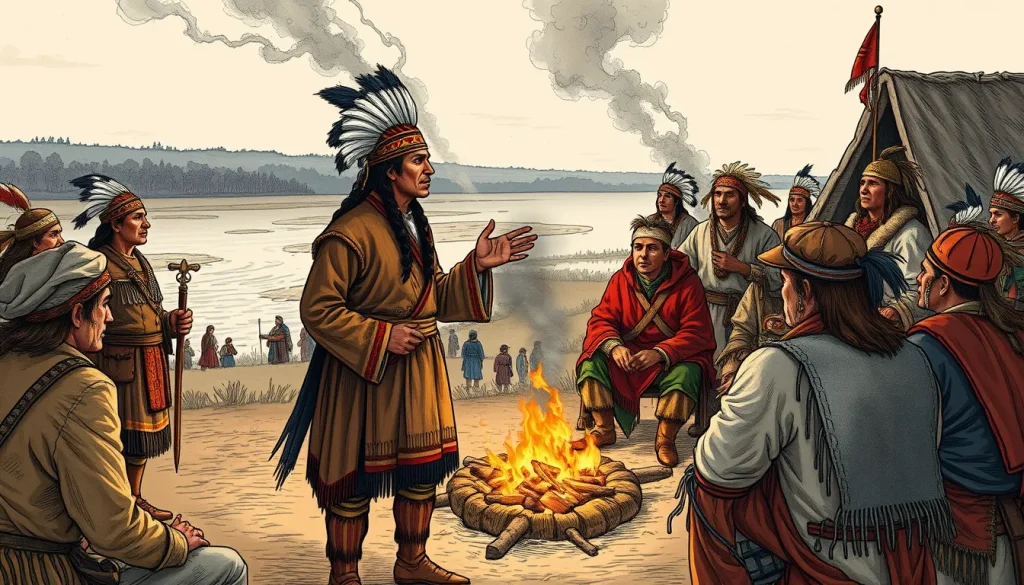
Tecumseh’s Confederacy was a pan-Indigenous political and military alliance formed in the early 19th century by Shawnee chief Tecumseh and his brother Tenskwatawa, known as the Prophet. Its objective was to resist American expansion into the Northwest Territory and to protect Indigenous land and culture. The confederacy played a critical role in the War of 1812, when it allied with Great Britain, and its destruction after Tecumseh’s death in 1813 marked a turning point in the history of American westward expansion.
Historical Context
After the American Revolution, the Treaty of Paris (1783) awarded the United States all land north of the Ohio River, an area that included the present-day Midwest. This vast region, referred to as the Northwest Territory, was home to numerous Indigenous nations, including the Shawnee, Miami, Delaware, and others. The U.S. government encouraged settlement and pursued land cessions through treaties, many of which were negotiated with individual nations or groups that did not represent all Indigenous people. This approach created deep resentment and led to repeated conflicts, including the Northwest Indian War of the 1780s and 1790s. In 1794, General Anthony Wayne’s victory at the Battle of Fallen Timbers and the subsequent Treaty of Greenville (1795) forced many tribes to cede large portions of their lands.
By the early 1800s, new pressures on Indigenous communities included a series of epidemics, increasing white settlement, and the loss of traditional hunting grounds. It was in this context that Tecumseh and Tenskwatawa emerged as leaders. Tenskwatawa, a reformed alcoholic, began preaching a message of spiritual renewal and rejection of white customs after a vision in 1805. His brother Tecumseh, a respected warrior, became the political and military leader of a movement that sought to unite all Indigenous nations against American expansion.
What Happened
In 1808, Tecumseh and Tenskwatawa established the village of Prophetstown at the confluence of the Wabash and Tippecanoe rivers in present-day Indiana. This site became the center of the confederacy, attracting followers from various tribes. Tecumseh traveled extensively, from the Great Lakes region to the Southeast, urging native peoples to abandon intertribal conflicts and unite behind the belief that the land was held in common by all Indigenous people and could not be sold by any single tribe. He insisted that previous treaties ceding land were invalid because they had not been agreed upon by a unified council.
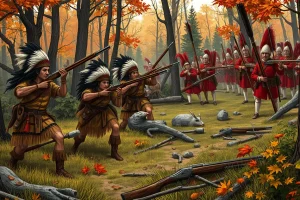
In 1811, while Tecumseh was away on a recruiting trip, Indiana Governor William Henry Harrison led a military force toward Prophetstown. Despite Tecumseh’s warning not to engage, Tenskwatawa ordered an attack on the American camp on November 7, 1811. The ensuing Battle of Tippecanoe ended in a U.S. victory. The Americans burned Prophetstown, and the confederacy was severely weakened.
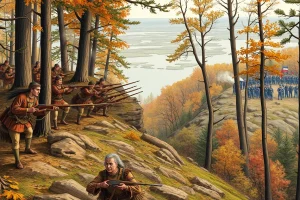
When the War of 1812 broke out between the United States and Britain, Tecumseh and his followers allied with the British in Canada. Tecumseh played a key role in the capture of Fort Detroit in August 1812, serving alongside British Major-General Isaac Brock. The alliance continued through the campaigns of 1813, including the siege of Fort Meigs. After U.S. victories on Lake Erie, British forces led by Major-General Henry Procter retreated into Upper Canada, with Tecumseh reluctantly accompanying. The retreat culminated in the Battle of the Thames on October 5, 1813, where Tecumseh was killed. His death, and the defeat of the allied forces, effectively destroyed the confederacy.
Why It Matters
Immediately, Tecumseh’s death and the defeat at the Thames ended large-scale Indigenous resistance in the Northwest Territory. Many tribes subsequently lost land through treaties and were relocated west of the Mississippi. For the British, Tecumseh’s alliance had been valuable for the defense of Upper Canada; his loss diminished Indigenous support for the British in later negotiations. Historically, the confederacy is significant because it represented one of the most ambitious attempts to create a pan-Indigenous alliance to resist American expansion. Tecumseh became a folk hero and symbol of Indigenous resistance, though interpretations of his legacy vary. Some historians emphasize his diplomatic and military skill, while others focus on the limitations of his vision in the face of demographic and military imbalances.
Definition
Tecumseh’s Confederacy was a loose coalition of Indigenous nations in the eastern and midwestern United States and Upper Canada, organized under the political leadership of Tecumseh and the religious authority of Tenskwatawa. It was not a centralized state but a shared movement based on common principles: resistance to further land cessions, the rejection of American cultural influence, and the belief that land belonged to all Indigenous peoples collectively.
Background
The confederacy drew upon earlier pan-Indigenous efforts, such as the Northwest Indian Confederacy of the 1780s, which attempted to unify tribes in the Ohio Valley. That movement collapsed after the Battle of Fallen Timbers. The spiritual revival led by Tenskwatawa provided a new unifying element. After his 1805 vision, the teachings emphasized a return to traditional customs and the rejection of alcohol, trade reliance, and other white practices. This message gained traction, especially after the epidemic of 1805–06 that devastated Indigenous communities.
How It Worked
Tecumseh and Tenskwatawa operated as a leadership pair. Tenskwatawa served as the spiritual authority, his religious movement lending cohesion and legitimacy to the alliance. Tecumseh acted as the political and military organizer, traveling to different tribes and councils to build consensus. The confederacy’s core principle—that no single tribe had the right to sell land—challenged the treaty-making process that the United States had used. Its influence spread through diplomacy and oratory rather than coercion, and many tribes participated voluntarily, though some stayed neutral or sided with the Americans or British for their own reasons.
Competing Viewpoints
Contemporaries and historians have interpreted Tecumseh’s Confederacy in various ways. Some American officials, like William Henry Harrison, saw it as a dangerous obstacle to expansion and accused Tenskwatawa of being an imposter. Indian leaders such as the Miami chief Little Turtle rejected Tecumseh’s call, preferring to negotiate with the United States. In later historiography, Tecumseh has often been romanticized as a noble war leader, while his brother has been dismissively portrayed as a religious fanatic. Historians such as Peter Cozzens have argued that this dualism oversimplifies their partnership and that Tenskwatawa’s spiritual message was essential to the movement’s appeal.
Role in the War of 1812
The confederacy had a direct impact on the outbreak of the War of 1812. American expansionists associated Tecumseh’s movement with British influence, and the desire to eliminate the confederacy and secure the Northwest Territory was one of the causes of the U.S. declaration of war. During the conflict, Tecumseh and his warriors fought alongside British forces, contributing to early victories such as the capture of Fort Detroit against General William Hull. Tecumseh’s presence bolstered British strength, and his death at the Battle of the Thames removed a key commander and symbol of Indigenous solidarity.
Consequences and Historical Interpretation
Following Tecumseh’s death, the confederacy quickly dissolved. Some allies sought peace, while others continued intermittent resistance. The British and Americans negotiated the Treaty of Ghent in 1814, which restored prewar boundaries but did not address Indigenous sovereignty. The collapse of Tecumseh’s Confederacy paved the way for the removal of most Indigenous peoples from the eastern United States in the following decades. Interpretation has shifted over time; Tecumseh is now remembered as a diplomat and unifier, and the confederacy is considered a significant precursor to later Indigenous rights movements. The story of Tecumseh’s Confederacy is thus integral to understanding the War of 1812, the displacement of Indigenous nations, and the construction of American national identity.
Primary Sources
The most relevant contemporary documents include the correspondence and reports of William Henry Harrison, who described the confederacy and the Battle of Tippecanoe to U.S. officials. British officers, including Isaac Brock, left accounts of Tecumseh’s leadership during the Siege of Detroit. American newspapers from the period reported on Tecumseh’s activities and speeches, though these reports were often colored by racial attitudes. Survivors’ accounts, such as that of the Shawnee warrior Black Hawk, who was inspired by Tecumseh, offer an Indigenous perspective, though they were recorded years later. Each source carries the bias of its author and must be read critically.
Further Reading
- Sugden, John. Tecumseh: A Life. New York: Henry Holt, 1997.
- Cozzens, Peter. Tecumseh and the Prophet. New York: Alfred A. Knopf, 2020.
- Calloway, Colin G. The Shawnee and the War for America. New York: Viking, 2007.
- Hurt, R. Douglas. Ohio Frontier: Crucible of the Old Northwest. Bloomington: Indiana University Press, 1996.
References
- The Canadian Encyclopedia, “Tecumseh,” https://thecanadianencyclopedia.ca/en/article/tecumseh.
- History.com Editors, “Tecumseh,” https://www.history.com/articles/tecumseh.
- National Geographic, “How Tecumseh fought for Native lands—and became a folk hero,” https://www.nationalgeographic.com/history/article/how-tecumseh-fought-for-native-lands-and-became-a-folk-hero.
- Lumen Learning, “President Madison and Tecumseh’s Confederacy,” https://courses.lumenlearning.com/wm-ushistory1/chapter/causes-of-the-war-of-1812/.
- CPN Cultural Heritage Center, “Tecumseh,” https://www.potawatomiheritage.com/encyclopedia/tecumseh/.
FAQ
What were Tecumseh's main goals?
Tecumseh aimed to unite all Indigenous peoples in a common defense of their lands, reject further land sales to the United States, and preserve traditional cultures.
Why did Tecumseh ally with the British in the War of 1812?
Tecumseh saw the British as a counterweight to American expansion and hoped that a British victory would protect Indigenous lands.
How did the confederacy end?
It collapsed after Tecumseh was killed at the Battle of the Thames on October 5, 1813, and subsequent military defeats and treaties eroded its power.

Leave a Reply