Short Answer
Privateering was the practice of governments licensing privately owned armed vessels to attack and capture enemy merchant ships during wartime. In the War of 1812, the United States, Britain, and British North American colonies all commissioned privateers, turning ordinary merchant vessels into legalized commerce raiders. These ships sought profit through prize money while damaging the enemy’s economy, and their activities profoundly affected the maritime war from 1812 to 1815.
Historical Context
At the outbreak of the War of 1812, the Royal Navy dominated the world’s oceans, while the United States Navy consisted of only about fifteen oceangoing warships. Facing a global hegemonic power, the United States turned to privateering as a cost-effective supplement to its regular navy. The practice was centuries old, rooted in the European maritime tradition, and had been used extensively during the American Revolution. Privateers were considered legitimate under the law of nations, as long as they operated under a commission known as a letter of marque and followed established prize rules. For Britain and its colonies, privateering was equally familiar, having been employed against French and Spanish commerce in the Napoleonic Wars.
What Happened
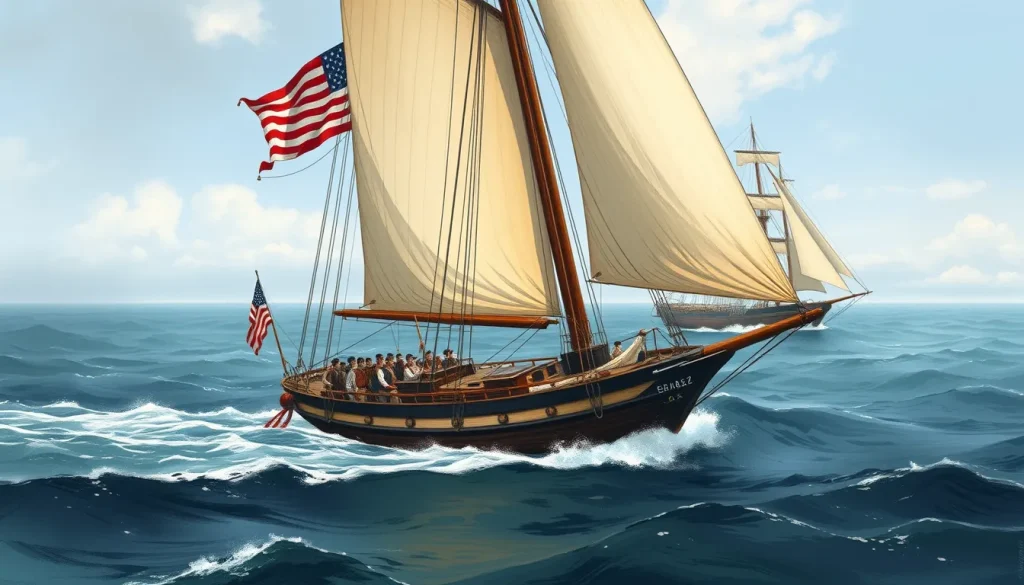
Within a week of Congress declaring war on Britain on 18 June 1812, a bill authorizing privateers was passed and signed by President James Madison on 27 June 1812. American ship owners quickly fitted out hundreds of merchant vessels as privateers, purchasing cannons, recruiting large crews, and obtaining letters of marque. The first commission went to the Baltimore schooner Rossie on 12 July 1812, commanded by Joshua Barney. Over the course of the war, the U.S. government issued at least 1,100 letters of marque, and privateers captured an estimated 1,200 to 2,000 British merchant ships—far more than the regular U.S. Navy, which captured only about 250 vessels.
British and Canadian privateers also operated. Halifax, Nova Scotia, was a major base, with privateers like Liverpool Packet, Sir John Sherbrooke, and Retaliation. Liverpool Packet, a former slaver, captured some 50 prizes and became the most successful privateer of the war. British privateers and their colonial counterparts harassed American shipping, but their impact was smaller compared to the toll American privateers took on British trade.
Why It Matters
Privateering had important strategic and economic effects. The constant threat of American privateers forced British merchants to sail in convoys, pay soaring insurance rates (reaching 13% on England–Ireland routes by 1814), and lose valuable cargoes. Privateer cruises brought in millions of dollars in prize goods, injecting money into the American economy and helping finance the war. Conversely, American privateers also disrupted the Royal Navy’s blockade efforts by tying up warships in convoy duties. The practice also had humanitarian and legal consequences, including the exchange of prisoners captured on merchant vessels.
Historians debate the overall significance of privateering. Some argue it was crucial in pressuring Britain to negotiate peace, while others contend its effect was marginal because British trade with the rest of the world remained vast. Nevertheless, privateering was the largest American maritime effort after the navy, and its legacy continued into the 1850s when the Declaration of Paris outlawed privateering internationally.
Definition
Privateering was a government-sanctioned naval warfare conducted by privately owned vessels. Owners received a commission (letter of marque) authorizing them to seize enemy ships and cargoes. The captured property became “prize,” subject to adjudication by prize courts. Privateers differed from pirates because their actions were legal under national and international law of the period.
Background
The practice evolved from medieval reprisal systems, where a government issued a “letter of marque and reprisal” to a merchant to recover losses by seizing the property of a foreign state. By the 18th century, it had become a standard naval weapon of weaker powers. During the American Revolution, the United States commissioned over 2,000 privateers. In the War of 1812, both sides used privateers to supplement their navies.
How It Worked
Privateering began as a business venture. Investors—often merchants, ship captains, and local elites—formed syndicates to purchase and fit out a vessel. The ship was usually a fast schooner or sloop, lightly armed but with a large crew (often 50–150 men) to provide prize crews and intimidate merchantmen. The owners applied to the government for a letter of marque, which cost a fee and sometimes a bond. Once granted, the captain and crew sailed in search of enemy merchant ships. Upon capturing a vessel, a prize crew boarded it and sailed it to a friendly port, often the privateer’s home port. There, the prize and its cargo were brought before a vice-admiralty or district court. If the court found the capture legitimate (i.e., the ship was truly enemy property and the privateer had acted by its commission), the prize was condemned and sold at auction. Proceeds were divided among the owners, officers, and crew according to a pre-agreed share system—typically the owners received a large share, the captain a percentage, and the crew the remainder. The government also took a customs duty on the cargo.
Competing Viewpoints
Historians disagree over the effectiveness of privateering in the War of 1812. Traditional accounts, such as that of Edgar Stanton Maclay, portray privateers as heroic commerce raiders who struck at Britain’s economic heart. Others, including many recent scholars, have downplayed their strategic impact, arguing that the Royal Navy quickly adapted and that the capture of 1,200–2,000 ships out of thousands of British merchant voyages was relatively small. Some also emphasize the questionable nature of privateers, with crews “scraped together from the lowest dens of wretchedness,” as sailor George Little put it, and incidents of fraud and misconduct. The debate hinges on evaluating both economic damage and strategic disruption.
Role in the War of 1812
For the United States, privateers were a vital form of naval power. They operated in the Atlantic, the Caribbean, the Irish Sea, and even off the British coast, forcing convoys and raising insurance rates. American privateers like Chasseur captured over 20 prizes and famously declared a blockade of the British Isles. On the British side, privateers from Halifax and other colonial ports preyed on American shipping, capturing vessels and supplies. On the Great Lakes, small privateer sloops also attacked bateaux. Privateering was thus a truly global maritime contest, though its center of gravity lay in the Atlantic.
Consequences and Historical Interpretation
Privateering influenced the course and outcome of the war. It boosted American morale after early land defeats, provided critical prize goods, and forced Britain to divert warships to protect trade. It also complicated prisoner exchanges, as captured privateersmen were often treated as pirates rather than prisoners of war. The war’s end saw the cessation of privateering, though the practice was only formally abolished internationally by the Declaration of Paris in 1856. Historians now recognize that privateering was a major component of the maritime war, but its precise strategic weight remains a matter of interpretation.
Primary Sources
Several contemporary sources illuminate privateering. George Little, a common seaman on American privateers, left an account describing the polyglot, hard-bitten nature of crews. The Rossie’s log and Joshua Barney’s reports survive, detailing captures. British shipping insurance rates and newspaper articles document the commercial panic caused by privateers. The Navy Chronicle reported on the 13% insurance rate, comparing it to the Napoleonic Wars. Each source has biases: American accounts often glorify privateering, while British sources emphasize the “pirates” of Baltimore. The records of prize courts also provide legal documentation, but only for ships that were brought to port; many captures were ransomed or destroyed at sea.
Further Reading
- American Privateers in the War of 1812: The Vessels and Their Prizes by Frederick C. Leiner (a modern scholarly account).
- A History of American Privateers by Edgar Stanton Maclay (1899, a classic but dated work).
- “Privateering During the War of 1812,” The Canadian Encyclopedia (for British/Canadian perspective).
- Gilje, Paul. “Cruising for Dollars: Privateers in the World of 1812.” National Park Service.
- American Battlefield Trust. “David and Goliath: Privateers vs. the Mighty British Navy.”
References
- Gilje, Paul. “Cruising for Dollars: Privateers in the World of 1812.” U.S. National Park Service, August 16, 2017. https://www.nps.gov/articles/cruising-for-dollars.htm.
- Marsh, James H. “Privateering During the War of 1812.” The Canadian Encyclopedia, March 12, 2011, last edited June 8, 2015. https://thecanadianencyclopedia.ca/index.php/en/article/privateering-during-the-war-of-1812.
- Leiner, Frederick C. “Yes, Privateers Mattered.” Naval History 28, no. 2 (March 2014). https://www.usni.org/magazines/naval-history-magazine/2014/march/yes-privateers-mattered.
- American Battlefield Trust. “David and Goliath: Privateers vs. the Mighty British Navy.” Updated June 10, 2024. https://www.battlefields.org/learn/articles/head-tilting-history/david-and-goliath-privateers-vs-mighty-british-navy.
- Beirne, Francis F. The War of 1812. New York: E. P. Dutton & Co., 1949, Chapter 24. https://penelope.uchicago.edu/Thayer/E/Gazetteer/Places/America/United_States/_Topics/history/_Texts/BEI1812/24*.html.
FAQ
What was the legal basis of privateering in 1812?
Privateering was legal under the law of nations. A government issued a letter of marque to a private ship owner, empowering the vessel to seize enemy merchant ships. Captures had to be approved by a prize court to become valid.
How did privateer crews get paid?
Crews were paid through shares of the prize proceeds. After a prize was condemned and sold, the net revenue was divided among owners, officers, and crew according to a pre-agreed percentage. If no prizes were taken, the crew received little or nothing.
Were privateers effective in the War of 1812?
Historians disagree. American privateers captured at least 1,200 British ships, forcing convoys and raising insurance rates. However, some argue this was not decisive. They were certainly more numerous than the regular U.S. Navy, but their strategic impact is debated.

Leave a Reply