
Short Answer
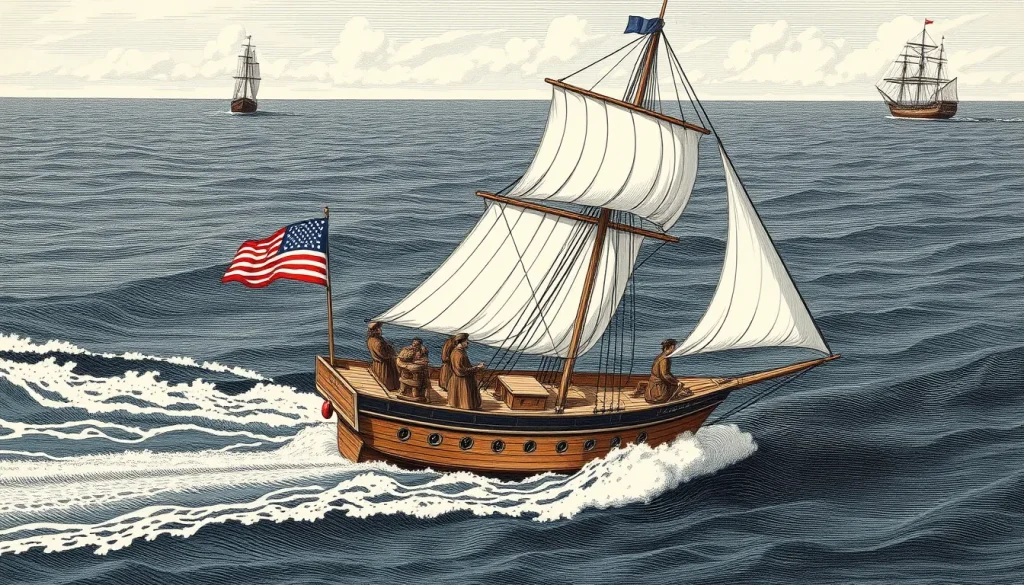
American privateers in the War of 1812 were privately owned armed vessels commissioned by the U.S. government to attack enemy shipping. Operating from 1812 to 1815, they captured over 1,300 British merchant ships and inflicted far greater damage on British commerce than the regular United States Navy. Their activities shaped the maritime war and influenced the peace negotiations at Ghent.
Historical Context
The War of 1812 was fought against the backdrop of the Napoleonic Wars, where Britain and France both sought to blockade each other’s trade. The United States, as a neutral, suffered from British impressment of American sailors and seizure of neutral shipping. When diplomatic efforts failed, Congress declared war in June 1812. The U.S. Navy at that time consisted of only a few frigates and smaller vessels, far outmatched by the Royal Navy’s hundreds of ships. Privateering offered an immediate and profitable way to strike at British commerce, drawing on a long tradition in American colonial and Revolutionary history. Seaports like Salem, Baltimore, and New York quickly outfitted privateers, motivated by profits from captured prizes.
What Happened
In June 1812, Congress passed “An Act concerning Letters of Marque, Prizes, and Prize Goods,” authorizing the President to issue commissions to private vessels. Early American privateers were small schooners and brigs often carrying a single gun, but as the war progressed they became larger and heavily armed. The privateer America, out of Salem, carried 20 guns and reportedly captured 26 prizes. The Chasseur, commanded by Thomas Boyle, became famous for its cruises in British waters and its capture of the British schooner St. Lawrence in February 1815. The Decatur, sailing from Charleston, fought a fierce duel with a Royal Navy warship, inflicting heavy casualties. By 1814, British insurance rates for shipments between England and Ireland had risen to an unprecedented 13%, three times higher than during wars with all of Europe. American privateers cruised in the Irish Sea, the English Channel, and the Caribbean, seizing or sinking merchantmen. They also operated on the Great Lakes and in the St. Lawrence River, as seen with the sloops Neptune and Fox in July 1813.
Privateering was a business venture: investors outfitted ships, captains and crews signed on for a share of prize money. Captured vessels were sent to friendly ports where admiralty courts condemned them and sold them at auction. Owners received half the proceeds; the rest was divided among captain, officers, and crew according to signed agreements. The U.S. government issued over 500 privateering commissions during the war. The privateers were most active in 1812 and 1813, but continued operations until the Treaty of Ghent ended the war in 1815.
Why It Matters
American privateering had immediate and far-reaching consequences. It disrupted British trade, raised insurance rates, and forced the Royal Navy to divert ships to protect convoys, thereby reducing pressure on the U.S. coast and navy. Privateers also captured many British seamen, contributing to prisoner exchanges. While historians debate the overall strategic effect, most agree that privateering inflicted more damage on British commerce than the entire U.S. Navy. The war demonstrated the effectiveness of private armed vessels, but also led to international movements to abolish the practice, culminating in the Declaration of Paris (1856) which prohibited privateering. In the longer term, the success of American privateers in the War of 1812 helped shape American naval doctrine and the development of the U.S. Navy, although the practice itself was never again used on a large scale.
Definition
A privateer was a privately owned armed ship authorized by a government (via a letter of marque) to attack enemy vessels during wartime. The license allowed the captain and crew to seize enemy goods and ships, called prizes, which were sold and the profits distributed among the owners and crew. Privateering was distinct from piracy because it was legal, government-sanctioned warfare.
Background
Privateering had a long history in European and American warfare. In the colonial period, American colonists used privateers against French and Spanish shipping. During the American Revolution, privateers numbered over 1,000 and captured many British prizes. The practice was rooted in the international law of reprisals: a belligerent could authorize private citizens to use armed force against enemy commerce. In the early American republic, the U.S. government used privateers extensively because it did not maintain a large standing navy.
How It Worked
Investors—merchants and shipowners—purchased and fitted out a vessel with cannons and crew. They applied to the federal government for a letter of marque, which required a bond and a description of the ship, armament, and crew. Once licensed, the privateer sailed independently, searching for British merchantmen. Upon capturing a prize, a small crew would sail it to an American or friendly port, such as Baltimore, Salem, or New York, where an admiralty court reviewed the legality of the capture. If condemned, the ship and cargo were auctioned. The proceeds were divided: the owner took one half, and the captain and crew shared the remainder according to their contract. Seamen often preferred privateering over navy service because of higher pay, looser discipline, and a chance at prize money.
Competing Viewpoints
Historians differ on the strategic effectiveness of American privateers. Some, like Theodore Roosevelt, dismissed them as little more than pests, arguing that they avoided Royal Navy warships and did little to change the outcome of the war. Others, such as George Coggeshall and modern scholars like Frederick C. Leiner, argue that privateers inflicted enormous economic damage on Britain, forcing the Royal Navy to spend resources on convoy duty and causing merchants to demand peace. The debate also extends to the motivations of privateersmen: were they patriots defending national rights, or profit-driven adventurers? Recent research emphasizes the economic incentive as the primary driving force.
Role in the War of 1812
American privateers played a decisive role in the maritime war. By the end of the conflict, the U.S. government had issued at least 517 privateering commissions. Together, they captured 1,300 British ships, compared to 254 captured by the U.S. Navy. Privateers also captured around 30,000 British prisoners. They operated throughout the Atlantic, in the Caribbean, and even in British home waters, creating such alarm that insurance rates skyrocketed. Notable successes included the Chasseur‘s raids, the America‘s captures, and the Comet‘s actions. On the Great Lakes, small privateers intercepted British supply bateaux. Privateers also provided intelligence to the U.S. Navy and harassed British blockading squadrons.
Consequences and Historical Interpretation
The war ended with the Treaty of Ghent in December 1814, and privateering ceased soon after. American privateering contributed to the peace negotiations, as British merchants pressured their government to end the conflict. After the war, the United States never again used privateers on the scale of 1812. The international community moved to outlaw privateering altogether in the Declaration of Paris (1856), which the United States declined to sign initially but never again practiced. Historians today view American privateering as an important, though controversial, part of the War of 1812, embodying both the commercial energy and the military limitations of the early American republic.
Primary Sources
The most important primary source is the U.S. Congress’s “An Act concerning Letters of Marque, Prizes, and Prize Goods” (1812), which established the legal framework for privateering. George Coggeshall, a privateersman, published History of the American Privateers in 1856, offering firsthand accounts of many cruises. Official documents, including vessel registration and prize court records, are held at the U.S. National Archives. The naval correspondence and prize lists are reproduced in The Naval War of 1812: A Documentary History edited by William S. Dudley and Michael J. Crawford. Also valuable are letters from privateer captains such as Nathaniel Shaler’s January 1, 1813 letter describing the bravery of African American crew members aboard the General Tompkins. These sources provide both official and personal perspectives, though they often contain exaggerations and patriotic biases.
Further Reading
- Garitee, Jerome R. The Republic’s Private Navy: The American Privateering Business as Practiced by Baltimore During the War of 1812. Middletown, CT: Wesleyan University Press, 1977.
- Hickey, Donald R. The War of 1812: A Forgotten Conflict. Urbana: University of Illinois Press, 1989 (revised 2012).
- Dudley, William S., and Michael J. Crawford, eds. The Naval War of 1812: A Documentary History. 3 vols. Washington: Naval Historical Center, 1985–1992.
- Coggeshall, George. History of the American Privateers and Letters-of-Marque during our War with England in the years 1812, ’13, and ’14. New York: 1856.
- Leiner, Frederick C. “Privateers and Profit in the War of 1812.” Journal of Military History 77, no. 4 (October 2013): 1225–1250.
References
- Marsh, James H. “Privateering During the War of 1812.” The Canadian Encyclopedia, 2015. https://thecanadianencyclopedia.ca/en/article/privateering-during-the-war-of-1812.
- “For Fate and Fortune: American Privateers in the War of 1812.” The General: Brock University Undergraduate Journal of History 2 (2017). https://journals.library.brocku.ca/index.php/bujh/article/view/1485.
- “War of 1812: US privateers.” 1812privateers.org. https://www.1812privateers.org/USgov.html.
- Lossing, Benson J. Pictorial Field-Book of the War of 1812. 1869. Chapter XLI. https://freepages.rootsweb.com/~wcarr1/history/Lossing2/Chap41.html.
- “American Merchant Marine and Privateers in War of 1812.” American Merchant Marine at War. https://usmm.ianewatts.org/warof1812.html.
FAQ
What was the difference between a privateer and a pirate?
A privateer operated under a legal commission (letter of marque) that authorized attacks on enemy shipping, while a pirate acted without legal sanction.
How many ships did American privateers capture in the War of 1812?
American privateers captured over 1,300 British merchant vessels during the conflict, far exceeding the captures made by the regular U.S. Navy.
Why did Americans use privateers in the War of 1812?
The U.S. Navy was small, while privateering offered a means to attack British commerce, raise revenue, and avoid the heavy costs of building a large navy.

Leave a Reply