
Short Answer
The Battle of Burnt Corn, also known as the Battle of Burnt Corn Creek, was fought on July 27, 1813, near a bend of Burnt Corn Creek in what is now Escambia County, Alabama, then part of the Mississippi Territory. It was the first armed clash between United States militia and the Red Stick faction of the Muscogee (Creek) Nation, and it marked the transition of the Creek War from an internal tribal conflict into a broader regional war connected to the War of 1812. Although a small engagement, its consequences—particularly the subsequent attack on Fort Mims—made it a pivotal event in the southern theater.
Historical Context
The Creek War of 1813–14 grew out of deep divisions within the Muscogee Confederacy. Pressure from American settlers, the construction of the Federal Road through Creek lands, and the economic transformation encouraged by U.S. Indian agent Benjamin Hawkins had created two broad factions. A traditionalist group, known as the Red Sticks (for the red-painted war clubs they carried), opposed the National Council’s land cessions and its cooperation with the United States. They sought to restore traditional Muscogee lifeways and resist American encroachment. The Shawnee leader Tecumseh’s visit in 1811, during which he called for resistance, further inflamed tensions. After attacks on settlers along the Duck River in 1812 and a series of internal Creek killings, the National Council, led by Big Warrior, authorized punitive expeditions against the murderers. The Red Sticks violently opposed such actions, and by 1813 the conflict had become a civil war between Upper Creek towns (where the Red Sticks had strength) and those who supported the National Council.
In addition to internal Creek strife, the United States was at war with Great Britain, and British agents in Florida were supplying arms to Indigenous groups. The Spanish, nominal British allies, controlled Pensacola and served as a potential source of munitions. American settlers along the Tombigbee and Tensaw rivers, many of whom were mixed-blood Creeks or had ties to the Lower Creek towns, feared that the Red Sticks would launch attacks against them. Volunteer militia companies were organized, and settlers in the area fortified their homes.
What Happened
In July 1813, a Red Stick war party led by Peter McQueen, the head warrior of Tallassee, traveled to Pensacola to obtain arms and ammunition from the Spanish governor. On their way to Pensacola, McQueen’s men destroyed plantations owned by mixed-blood Creeks Sam Moniac and James Cornells, and they kidnapped Cornells’s wife (later ransomed). After negotiations, the Spanish supplied about 300 pounds of gunpowder and lead shot, which the Red Sticks intended to carry back to their towns. The news of this expedition alarmed the settlers, and Colonel James Caller of the Mississippi Territory militia raised a force of about 180 men, including volunteers, militia, and a company of mixed-blood Creeks under Captain Dixon Bailey, to intercept the returning war party.
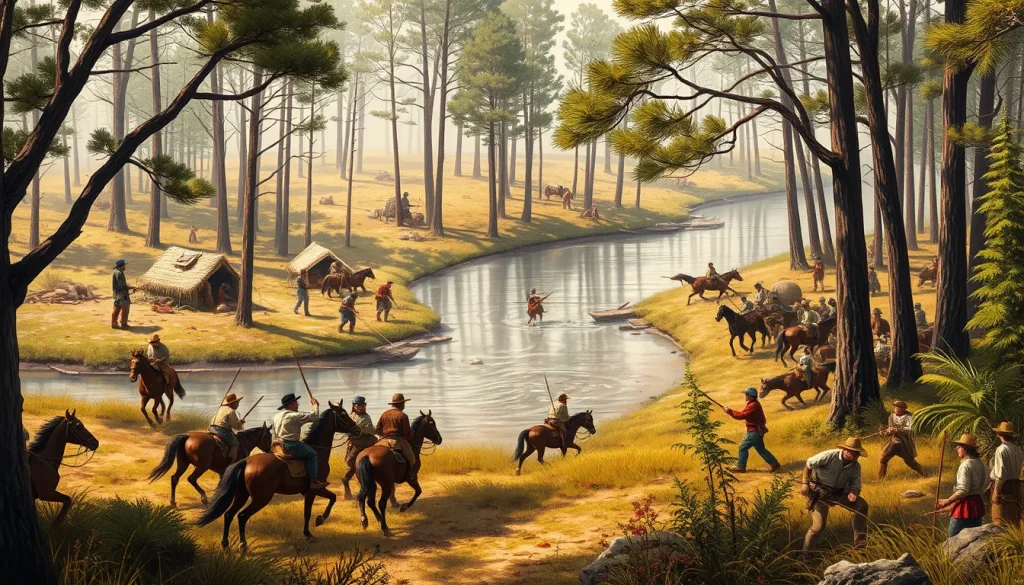
Caller’s force crossed the Alabama River on July 26 and reached Burnt Corn Creek on the morning of July 27. Scouts reported that McQueen’s band—numbering perhaps 60 to 100 warriors—was encamped at a bend in the creek, having stopped to prepare a meal, unaware of the approaching militia. Caller ordered an attack. The initial charge surprised the Red Sticks and drove them across the creek into nearby brush. Believing the enemy routed, the militia began looting the camp and seizing the packhorses loaded with the ammunition. This lapse gave the Red Sticks time to regroup. Under the leadership of McQueen and High-head Jim, the warriors counterattacked fiercely. The militia, caught off guard and scattered among the plunder, fell into disorder. Many fled, some on foot, others on horses, leaving the pack animals behind. A small group of officers—Samuel Dale, Dixon Bailey, and Benjamin Smoot—rallied about eighty men and made a stand, preventing a complete rout. The Red Sticks pursued the retreating militia only a short distance before breaking off. Caller and one of his officers became lost in the swampy woods; they did not return to their homes for two weeks, malnourished and delirious.
The battle lasted only a short time. Casualties on the militia side were officially recorded as two killed and ten to fifteen wounded. The Red Sticks lost perhaps ten to twelve killed and eight to nine wounded. Although the militia captured a portion of the ammunition, the Red Sticks managed to retain most of their powder and lead. The American force immediately withdrew and later disbanded.
Why It Matters
The Battle of Burnt Corn holds significance primarily for its role in escalating the Creek War. It represented the first open, armed confrontation between the United States and the Red Stick faction, turning a civil conflict among the Creeks into a war involving American settlers and the U.S. government. The American attack convinced many Red Stick leaders that the settlers were their enemies and that a general war was unavoidable. In the weeks after Burnt Corn, the Red Sticks organized a retaliatory strike against Fort Mims, a stockade established by Samuel Mims on the Alabama River. On August 30, 1813, a force of about 700 Red Stick warriors attacked the fort, killing over 250 settlers, U.S.-allied Creeks, and enslaved African Americans—known as the Fort Mims massacre. This event galvanized American military action in the South, leading to campaigns against the Red Sticks and culminating in the Battle of Horseshoe Bend in 1814. The war ended with the Treaty of Fort Jackson, which forced large land cessions on the Creeks and eventually facilitated the removal of most Muscogee people from Alabama and Georgia.
Historian interpretation of the battle has varied. Some early chroniclers, such as H. S. Halbert and T. H. Ball in their 1895 work The Creek War of 1813 and 1814, emphasized the militia’s indiscipline and the humiliation of the defeat. Later scholars, including Gregory A. Waselkov in A Conquering Spirit: Fort Mims and the Redstick War of 1813–14, view Burnt Corn as the opening act of a broader conflict that must be understood within the context of the War of 1812 and indigenous resistance. The engagement itself had little strategic importance, but its symbolic role as a provocation is universally acknowledged. The battle also became a subject of satire in Lewis Sewall’s 1815 poem The Last Campaign of Sir John Falstaff the II, which ridiculed Colonel Caller’s conduct and compared him to Shakespeare’s cowardly Falstaff—a testament to the contemporary public perception of the affair as a disgraceful defeat.
Prelude
The immediate prelude to the battle lay in the Red Sticks’ decision to obtain arms. In the spring and summer of 1813, Red Stick bands conducted raids against mixed-blood plantations and Lower Creek towns that supported the National Council. Peter McQueen’s party, which included the prophets High-head Jim and Francis, collected plunder and livestock, driving a herd of cattle to Pensacola for sale. At Pensacola, the Spanish governor, under pressure from British agents, supplied the Creeks with gunpowder and shot, though seemingly in limited quantities—McQueen later reported receiving “a small bag of powder for each ten towns, and five bullets to each man.” Meanwhile, settlers in Washington County and the Tensaw district learned of the Red Sticks’ mission through intelligence from friendly Creeks. Sam Moniac, whose plantation had been burned, conveyed information about the planned return. Colonel James Caller, a prominent militia officer, acted quickly, calling out volunteer companies. The force that assembled was heterogeneous: frontier fighters like Samuel Dale, mixed-blood Creeks under Dixon Bailey, and regular territorial militia.
Forces and Commanders
United States / Mississippi Territory Militia:
- Commander: Colonel James Caller
- Subordinate officers: Captains Samuel Dale, Dixon Bailey, and Benjamin Smoot
- Strength: approximately 180 men
- Composition: Mississippi Territory volunteers, local militia, and mixed-blood Creek auxiliaries
Red Stick Creeks:
- Commanders: Peter McQueen, High-head Jim, and the Prophet Francis
- Strength: approximately 60–100 warriors (estimates vary; some sources suggest up to 300, but most contemporary accounts give a smaller number)
- Composition: Red Stick warriors from Upper Creek towns, primarily from the Tallapoosa and Coosa area
The militia force was ill-disciplined and untrained, which proved crucial in the battle. The Red Sticks, though outnumbered, were experienced and motivated fighters.
Battlefield and Map Context
The exact location of the battle has never been conclusively identified. It occurred near a bend in Burnt Corn Creek, which flows in present-day Escambia County, Alabama, near the line with Conecuh County. The battlefield was roughly eighty miles north of Pensacola, in an area of pine woods, swamps, and creek bottoms. The Red Sticks’ camp was on a rise overlooking the creek, with a swampy area on the opposite side that provided cover for their regrouping. The terrain contributed to the militia’s difficulty in mounting a coordinated defense after their initial attack.
Modern maps place the site at approximately 31°15′N, 87°09′W, but no official battlefield preservation exists. The area remains rural, largely agricultural or forested.
Battle Chronology
- July 26, 1813: Caller’s force crosses the Alabama River and marches eastward along the Federal Road.
- Morning of July 27: Scouts report McQueen’s camp at Burnt Corn Creek; Caller orders a surprise attack.
- Noon: The militia attacks, scattering the Red Sticks and capturing their camp.
- Immediately after: The militia begins looting; many men break formation to secure plunder.
- The Red Sticks rally in the nearby brush and launch a counterattack.
- Caught off guard, the militia retreats in disorder, with a small rear guard under Dale and Bailey preventing total annihilation.
- Late afternoon: The Red Sticks withdraw; the militia flees, leaving horses and abandoned equipment.
- Subsequent days: The militia reassembles at various settlements; Caller is lost for two weeks before being found.
Casualties and Losses
Casualty figures are approximate and vary by source. The most commonly cited numbers are:
- Militia: 2 killed and 10–15 wounded. Some accounts also list men missing.
- Red Sticks: 10–12 killed and 8–9 wounded.
The militia lost most of its packhorses and personal equipment, but the Red Sticks also suffered a material loss—some of the powder and lead they had obtained from the Spanish was captured. Yet the Red Sticks managed to retain the majority of their supplies, allowing them to continue their campaign.
Result
The Battle of Burnt Corn was a Red Stick victory. Although the militia initially surprised the Red Sticks and captured their camp, the Red Sticks repulsed the American attack and forced the militia to retreat in disorder. The Red Sticks achieved this despite being outnumbered and losing some of their ammunition. The battle was a costly humiliation for the American militia and a psychological boost for the Red Sticks.
Strategic Consequences
The battle had disproportionate strategic consequences. It signaled to the Red Sticks that the United States had committed to military action against them, and it hardened their resolve. Within a month, the Red Sticks launched the attack on Fort Mims, which resulted in a devastating massacre. That massacre prompted the United States to mount a full-scale military campaign against the Red Sticks, including forces under Andrew Jackson. The subsequent campaign led to the destruction of many Red Stick towns, the decisive Battle of Horseshoe Bend, and the Treaty of Fort Jackson in 1814, which forced the Creeks to cede more than 20 million acres of land to the United States. The Creek War also meshed with the War of 1812, as British agents continued to support the Red Sticks from Spanish Florida. The battle thus was a catalyst for a broader conflict that ultimately contributed to the consolidation of American control over the Southeast and the eventual removal of the Muscogee people.
Primary Accounts
Several primary accounts exist, though they must be used with caution. The most reliable is the testimony of Sam Moniac, a Creek warrior who accompanied the Red Stick party but later gave a deposition to American authorities on August 2, 1813. Moniac described the expedition to Pensacola, the meeting with the Spanish governor, and the return journey. He recounted that High-head Jim intended a second trip for more ammunition, which indicates the Red Sticks’ strategic planning. Another account comes from the memoirs of Samuel Dale, who later became a celebrated frontiersman. Dale’s memoirs, though written years later, provide a first-person narrative of the battle, including his role in the rear guard. A contemporary anonymous account appeared in the Niles’ Weekly Register in August 1813, but it is brief and sometimes inaccurate. The most detailed early history is Egerton Ryerson’s or more commonly, the 1895 work by Halbert and Ball, which drew on surviving veteran testimonies.
Battlefield Today
No physical traces of the battle are known to exist. The site is unmarked, and the exact spot has not been confirmed. A historical marker erected by the Alabama Historical Association in 1971 stands along U.S. Highway 84 near the presumed location, but it does not pinpoint the battlefield. Local efforts have attempted to identify the area, but the landscape has changed considerably. The battlefield land is in private ownership, and there is no public access. The closest interpretive center is the Fort Mims State Historic Site in Baldwin County, which covers the broader Creek War and includes references to Burnt Corn.
Primary Sources
The earliest and most direct primary source is the testimony of Samuel Moniac, taken on August 2, 1813, by an American officer. This deposition is preserved in the National Archives and has been quoted in many histories. It describes the Red Sticks’ journey, the Spanish gift of ammunition, and the planned return. Moniac’s account is valuable because he was an eyewitness, but he was also a mixed-blood Creek who had been attacked by the Red Sticks, so his testimony may be colored by bias.
Another primary source is the official report of the engagement, likely submitted by Colonel Caller to the territorial governor. That report has not survived, but its contents were summarized in the press. The Mobile Gazette and other contemporary newspapers printed accounts of the battle, often emphasizing the militia’s cowardice. One such account criticized the men for looting instead of pursuing.
Samuel Dale’s memoirs, published in Life and Times of Sam Dale (1842), give a veteran’s perspective but were written decades later and may exaggerate his heroism. A more critical contemporary is Lewis Sewall’s satirical poem The Last Campaign of Sir John Falstaff the II (1815), which mockingly portrays Caller as a foolish braggart; it is useful for understanding public ridicule of the militia.
Further Reading
- Bunn, Mike, and Clay Williams. Battle for the Southern Frontier: The Creek War and the War of 1812. Charleston, SC: The History Press, 2008.
- Halbert, H. S., and T. H. Ball. The Creek War of 1813 and 1814. Tuscaloosa: University of Alabama Press, 1969 (reprint of 1895 original).
- Waselkov, Gregory A. A Conquering Spirit: Fort Mims and the Redstick War of 1813–14. Tuscaloosa: University of Alabama Press, 2006.
- O’Brien, Greg. Choctaws in a Revolutionary Age: A Study of Power and Identity. Lincoln: University of Nebraska Press, 2002 (contains context on indigenous diplomacy).
References
- Kaetz, James P. “Battle of Burnt Corn Creek.” Encyclopedia of Alabama. Auburn University. Last updated July 12, 2024. https://encyclopediaofalabama.org/article/battle-of-burnt-corn-creek/
- “Battle of Burnt Corn.” Wikipedia. Accessed date. https://en.wikipedia.org/wiki/Battle_of_Burnt_Corn
- “Battle of Burnt Corn.” MyWarof1812.com. https://www.mywarof1812.com/battles/130727.html
- “Battle of Burnt Corn.” Alabama Genealogy Trails (transcription of Eggleston’s account). http://genealogytrails.com/ala/burntcorn_battle.html
- Halbert, H. S., and T. H. Ball. The Creek War of 1813 and 1814. Tuscaloosa: University of Alabama Press, 1969.
- Waselkov, Gregory A. A Conquering Spirit: Fort Mims and the Redstick War of 1813–14. Tuscaloosa: University of Alabama Press, 2006.
FAQ
Why is the Battle of Burnt Corn considered significant?
It was the first armed conflict between U.S. forces and Red Stick Creeks, effectively starting the Creek War. Its immediate consequence was the Fort Mims massacre.
Who fought at Burnt Corn?
A force of about 180 Mississippi Territory militia, volunteers, and mixed-blood Creeks under Colonel James Caller faced approximately 60–100 Red Stick warriors led by Peter McQueen and High-head Jim.
What was the outcome of the battle?
The Red Sticks won. Although initially surprised, they counterattacked and forced the militia to retreat in disarray. Both sides suffered modest casualties.


Leave a Reply