
Short Answer
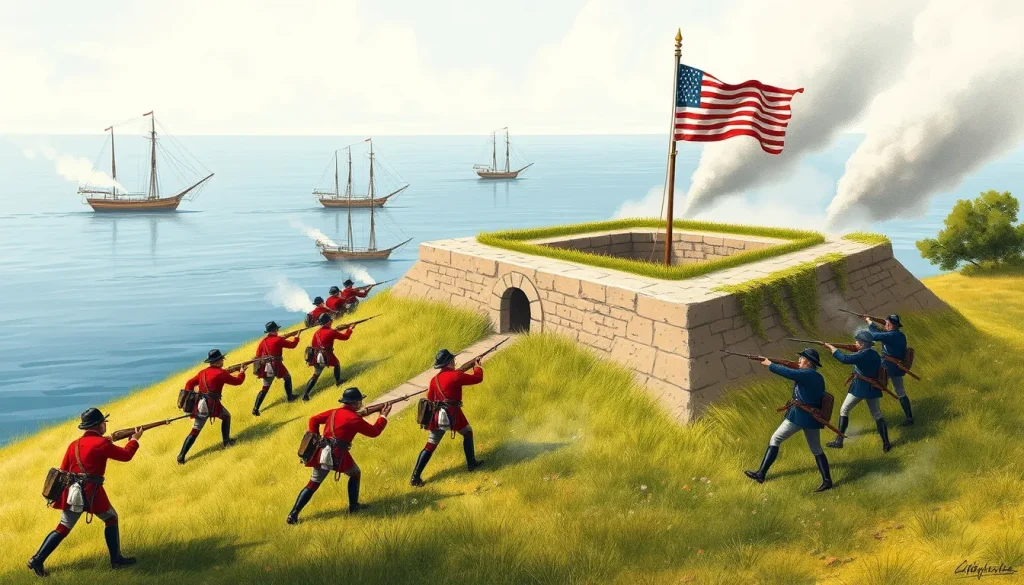
Fort Ontario, a small earth-and-timber fortification perched on the eastern bluffs at the mouth of the Oswego River on Lake Ontario, served as a crucial American transit depot and coastal-defense post during the War of 1812. On May 5–6, 1814, a British naval and military force under Commodore Sir James Lucas Yeo and Lieutenant General Gordon Drummond attacked and captured the fort, but the Americans had already removed the most valuable naval stores upriver to Oswego Falls, thereby thwarting the British strategic objective of crippling American shipbuilding at Sackets Harbor. The Battle of Fort Ontario, also known as the Battle of Oswego, demonstrated the importance of the Lake Ontario supply line and the limits of British amphibious power.
Historical Context
Oswego, located where the Oswego River flows into Lake Ontario in central New York, had been a strategic point since French and British colonial times because of its position on the Mohawk-Oswego-Oneida water route connecting the Hudson River and Atlantic coast with the Great Lakes. During the War of 1812, Oswego served as the principal forward base for forwarding ordnance, cordage, provisions, and other military stores from the interior to the American naval establishment at Sackets Harbor, the main fleet anchorage on Lake Ontario. The American squadron under Commodore Isaac Chauncey and the British squadron under Commodore Yeo struggled for control of the lake, and both sides recognized that whichever navy could maintain superiority would dominate frontier operations. Shipbuilding at Sackets Harbor was essential to the American effort; by 1814, the Americans were constructing or fitting out large warships, including the ships of the line Jefferson, Jones, and Superior. These vessels needed heavy cannon, anchors, cables, and other heavy equipment that could only be moved via Oswego, because the alternative overland route was slow and difficult. British intelligence recognized Oswego as a vital choke point, and cutting this supply route became a major objective in 1814. The fortifications at Oswego consisted of two principal works: Fort Ontario on the east side of the river and Fort Oswego (often called Fort George) on the west. By 1814, Fort Ontario had been rebuilt and strengthened by the Americans, though it remained a small defensive work with a peacetime garrison.
What Happened
In early May 1814, Commodore Yeo assembled a powerful squadron on Lake Ontario, numbering about 1,100 troops drawn from De Watteville’s Regiment, Royal Marines, and Glengarry Light Infantry, under the overall command of Lieutenant General Drummond. The force set sail from Kingston, Upper Canada, and approached Oswego on May 5. American commander Lieutenant Colonel George E. Mitchell, with approximately 300 regular artillerymen and local militia, had anticipated the attack. He had been ordered to hold the fort while moving the most essential naval munitions to the relative safety of Oswego Falls, about ten miles upriver. On May 5, a storm and American cannon fire from Fort Ontario drove off the first British landing attempt, giving Mitchell extra time to remove the heavy ship-rigging, anchors, and several large guns. The British came ashore on May 6 east of the fort, landing at a point near present-day East Seneca Street. They methodically advanced over the rough ground toward Fort Ontario, while Yeo’s ships anchored in the river and bombarded the position. Mitchell’s gunners returned fire, but the British troops, better trained and numerically superior, breached the parapet after about an hour of close combat. The Royal Marines and De Watteville’s regiment stormed the works; the Americans, outflanked and outnumbered, retreated. Mitchell ordered to the interior, leaving the fort and its remaining stores to the British. Lieutenant John Hewett of the Royal Marines was wounded three times while tearing down the American flag from the fort’s flagpole, an act later celebrated in British accounts. American casualties were light: six killed, thirty-eight wounded, and twenty-five captured. British losses were heavier—eighteen killed and seventy-three wounded—evidence of the determination of Mitchell’s defence. The British occupied Fort Ontario and the nearby village of Oswego for a short period, but they had failed to capture the heavy guns and cables intended for the American warships. Mitchell had sent these upriver; later they were transported overland to Sackets Harbor, arriving in time to equip the American squadron. A follow-up British attempt to destroy these stores at Sandy Creek on May 30 failed when American forces and Oneida warriors ambushed the British party.
Why It Matters
The capture of Fort Ontario on May 6, 1814, was a tactical victory for the British, but it proved a strategic disappointment. Yeo and Drummond had sought to capture the heavy naval equipment meant for the new American warships, which would have delayed the completion of the Superior and its consorts and possibly preserved British naval superiority on Lake Ontario. Instead, the Americans’ prior removal of the most vital stores meant that the British gained only limited quantities of provisions, clothing, and small stores. American naval strength at Sackets Harbor continued to grow, and by mid-1814 the U.S. squadron on Lake Ontario outgunned Yeo’s force, enabling an American offensive thrust. The battle illustrated the fragility of the American supply line and the importance of foresight and logistical planning. For the British, Oswego demonstrated the capability of their amphibious forces to strike across the lake, though the ultimate failure to intercept the cargoes undermined the operation’s purpose. In American memory, Fort Ontario became a symbol of stubborn resistance; Mitchell’s withdrawal of the key stores was seen as a clever tactical feat. Later, the fort was not rebuilt until 1839–1845, when tensions with Britain again made the border a concern. Today the site is a New York State Historic Site, interpreting the fort’s history across the colonial and national periods, including the War of 1812.
Historical Map Context
Fort Ontario stood on a high bluff on the eastern bank at the mouth of the Oswego River, directly opposite Fort Oswego (also called Fort George) on the west bank. The two forts protected the harbor and the entrance to the river, through which shallow-draft boats could ascend about ten miles to Oswego Falls, where cargo had to be portaged around the rapids. The river formed part of the Mohawk–Oneida–Oswego route from the Hudson River to Lake Ontario, a key transportation corridor. Maps from 1814 show the fort’s roughly square outline with bastions on the landward sides, overlooking the lake to the north and the village of Oswego to the west. The British landing on May 6 occurred east of the fort on the open lake shore, where the ground rises gradually inland. The area was characterized by low, sandy hills and scrub growth, offering some cover to attackers but also limiting fields of fire.
Modern Location
The site of Fort Ontario is now part of Fort Ontario State Historic Site, located at 1 East Fourth Street in Oswego, New York. The present fortification visible today is the fourth Fort Ontario, a masonry pentagonal structure built between 1839 and 1845, with later improvements in the 1860s and early 1870s. It sits on the same bluff that commanded the harbor in 1814. The modern park includes the historic fort buildings, a cemetery with graves from the fort’s military and civilian residents (including soldiers from the War of 1812), and visitor facilities. The village of Oswego has grown around the site, and the harbor is a commercial and recreational port. The original War of 1812 earthworks have been obliterated by time and subsequent rebuilding, but interpretive plaques and museum exhibits explain the battle and the fort’s history.
Events at the Site
Fort Ontario has a long martial lineage. The first fort on the site was built by the British in 1755 during the French and Indian War, destroyed by the French in 1756, rebuilt in 1759, and later used by the British during the American Revolution. It was destroyed by American forces in 1778 while temporarily abandoned, rebuilt by the British in 1782, and turned over to the United States in 1796 under the Jay Treaty. During the War of 1812, the fort was attacked by a British raid in 1813, which was repulsed. The May 5–6, 1814, battle was the fort’s most significant engagement of the war. After the war, the fort was abandoned and fell into ruin, but the site remained a military reservation, and the current fort was built in the 1840s. It later served as a Union Army recruiting station during the Civil War, a military hospital in World War I, and a refugee camp for Holocaust survivors from 1944 to 1946. The site also contains the graves of twelve unknown soldiers from the 1814 battle, originally marked as Revolutionary War veterans but later corrected. The cemetery also holds the remains of men, women, and children who served or lived at the fort from 1759 to 1943.
Associated People
Key figures in the War of 1812 history of Fort Ontario include:
• Lieutenant Colonel George E. Mitchell – American commander of the Oswego garrison. He demonstrated tactical prudence by moving the most vital naval stores upriver before the British attack, and his small force resisted the assault with determination.
• Commodore Sir James Lucas Yeo – British naval commander on Lake Ontario, who led the expedition and provided gunfire support during the May 6 assault.
• Lieutenant General Gordon Drummond – British army commander in Upper Canada, overall military leader of the landing force.
• Lieutenant John Hewett – Royal Marine officer who was wounded three times while tearing down the American flag from the fort’s flagpole. He survived and later received a commission as a result of his bravery.
• Lieutenant Daniel Blaney – the only American officer killed during the battle; his body was buried in a civilian cemetery and later lost due to relocations.
• Paul Lear – a historian and longtime site manager of Fort Ontario State Historic Site who has researched the battle and published on it.
Surviving Monuments and Site
Today, Fort Ontario State Historic Site preserves the third-generation fortification, an 1840s star-shaped masonry work with restored barracks, powder magazine, guardhouses, and casemates. Interpretive exhibits include displays on the fort’s military history, including the War of 1812. The post cemetery on the grounds contains graves of soldiers and dependents from various periods, including a section with the stones of twelve unknowns from the 1814 battle. A flagpole commemorates the site, and a small monument near the entrance explains the fort’s story. The original Fort Ontario earthworks of 1814 have not survived, but archaeological excavation has located traces of earlier fortifications. The fort is open to the public seasonally, with living history demonstrations and tours. The site also includes an orientation film and a museum.
Primary Sources
The most important contemporary sources for the Battle of Fort Ontario are the official dispatches and reports from the commanders involved. Lieutenant Colonel George Mitchell’s after-action report, dated May 7 or 8, 1814, to the American Adjutant General, details his decisions, the American troop strength, and the timing of the removal of the stores. Commodore Yeo and Lieutenant General Drummond also submitted reports to their superiors in Montreal and London, describing the operation and its results. These reports are held in the National Archives of the United States and the British National Archives (Kew) and have been published in documentary collections such as the Documentary History of the Campaign upon the Niagara Frontier (edited by E. Cruikshank) and the American State Papers. A notable artifact is the American flag captured by the British; it was reportedly taken by Lieutenant John Hewett and is now in a private home in Scotland. Contemporary newspaper accounts in American and British papers also reported the battle, though these were often coloured by propaganda. The primary source record provides a useful but contradictory picture of casualty figures and the exact sequence of events, as each side emphasized its own successes.
Further Reading
- Hickey, Donald R. The War of 1812: A Forgotten Conflict. University of Illinois Press, 1989.
- Lambert, Andrew. The Challenge: America, Britain and the War of 1812. Faber & Faber, 2012.
- Latimer, Jon. 1812: War with America. Harvard University Press, 2007.
- Workmaster, Wallace F. “The Forts of Oswego.” Northeast Historical Archaeology 2, no. 1 (1972).
- American Battlefield Trust. “Fort Ontario Battle Facts and Summary.” Accessed 2025. https://www.battlefields.org/learn/war-1812/battles/fort-ontario.
- New York State Parks. “Fort Ontario State Historic Site.” Accessed 2025. https://parks.ny.gov/visit/historic-sites/fort-ontario-state-historic-site.
- WCNY. “The Battle of Oswego.” Accessed 2025. https://www.wcny.org/education/war-of-1812/the-battle-of-oswego/.
References
- Hickey, Donald R. The War of 1812: A Forgotten Conflict. University of Illinois Press, 1989.
- Lambert, Andrew. The Challenge: America, Britain and the War of 1812. Faber & Faber, 2012.
- Latimer, Jon. 1812: War with America. Harvard University Press, 2007.
- Workmaster, Wallace F. “The Forts of Oswego.” Northeast Historical Archaeology 2, no. 1 (1972). doi:10.22191/neha/vol2/iss1/3.
- American Battlefield Trust. “Fort Ontario Battle Facts and Summary.” Accessed 2025. https://www.battlefields.org/learn/war-1812/battles/fort-ontario.
- New York State Parks. “Fort Ontario State Historic Site.” Accessed 2025. https://parks.ny.gov/visit/historic-sites/fort-ontario-state-historic-site.
- WCNY. “The Battle of Oswego.” Accessed 2025. https://www.wcny.org/education/war-of-1812/the-battle-of-oswego/.
- The War of 1812 Website. “Raid on Oswego.” Accessed 2025. https://thewarof1812.org/battles/raid-on-oswego/.
FAQ
What was the British objective in attacking Fort Ontario?
The British aimed to capture American naval supplies—especially heavy guns, cables, and rigging—that were being forwarded through Oswego to the shipyard at Sackets Harbor, in order to delay the completion of new American warships.
Did the British achieve their objective?
No. Although they captured the fort and some stores, the most critical naval material had already been moved upriver by Lt. Col. George Mitchell, and later reached Sackets Harbor overland. This failure blunted the strategic effect of the tactical British victory.
What happened to the American flag at Fort Ontario?
Lieutenant John Hewett of the Royal Marines tore down the American flag from the fort's flagpole during the assault, despite being wounded three times. The flag was later taken to Britain and now resides in a private home in Scotland.



Leave a Reply