
Short Answer
The Niagara Campaign of 1813 comprised a series of military operations along the Niagara River, the thirty-seven-mile strait connecting Lake Erie and Lake Ontario that formed the border between Upper Canada (now Ontario) and New York State. The campaign included the American amphibious capture of Fort George, the British counterattacks at Stoney Creek and Beaver Dams, and the retaliatory destruction of Newark, Fort Niagara, and several American settlements. It was part of the larger War of 1812 and resulted in no permanent territorial change, but it shaped the brutal pattern of frontier warfare.
Historical Context
The War of 1812 began in June 1812 amid American grievances over British impressment of sailors, seizure of ships, and suspected encouragement of Indigenous resistance. President James Madison’s government planned to invade British North America, expecting quick gains, but the 1812 campaigns ended in disaster at Detroit, the River Raisin, and Queenston Heights. On the Niagara frontier, the American defeat at Queenston in October 1812 had exposed the refusal of state militia to cross into foreign territory, a structural problem that plagued the army.
For 1813, American strategy shifted toward coordinated offensives on several fronts, with a renewed emphasis on the Niagara and Lake Ontario theater. The U.S. Navy, under Commodore Isaac Chauncey, raced to build warships at Sackett’s Harbor to challenge British control of Lake Ontario. In February 1813, Secretary of War John Armstrong, a veteran of the Revolution, took office and pressed for aggressive operations. The British and Canadian forces, led by Governor General Sir George Prevost and Major General John Vincent, were numerically weaker but held fortified positions and relied on Indigenous allies, including Mohawk and Caughnawaga warriors. The Niagara frontier was dotted with small farms and settlements, and both sides intended to use the narrow, crossable river as both a barrier and a springboard.
What Happened
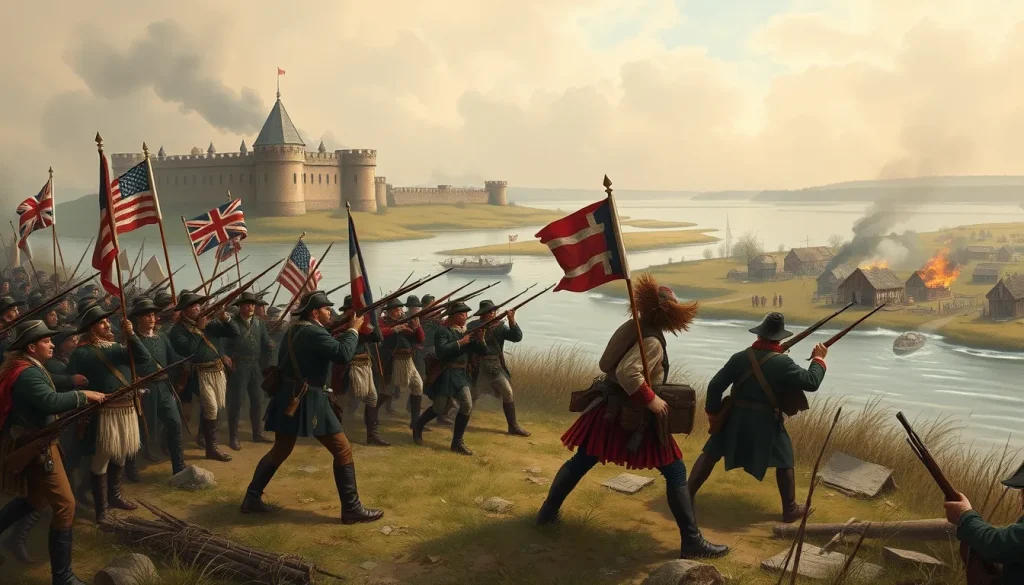
The campaign opened with a well-coordinated American assault on Fort George, the principal British post on the lake side of the Niagara River. On 27 May 1813, a joint army-navy force under Major General Henry Dearborn and Commodore Chauncey landed 2,000 troops south of the fort. The British garrison, outnumbered, abandoned the fort after a sharp fight and retreated westward under Brigadier General Vincent. American forces under Brigadier General W.H. Winder and Colonel Winfield Scott pursued, but the advance was slow, and the British escaped to the west.
The British momentum shifted on the night of 6 June 1813. Lieutenant Colonel John Harvey led a column of about 700 men in a surprise attack on the American encampment at Stoney Creek. In the darkness and confusion, the raiders captured two American generals, Winder and John Chandler, and forced the entire American force to fall back to Fort George. The British then anchored their position at Burlington Heights.
On 24 June 1813, an American column of 575 men under Lieutenant Colonel Charles Boerstler marched toward the British outpost at Beaver Dams, intending to strike at a detachment commanded by Lieutenant James FitzGibbon. However, the Americans were ambushed by a force of approximately 400 Caughnawaga and Mohawk warriors led by Captain Dominique Ducharme. FitzGibbon and his 50 regulars arrived after the fighting, and Boerstler, surrounded and suffering casualties, surrendered. FitzGibbon later acknowledged that “not a shot was fired on our side by any but the Indians.”
The defeated Americans confined themselves to the narrow perimeter around Fort George, and the British established a blockade. In October, after a failed American advance, the British and Canadians remained in control of the Niagara frontier. In December, Brigadier General George McClure, commanding the American garrison at Fort George, ordered the evacuation and burning of the nearby village of Newark (modern Niagara-on-the-Lake), leaving about 400 families homeless in midwinter. In retaliation, British Colonel John Murray launched a night attack on Fort Niagara on 19 December, capturing the fort, and subsequent raids burned the towns of Lewiston, Black Rock, and Buffalo in New York.
Why It Matters
The Niagara Campaign of 1813 demonstrated the fundamental difficulty of the American invasion strategy. Despite initial tactical successes, the Americans failed to capitalize on the capture of Fort George, and their subsequent defeats at Stoney Creek and Beaver Dams highlighted the importance of Indigenous participation and the skill of British regulars. The campaign also escalated the cycle of retaliatory destruction: the burning of Newark led directly to the burning of Niagara frontier towns, and it foreshadowed the burning of Washington in 1814. For the British, the campaign reinforced the value of Indigenous allies and exposed the vulnerability of their position. For Americans, the failures of 1813 pushed leaders to reform the army, leading to the more professional performance of the 1814 Niagara campaign. Historians see the 1813 campaign as a pivotal moment when the war in the Niagara theater became entrenched, with no side gaining lasting advantage.
Prelude
After the American defeat at Queenston Heights in October 1812, both sides prepared for renewed operations. The U.S. Army, under Major General Henry Dearborn, wintered in the Niagara region, while the British strengthened their defenses and awaited reinforcements. Commodore Isaac Chauncey’s naval buildup on Lake Ontario was crucial: he assembled a squadron that outgunned the British, enabling the amphibious attack on Fort George in May 1813. The American plan called for seizing Fort George, then pushing north to capture Burlington Heights and eventually Kingston, but the execution faltered.
Forces and Commanders
American forces included the Army of the North under Major General Henry Dearborn, with brigades commanded by Brigadier General John Chandler, Brigadier General William H. Winder, and Colonel Winfield Scott. The naval squadron under Commodore Isaac Chauncey provided gunfire support and transportation. British forces were led by Brigadier General John Vincent, with detachments under Lieutenant Colonel John Harvey and Lieutenant James FitzGibbon. Indigenous allies, principally Caughnawaga and Mohawk warriors, were led by Captain Dominique Ducharme and other officers from the British Indian Department. The battles involved regular infantry, artillery, militia, and naval forces on both sides.
Battlefield and Map Context
The Niagara River flows north from Lake Erie to Lake Ontario. The key sites included Fort George, located at the northern mouth of the river near the village of Newark; Stoney Creek, a settlement about ten miles west of the fort; and Beaver Dams, an area near modern Thorold, Ontario, where the river meets the Welland River. The river’s steep gorge below Niagara Falls made crossings difficult, while the flatter upper river made landing and movement easier. The Americans used Fort Niagara as a base, while the British held Fort Erie to the south and Fort George to the north, as well as outposts at Chippawa and Queenston.
Battle Chronology
27 May 1813: American amphibious assault captures Fort George. The British retreat to Burlington Heights.
6 June 1813: British night attack at Stoney Creek captures two American generals, forcing American withdrawal to Fort George.
24 June 1813: American column defeated at Beaver Dams by Indigenous warriors, leading to surrender of 575 men.
July–November 1813: Standoff and skirmishing along the frontier; Americans remain confined to Fort George.
10 December 1813: Americans burn Newark (Niagara-on-the-Lake).
19 December 1813: British capture Fort Niagara in a night assault.
December 1813: British burn Lewiston, Black Rock, and Buffalo in retaliation.
Casualties and Losses
Exact casualty figures vary by source. At Fort George, British losses were about 50 killed and wounded; American losses were lighter. At Stoney Creek, American casualties were around 55 killed, wounded, and captured, including the two generals. At Beaver Dams, the Americans lost 25 killed and 550 captured, while the Indigenous and British suffered fewer than 10 casualties. The burning of Newark rendered approximately 400 families homeless. British raids on American towns caused similar destruction and civilian displacement.
Result
The campaign ended in a strategic stalemate. The Americans failed to secure control of the Niagara frontier, and by the end of 1813 they had withdrawn from Fort George, which the British reoccupied. The frontier line returned to essentially its pre-campaign position. No permanent territorial change occurred.
Strategic Consequences
The campaign demonstrated that the United States could not easily conquer Canada and that the British, with Indigenous support, could effectively counter invasions. It also intensified the use of punitive burning as a tactic, setting a precedent for both sides. For the Americans, the failures led to the emergence of more professional officers, particularly Winfield Scott, and to a major reorganization of the army for the 1814 campaign. For the British, the campaign reinforced the importance of naval control on Lake Ontario and the value of flexible, night actions.
Primary Accounts
Contemporary accounts include official reports from Major General Henry Dearborn, Commodore Isaac Chauncey, and British commanders such as John Vincent and John Harvey. The most comprehensive compilation is The Documentary History of the Campaign upon the Niagara Frontier in the Year 1813, edited by Ernest A. Cruikshank and published in 1902 by the Lundy’s Lane Historical Society. This collection contains letters, orders, and reports from both sides. Lieutenant James FitzGibbon’s own letters are also important, as they candidly describe the role of the Indigenous warriors at Beaver Dams.
Battlefield Today
Many sites are preserved in parks and museums. Fort George National Historic Site in Niagara-on-the-Lake, Ontario, is reconstructed and interprets the fort’s history. Stoney Creek Battlefield is part of the Battlefield House and Monument, a national historic site. Beaver Dams is commemorated with a plaque and the historic DeCew House, once a British post. On the American side, Fort Niagara State Park preserves the fortress captured by the British in December 1813. These sites allow visitors to explore the campaign’s terrain and fortifications.
Primary Sources
The most valuable documentary source is the Cruikshank collection, which includes official correspondence, orders, and casualty returns. The National Archives of Canada and the U.S. National Archives also hold original reports. Published memoirs, such as those of Winfield Scott, provide additional perspective, though written years later. For the December raids, local newspaper accounts from the Buffalo area offer eyewitness descriptions of the burning of towns. All these sources must be read with attention to their authors’ national and personal biases.
Further Reading
- Barbuto, Richard V. The Canadian Theater, 1813. U.S. Army Center of Military History, 2013.
- Cruikshank, E.A., ed. The Documentary History of the Campaign upon the Niagara Frontier in the Year 1813. Lundy’s Lane Historical Society, 1902.
- Hickey, Donald R. The War of 1812: A Forgotten Conflict. University of Illinois Press, 1989.
- Latimer, Jon. 1812: War with America. Harvard University Press, 2007.
References
- “The Niagara Campaign – War of 1812,” The War of 1812 Website. https://thewarof1812.org/campaigns/the-niagara-campaign/
- Barbuto, Richard V. The Canadian Theater, 1813. U.S. Army Center of Military History, 2013. https://www.govinfo.gov/content/pkg/GOVPUB-D114-PURL-gpo41603/pdf/GOVPUB-D114-PURL-gpo41603.pdf
- “War of 1812 – The Campaigns of 1813,” WarHistory.org. https://warhistory.org/article/war-of-1812-the-campaigns-of-1813
- Barbuto, Richard V. “The War of 1812 on the Niagara River,” The Army Historical Foundation. https://armyhistory.org/the-war-of-1812-on-the-niagara-river/
- Cruikshank, E.A., ed. The Documentary History of the Campaign upon the Niagara Frontier in the Year 1813. Canadiana. https://www.canadiana.ca/view/oocihm.05285
FAQ
What was the main objective of the 1813 Niagara Campaign?
The American objective was to seize Fort George and control the Niagara River, with the larger goal of invading Upper Canada and eventually capturing Montreal or Kingston.
Why did the American attack on Fort George succeed but later operations fail?
The amphibious landing on May 27 was well-coordinated with naval support, but the failure to aggressively pursue the retreating British allowed them to regroup and counterattack at Stoney Creek.
What role did Indigenous peoples play in the 1813 campaign?
Indigenous warriors, especially Caughnawaga and Mohawk, were crucial in the ambush at Beaver Dams, which led to the surrender of an entire American column and demonstrated their effectiveness in this theater.

Leave a Reply