
Short Answer
The United States declared war on Great Britain on June 18, 1812, after years of escalating grievances over maritime rights, impressment, and British support for Indigenous resistance along the American frontier. This declaration initiated the War of 1812, a conflict that tested the young republic’s independence and reshaped North American geopolitics. The decision was neither unanimous nor inevitable, emerging from a complex mix of diplomatic failure, economic disruption, and domestic political pressure.
Historical Context
The decades before 1812 were dominated by the Napoleonic Wars (1803–1815), in which Britain and France sought to cut off each other’s trade. As a neutral power, the United States profited from carrying goods for both belligerents, but also suffered from their attempts to restrict neutral commerce. Britain’s Orders in Council (1807) and France’s Berlin and Milan Decrees (1806–1807) each sought to blockade the other’s ports, and American ships were caught in the middle. The Royal Navy, short of manpower, also impressed sailors—including American citizens—into service, claiming they were British deserters. The 1807 Chesapeake-Leopard affair, in which a British ship attacked an American warship, inflamed public opinion. Simultaneously, American settlers pushed westward into territories inhabited by Indigenous nations, who in turn received support and supplies from British posts in Canada. These converging pressures created a powerful case for war among those who believed the nation’s independence and honor were at stake.
What Happened
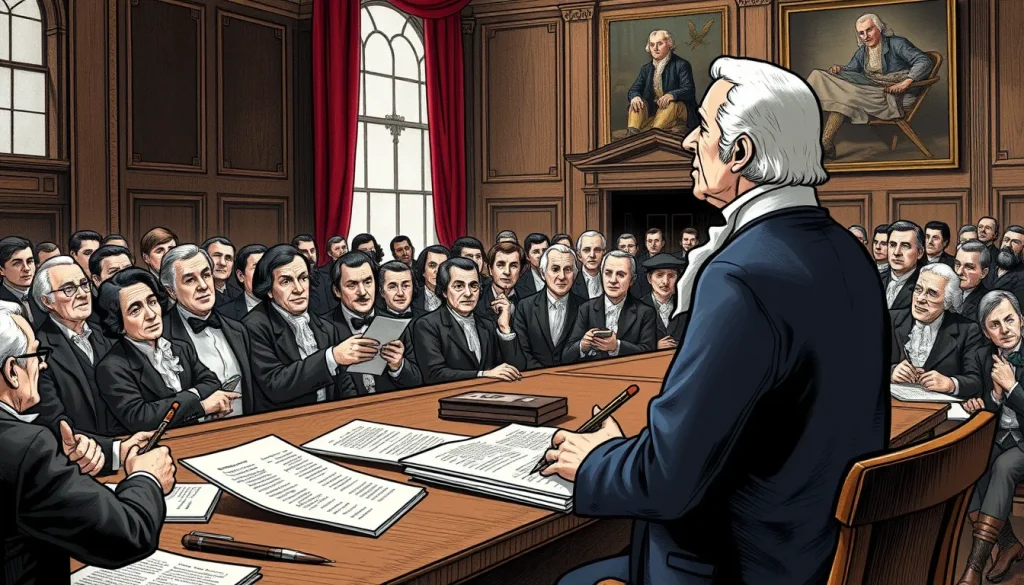
President James Madison, after years of attempting economic coercion through embargoes, sent a special message to Congress on June 1, 1812. He listed grievances: violations of neutral rights, impressment of American sailors, and British encouragement of Indian warfare on the frontier. The House of Representatives debated and on June 4 voted 79 to 49 for a declaration of war. The Senate debated more than two weeks, narrowly defeating a proposal for a limited naval war, and on June 17 voted 19 to 13 in favor. Madison signed the declaration the next day. The vote was sharply partisan: all Federalists opposed it, while most Republicans supported it. The country was divided, especially in New England, where shipping interests feared economic ruin. The first military actions were an attempted invasion of Canada in the summer of 1812, which failed, and later naval victories that boosted American morale.
Why It Matters
The declaration of war launched a conflict that ended in a stalemate at the Treaty of Ghent (1814), with no territorial changes. Yet it had profound consequences: it cemented a sense of American national identity, broke Indigenous resistance in the Old Northwest, and confirmed the United States’s place among nations. The war also revealed deep domestic divisions and led to a resurgence of Federalist opposition, culminating in the Hartford Convention of 1814. Historians debate the relative importance of the causes—whether it was primarily a war for maritime rights, for territorial expansion, or for national honor—and the degree to which Britain’s unilateral repeal of the Orders in Council on June 23, 1812, might have made the declaration premature.
Definition
The question “Why did the United States declare war on Britain?” refers to the set of reasons and political processes that led Congress to issue the first declaration of war under the U.S. Constitution on June 18, 1812. It encompasses the immediate grievances, the diplomatic failures, and the domestic political calculations that brought the United States into conflict with the world’s leading naval power.
Background
The roots of the declaration lie in the U.S. response to the Napoleonic Wars. Britain’s Royal Navy, seeking to deny France supplies, enforced a loose blockade of continental Europe and enforced the Rule of 1756, which restricted neutral trade with enemy colonies. Impressment, the forced recruitment of sailors, was a long-standing practice intended to reclaim British deserters but it caught thousands of American-born sailors. Furthermore, the British maintained posts along the Great Lakes and in Canada and supplied Indigenous peoples resisting American expansion. The failure of diplomatic negotiations, including the Monroe-Pinkney Treaty of 1806, and the ineffectiveness of the Embargo Act of 1807 and the Non-Intercourse Act of 1809, set the stage for a military response.
How It Worked
The causes of the declaration did not operate in isolation; they reinforced each other. Economic losses from seizure of ships and cargoes hurt American commerce, especially in the South and West. Impressment offended national honor and sovereignty. The perception of British instigation of Indian attacks on frontier settlements—most notably the Battle of Tippecanoe in 1811—fused with expansionist desires for Canada, which many War Hawks saw as part of a providential destiny. President Madison, facing a reelection campaign and pressured by a vocal group of young congressmen known as War Hawks, concluded that peaceful coercion had failed and that war was necessary to claim the nation’s rights.
Competing Viewpoints
Contemporary Americans differed on the wisdom of war. War Hawks, like Henry Clay and John C. Calhoun, argued that the country had to resist British tyranny and that Canada could be easily conquered. New England Federalists, however, saw war as destructive to trade and maintained close commercial ties with Britain. The British government, as expressed in the Prince Regent’s declaration of 1813, insisted that its maritime measures were a necessary response to French decrees, that impressment was only a claim to its own subjects, and that the United States had exaggerated the Indian issue. Modern historians debate whether the war was driven primarily by maritime grievances or by expansionist ambitions, with some emphasizing the role of frontier settlers and Indigenous conflicts.
Role in the War of 1812
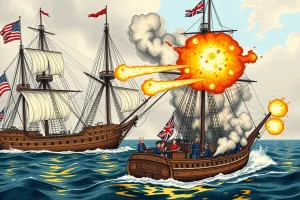
The declaration of war directly initiated the armed conflict. The U.S. strategy, reflecting the causes, was to invade Canada to force Britain to respect neutral rights and to break the alleged British-Indian alliance. The first campaigns in 1812 and 1813 failed, largely due to poor planning, inadequate forces, and strong British and Canadian resistance, supported by Indigenous allies. The war expanded to include naval battles, blockades, and eventually the British raid on Washington, D.C., in 1814. The causes also shaped the peace negotiations at Ghent, where American negotiators dropped demands regarding impressment and neutrality as the war’s costs mounted.
Consequences and Historical Interpretation
Historians have long debated the relative importance of the causes. While impressment and Orders in Council were the stated causes, some scholars argue that the real U.S. goal was territorial expansion into Canada and the destruction of indigenous resistance, while others see it as a defense of republican sovereignty against British maritime dominance. The war’s outcome—a return to the status quo ante bellum—led many contemporary Americans to claim victory, but later historians often view it as a costly and pointless conflict. The declaration also set a precedent for congressional war powers and contributed to the eventual rise of a distinct Canadian identity.
Primary Sources
Key primary sources include President Madison’s message to Congress of June 1, 1812, which enumerated the grievances; the House Foreign Relations Committee report of June 3, 1812, often called the “War Manifesto,” which recommended war; the official declaration of war signed by Madison on June 18; and the British Prince Regent’s declaration of February 3, 1813, presented in Parliament, which gave the British perspective. The National Archives houses the original documents, and the Congressional debates are recorded in the Annals of Congress. These sources reveal the passionate arguments and the partisan divisions of the era.
Further Reading
- Hickey, Donald R. The War of 1812: A Forgotten Conflict. University of Illinois Press.
- Stagg, J.C.A. Mr. Madison’s War: Politics, Diplomacy, and Warfare in the Early American Republic. Princeton University Press.
- Taylor, Alan. The Civil War of 1812: American Citizens, British Subjects, Irish Rebels, & Indian Allies. Alfred A. Knopf.
- United States National Archives. “1812: Congress’s First Declaration of War Under the Constitution.” Educational resources.
References
- National Park Service. “Causes of War.” Star-Spangled Banner National Historic Trail. Accessed June 2023. https://www.nps.gov/stsp/learn/historyculture/causes-of-war.htm
- Lindsay, James M. “The United States Declares War on Britain in 1812.” Council on Foreign Relations. Published June 18, 2026. https://www.cfr.org/articles/the-united-states-declares-war-on-britain-in-1812
- “Causes of the War of 1812.” American Experience, Smithsonian Institution. PDF. https://americanexperience.si.edu/wp-content/uploads/2014/10/Causes-of-the-War-of-1812_.pdf
- “1812: Congress’s First Declaration of War Under the Constitution.” National Archives and Records Administration. Handout 3: War Manifesto. https://www.archives.gov/files/legislative/resources/education/1812/handout3.pdf
- “Declaration of His Royal Highness the Prince Regent…” Hansard, 3 February 1813. https://api.parliament.uk/historic-hansard/commons/1813/feb/03/declaration-of-his-royal-highness-the
FAQ
What were the immediate causes of the U.S. declaration of war in 1812?
The immediate causes were British impressment of American sailors, seizure of American ships and cargoes under the Orders in Council, and British support for Indigenous attacks on American frontier settlements.
How did Congress vote on the declaration of war?
The House approved on June 4, 1812, by 79–49, and the Senate approved on June 17 by 19–13. The declaration was signed by President Madison on June 18.
Did Britain repeal the Orders in Council before the war?
Yes, Britain suspended the Orders in Council on June 23, 1812, but word did not reach the United States until after the declaration was issued. This made the war seem avoidable in hindsight.

Leave a Reply