Short Answer
The Embargo Act of 1807 was a U.S. law enacted on December 22, 1807, that prohibited American ships from departing for foreign ports in an effort to protect American commerce from European belligerent harassment during the Napoleonic Wars. President Thomas Jefferson and Secretary of State James Madison supported the embargo as an alternative to war, but the policy devastated the American economy and contributed directly to the tensions that led to the War of 1812.
Historical Context
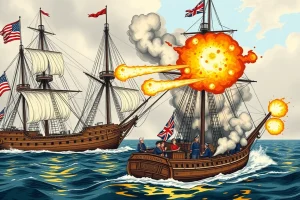
In the early 1800s, the United States remained a young and militarily weak republic, dependent on overseas trade while Europe was engulfed in the Napoleonic Wars between Great Britain and France. Both belligerents sought to cut off American supplies from their enemy. Britain issued the Orders in Council, which blocked neutral trade with France and its colonies, while France issued the Berlin Decree and later the Milan Decree, threatening to seize any neutral vessel that complied with British regulations. American merchants, who profited heavily from carrying goods between European colonies and the continent, faced the risk of having their ships and cargoes confiscated by both sides. The Royal Navy also impressed (conscripted) American sailors, claiming that they were British deserters. The Chesapeake-Leopard affair of June 22, 1807, when a British warship fired on the U.S. Navy frigate USS Chesapeake and removed four crewmen, brought the two countries to the brink of war and intensified American outrage.
What Happened
In response to the deteriorating situation, President Jefferson called Congress into an early session in October 1807. After receiving dispatches about new French and British decrees, Jefferson sent a message on December 17, 1807, recommending an “inhibition of the departure of our vessels from the ports of the United States.” Congress acted quickly. The Senate passed the embargo bill in a four-hour secret session by a vote of 22 to 6, and the House of Representatives, after three days of closed-door debate, passed it 82 to 44. The Embargo Act became law on December 22, 1807.
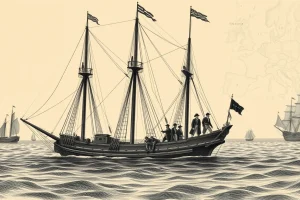
The act prohibited American vessels from sailing to foreign ports and required all American ships abroad to return home. It applied to both foreign and domestic ships in U.S. harbors, though coastal trade was allowed with restrictions. The goal was to withhold American exports from Britain and France, thereby forcing them to respect American neutral rights. However, enforcement proved difficult. Smuggling flourished, particularly along the Canadian border and through Florida, where merchants evaded the law. In April 1808, Jefferson issued a proclamation ordering military force to suppress insurrections against the embargo, particularly in Lake Champlain and northeastern New York. Congress passed additional enforcement acts in early 1809, but the embargo were repealed in March 1809, replaced by the Non-Intercourse Act, which reopened trade with all nations except Britain and France.
Why It Matters
The Embargo Act of 1807 is historically significant because it was the most ambitious attempt by the United States to use economic coercion to achieve foreign policy goals without military force. It failed in its immediate purpose: neither Britain nor France changed its maritime policies. Instead, the embargo had severe domestic consequences. American exports dropped from an estimated $108 million in 1807 to $22 million in 1808, causing widespread unemployment and depression in port cities and agricultural regions that relied on export markets. The Federalist Party, centered in New England, gained political support as communities suffered. The embargo also intensified sectional conflict and demonstrated the limitations of peaceful coercion. The failure of the embargo and subsequent trade restrictions, combined with continued impressment and British support for Native American resistance in the Northwest, contributed to the mounting grievances that led the United States to declare war on Britain on June 18, 1812.
Definition
The Embargo Act of 1807 was a prohibition on all foreign-bound shipping from the United States. It was a commercial restriction intended to safeguard American vessels from seizure and to pressure European belligerents by denying them American agricultural and manufactured exports.
Background
The embargo arose from the escalating commercial warfare between Britain and France during the Napoleonic Wars. The British Orders in Council (first issued in 1793 and renewed in 1807) required neutral ships to obtain a license from British authorities if they were to trade with France or French colonies, effectively blockading the European continent. France responded with the Berlin Decree (1806) and Milan Decree (1807), which declared any neutral vessel that submitted to British search liable to seizure. American merchants, who had prospered as neutral carriers, saw their ships seized and cargoes confiscated by both belligerents. The U.S. attempted diplomacy through the Monroe-Pinkney Treaty (1806), which Jefferson rejected because it did not address impressment. The Chesapeake-Leopard affair further inflamed American anger, and Jefferson, a fiscal conservative and opponent of costly military buildup, turned to economic coercion as a way to defend neutral rights.
How It Worked
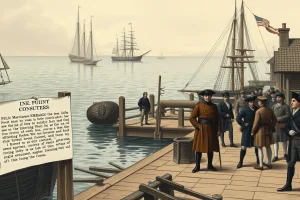
Under the Embargo Act, no vessel, whether American-owned or foreign, was permitted to depart for a foreign port from any U.S. harbor. Ships already abroad were ordered to return. The law allowed coastal trade, but even that was often restricted because captains had to post bonds guaranteeing that their cargo would not be delivered to a foreign port. Violations could result in forfeiture of ship and cargo. The federal government authorized revenue cutters and the U.S. Navy to enforce the law. Subsequent Enforcement Acts in January and February 1809 increased penalties, empowered customs officers to seize goods suspected of being destined for export, and authorized the use of the militia to suppress opposition. Nevertheless, smuggling remained rampant, especially across the Canadian border and to Spanish Florida, because the potential profits outweighed the risks.
Competing Viewpoints
Contemporaries and historians have debated the wisdom of the embargo. During the embargo period, Democratic-Republicans, including Jefferson and Madison, argued that it was a peaceful and rational measure to protect American seamen and ships while avoiding war. They believed that American goods were vital to Britain’s war economy and that the pressure of losing them would force the belligerents to respect American neutrality. Federalists, particularly in New England, condemned the embargo as unconstitutional, authoritarian, and destructive to commerce. They argued that it hurt the United States more than Europe and that it exceeded the federal government’s legitimate powers. Later historians generally view the embargo as a failure as a coercive tool, but some note that it temporarily kept the United States out of war and allowed the nation to prepare for eventual conflict. Others emphasize that the embargo had the unintended effect of harming American farmers and merchants, strengthening the Federalist Party, and setting a precedent for future trade sanctions.
Role in the War of 1812
The Embargo Act and its successors (the Non-Intercourse Act of 1809 and Macon’s Bill No. 2 in 1810) were central to the diplomatic breakdown that preceded the War of 1812. The embargo failed to win concessions from Britain, which continued impressment and Orders in Council. The American economy suffered, and the United States was unable to protect its commerce by peaceful means. In 1811, American ships and sailors continued to be seized, and tensions grew over British support for Native American confederations in the Northwest, culminating in the Battle of Tippecanoe in November 1811. The failure of trade restrictions convinced many in the so-called War Hawks, such as Henry Clay and John C. Calhoun, that economic coercion must be replaced by military force. When President James Madison declared war on Britain in June 1812, the embargo’s legacy was one of diplomatic frustration and a demonstration that the United States was unwilling to abandon trade as a vital national interest.
Consequences and Historical Interpretation
The immediate consequence of the embargo was economic depression in the United States, particularly in maritime states. It also led to widespread smuggling, which eroded respect for federal law. The embargo had diplomatic consequences, but not the desired ones: both Britain and France viewed it as a sign of weakness and continued their restrictive policies. Historians have interpreted the embargo as an early example of economic sanctions used as a foreign-policy tool, and its failure is often contrasted with the later success of trade embargoes in other contexts. The embargo also revealed the deep divisions in American politics and society, as regional interests clashed over what course to take. In the long term, the embargo contributed to the political decline of the Federalist Party, but it also set a precedent for federal interference in commerce that would have lasting constitutional implications.
Primary Sources
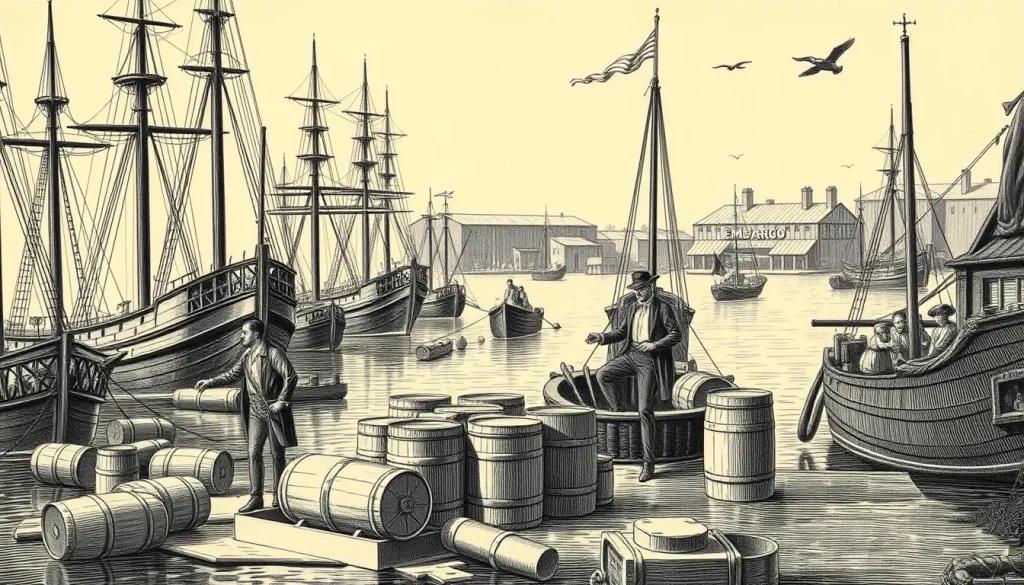
Key primary sources include President Jefferson’s message to Congress on December 17, 1807, in which he recommended an embargo, and the text of the Embargo Act itself, passed on December 22, 1807. Jefferson’s proclamation of April 19, 1808, ordering enforcement against smugglers on Lake Champlain, provides insight into the difficulties of implementation. Contemporary newspaper editorials and congressional debates document the controversy. A notable primary document is the etching by Alexander Anderson, “Embargo,” which satirizes the law’s impact. The National Archives holds the original legislation, and the Library of Congress provides access to the Annals of Congress containing the debates. These sources must be read with an understanding of their biases: Jefferson’s message emphasizes the danger to American commerce, while Federalist critics attacked the embargo’s constitutionality and economic effects.
Further Reading
- Burton Spivak, Jefferson’s English Crisis: Commerce, Embargo, and the Republican Revolution (1979).
- Donald R. Hickey, The War of 1812: A Forgotten Conflict (1989), provides context on the embargo’s role.
- Dumas Malone, Jefferson as President: The Sage of Monticello (1970).
- American Battlefield Trust, “Embargos: Economic Warfare on the Eve of the War of 1812” (2024) at battlefields.org.
- Teaching American History, “The Embargo Act” (edited by Stephen F. Knott) at teachingamericanhistory.org.
References
- Britannica, “Embargo Act” (https://www.britannica.com/topic/Embargo-Act).
- American Battlefield Trust, “Embargos: Economic Warfare on the Eve of the War of 1812” (https://www.battlefields.org/learn/articles/embargos-economic-warfare-eve-war-1812).
- Teaching American History, “The Embargo Act” (https://teachingamericanhistory.org/document/the-embargo-act/).
- Harper’s Encyclopedia of United States History, “Embargo acts” (https://www.perseus.tufts.edu/hopper/text?doc=Perseus%3Atext%3A2001.05.0132%3Aentry%3Dembargo-acts).
FAQ
Why was the Embargo Act of 1807 passed?
It was enacted to protect American ships and sailors from seizures by British and French warships and privateers during the Napoleonic Wars, an d to force the belligerents to respect American neutral rights.
Did the Embargo Act succeed in its goals?
No. It failed to change British or French policies, and instead caused severe economic hardship in the United States, leading to widespread smuggling and political opposition.
How did the Embargo Act contribute to the War of 1812?
The embargo's failure demonstrated the ineffectiveness of peaceful coercion and increased frustration with Britain, especially over impressment and trade restrictions. This contributed to the momentum for a declaration of war in 1812.
Leave a Reply