Short Answer
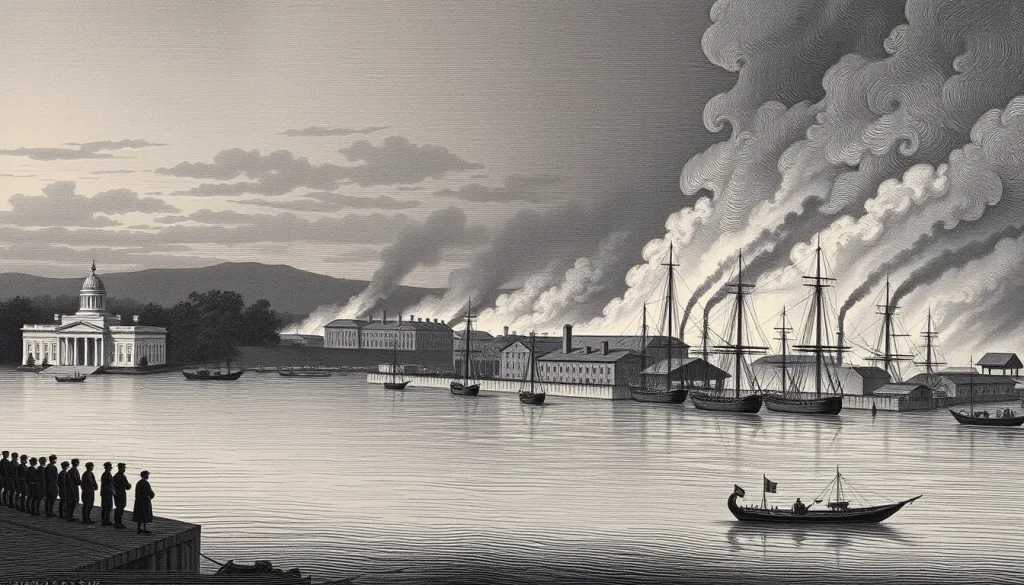
The Washington Navy Yard, authorized in 1799 and built along the Eastern Branch of the Potomac River (now the Anacostia), was the United States Navy’s first permanent shore establishment. During the War of 1812, it became a principal refitting and supply station for American warships, but on August 24, 1814, as British troops neared the capital, Commodore Thomas Tingey ordered the yard set ablaze to deny its resources to the enemy. The resulting inferno consumed unfinished ships and warehouses, leaving the yard a smoking ruin and marking a pivotal moment in the Burning of Washington.
Historical Context
The Navy Yard was established under the Naval Act of 1798, with land purchased under an act of July 23, 1798, and transferred to the Navy on October 2, 1799. It quickly became the Navy’s largest shipbuilding and shipfitting facility, constructing or fitting out twenty-two vessels, including the frigate USS Constitution, which refitted there in 1812 before its famous victories. The yard’s location on the Eastern Branch provided deep water and proximity to the federal government, but also left it vulnerable to attack from the Chesapeake Bay. By the summer of 1814, after Napoleon’s abdication in April, Britain dispatched thousands of battle-hardened veterans to the Chesapeake. Rear Admiral George Cockburn and Major General Robert Ross led a campaign that swept through tidewater Virginia and Maryland, and on August 24, 1814, they defeated American militia at Bladensburg, removing the last obstacle to Washington. The capital was defenseless, and the navy yard, filled with valuable stores and unfinished ships, lay directly in the path of the British advance.
What Happened
As the British entered Washington on the evening of August 24, 1814, Commodore Tingey recognized that the yard could not be defended. With the concurrence of President James Madison and Secretary of the Navy William Jones, he gave the order to destroy the yard. American sailors and workers set fire to the unfinished ship-of-the-line USS Columbia and the frigate USS Argus, along with extensive naval stores, timber, and buildings. The flames quickly spread, consuming most of the facility. The conflagration was so intense that British troops, approaching from Capitol Hill, saw the glow in the sky and assumed American forces were responsible; they did not need to torch the yard themselves. However, the British did set fire to other public buildings, including the Capitol and the White House, as part of the broader attack. The navy yard’s destruction was almost total: only the Latrobe Gate, Tingey’s quarters (now Quarters A), the adjoining offices, the barracks, and the small schooner Lynx survived. After the flames died down, local civilians looted remaining valuables, and Tingey later recommended raising the eastern wall to deter future theft.
Why It Matters
The burning of the navy yard denied the British a potentially valuable prize, but it also demonstrated the desperate measures Americans took to prevent enemy capture. The event highlighted the vulnerability of the capital and the navy’s inability to protect its own shore installations. In the immediate aftermath, the yard was left in ruins, and its shipbuilding role effectively ended. In May 1815, the Board of Naval Commissioners decided that the yard’s location, with shallow water and distance from the sea, was unsuitable for a major naval base. Instead, it was restructured as an ordnance and technology center, eventually evolving into the U.S. Naval Gun Factory, which produced weapons for the Navy for over a century. The fire thus marks a decisive turning point in the yard’s history, from a shipyard to an industrial arsenal, and underscores the broader consequences of the War of 1812 for American defense policy.
Historical Map Context
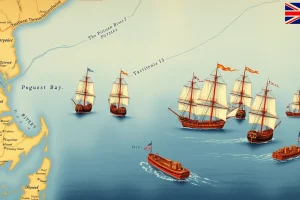
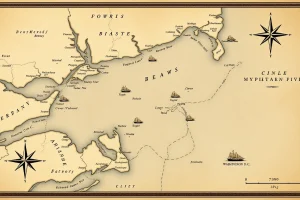
In 1814, the Washington Navy Yard occupied approximately forty acres along the Eastern Branch of the Potomac River, bounded on the north by 9th Street and on the west by the river, with marshland to the west and the developing city of Washington to the north. The yard included ship houses, launching ways, workshops, and a ropewalk, laid out around a central square. Its location made it strategically important yet exposed: British forces advancing from Bladensburg could approach it directly down Maryland Avenue. Modern maps of the period show the yard as a compact facility on the riverfront, with the Capitol and White House nearby.
Modern Location
The Washington Navy Yard today sits in Southeast Washington, D.C., still bounded by 9th and M Streets, though landfill has extended its southern edge into the Anacostia River. It operates as an active naval support base and ceremonial center, housing the Chief of Naval Operations and other commands. The historic district preserves many buildings, including the Latrobe Gate (a 19th-century gateway) and Tingey House (Quarters A), both of which survived the 1814 fire. Visitors can explore the area, though access is restricted as it is a working military installation.
Events at the Site
Beyond the burning, the yard was the site of numerous wartime activities. In 1812, the USS Constitution arrived to be refitted and fitted out for combat, receiving copper sheathing and other upgrades. Robert Fulton conducted experiments with his clockwork torpedo at the yard during the conflict. In the weeks before the August 24 fire, the yard served as a staging point for the American Chesapeake Flotilla under Joshua Barney, though that force was defeated and scattered on the Patuxent River. After the destruction, the yard was slowly rebuilt, and by 1815 it hosted early steam engines and began manufacturing ordnance. The site was also the location where, in later years, the body of John Wilkes Booth was examined aboard a monitor moored there (1865), but that is outside the War of 1812 period.
Associated People
Several individuals shaped the yard’s wartime story. Commodore Thomas Tingey served as commandant from 1799 until 1829, overseeing its construction and its destruction. He is remembered for his decisive action to burn the yard. Captain John Cassin, who commanded the yard’s ships in ordinary, assisted in the evacuation and burning. Secretary of the Navy William Jones and President James Madison authorized the destruction. On the British side, Rear Admiral George Cockburn and Major General Robert Ross led the land force that threatened Washington and observed the yard’s flames. Joshua Barney, though not directly at the yard, commanded the Chesapeake Flotilla that operated nearby and delayed British movements.
Surviving Monuments and Site
The most prominent surviving feature from the War of 1812 is the Latrobe Gate, designed by Benjamin Latrobe and completed in 1806, which served as the main entrance. Tingey House (Quarters A) also survived, as did the north wall built in 1809. The white brick wall that still surrounds part of the yard originally marked its boundary. After the fire, the yard was rebuilt and eventually became a National Historic Landmark district, designated a Category II Landmark by the Joint Committee on Landmarks. The U.S. Navy maintains exhibits and interprets the site’s history, including its role in the War of 1812.
Primary Sources
Key contemporary documents include Commodore Tingey’s official report to Secretary William Jones, written shortly after the fire, detailing the decision to burn and the extent of losses. Rear Admiral Cockburn’s and Major General Ross’s correspondence with their superiors provides a British perspective on the attack and the visible destruction. The U.S. Navy’s published series Naval Documents of the War of 1812 (Naval Historical Center) includes many of these letters and reports. Additional accounts come from eyewitnesses such as local residents and sailors; for instance, the diary of Michael Shiner, a free Black employee at the yard, later recalled the event, though his memoir was written years afterward. These sources must be read with awareness of command responsibilities and patriotic biases, but together they establish the facts.
Further Reading
- Marolda, Edward J. The Washington Navy Yard: An Illustrated History. Washington: Naval Historical Center, 1999.
- National Park Service. “1814 Chesapeake Campaign.” Star-Spangled Banner National Historic Trail, Accessed 2025. [https://www.nps.gov/stsp/learn/historyculture/1814-chesapeake-campaign.htm](https://www.nps.gov/stsp/learn/historyculture/1814-chesapeake-campaign.htm)
- Leahy, W.D. “Early History of the Washington Navy Yard.” U.S. Naval Institute Proceedings 54, no. 10 (October 1928).
- U.S. Navy. “History of the Washington Navy Yard.” Naval History and Heritage Command, archived October 2014. [web.archive.org/web/20141025120748/http://www.history.navy.mil/faqs/faq52-1.htm](https://web.archive.org/web/20141025120748/http://www.history.navy.mil/faqs/faq52-1.htm)
- Naval District Washington. “History.” Accessed 2025. [https://ndw.cnic.navy.mil/Installations/NSA-Washington/About/History/](https://ndw.cnic.navy.mil/Installations/NSA-Washington/About/History/)
References
- Marolda, Edward J. The Washington Navy Yard: An Illustrated History. Naval Historical Center, 1999.
- National Park Service. “1814 Chesapeake Campaign.” Accessed 2025. https://www.nps.gov/stsp/learn/historyculture/1814-chesapeake-campaign.htm
- Naval District Washington. “History.” Accessed 2025. https://ndw.cnic.navy.mil/Installations/NSA-Washington/About/History/
- Leahy, W.D. “Early History of the Washington Navy Yard.” Proceedings 54, no. 10 (October 1928). https://www.usni.org/magazines/proceedings/1928/october/early-history-washington-navy-yard
- Naval History and Heritage Command. “History of the Washington Navy Yard.” Archived October 25, 2014. https://web.archive.org/web/20141025120748/http://www.history.navy.mil/faqs/faq52-1.htm
FAQ
Why was the Washington Navy Yard burned in 1814?
Commodore Thomas Tingey ordered the yard destroyed to prevent it from falling into British hands. With British troops entering Washington after the Battle of Bladensburg, the yard could not be defended, and burning it denied the enemy valuable ships, supplies, and facilities.
What was lost in the fire at the Washington Navy Yard?
The fire consumed the unfinished ships USS Columbia and USS Argus, along with most of the yard’s buildings, naval stores, and equipment. Only the Latrobe Gate, Tingey's quarters, and a few structures survived.
How did the War of 1812 affect the Washington Navy Yard's future?
After the war, the yard's shipbuilding role was abandoned due to shallow water and vulnerability. It was repurposed as an ordnance and technology center, eventually becoming the U.S. Naval Gun Factory, which produced weapons for the Navy for over a century.
Leave a Reply