
Short Answer
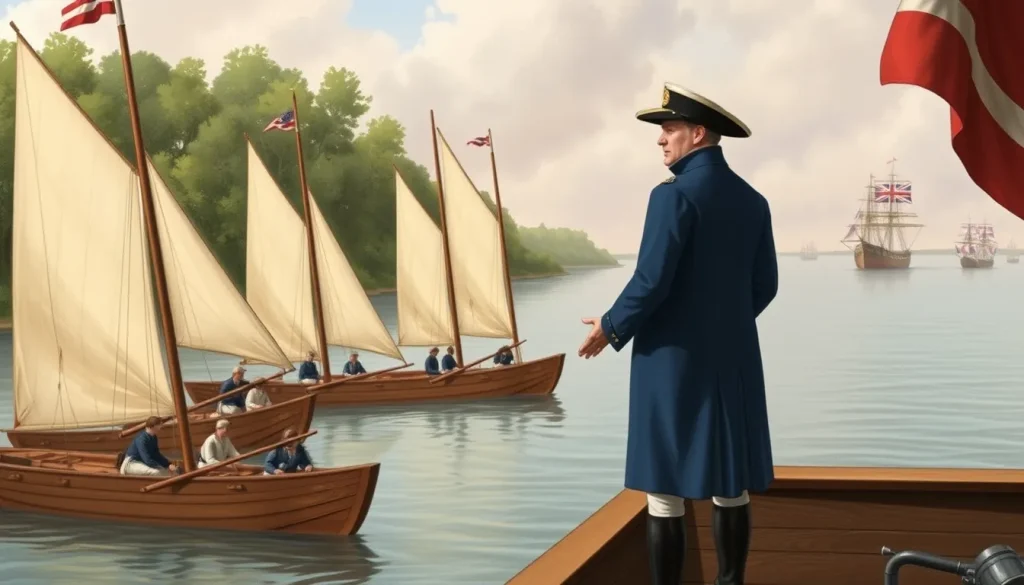
Joshua Barney, a veteran of the American Revolution and a prominent privateer, commanded the Chesapeake Flotilla, a U.S. naval force of shallow-draft barges and gunboats, during the War of 1812. Formed in 1813–1814 to defend the Chesapeake Bay against British raids, the flotilla engaged British forces along the Patuxent River and played a crucial, though ultimately unsuccessful, role in delaying the British advance on Washington. Its actions, particularly at St. Leonard’s Creek and the Battle of Bladensburg, became part of American naval lore.
Historical Context
After the United States declared war on Britain in June 1812, the Royal Navy quickly established dominance along the American coast. By 1813, British squadrons, under the command of Rear Admiral Sir George Cockburn, were raiding towns and plantations throughout the Chesapeake Bay, seizing supplies, burning vessels, and disrupting commerce. The U.S. Navy, focused on the Atlantic and the Great Lakes, had little presence in the bay. American coastal defenses were almost nonexistent, and local militia proved unreliable. The British raids created panic and economic hardship, and the federal government—then located in Washington—was vulnerable to attack from the sea. In this context, Joshua Barney, a Revolutionary War hero with a controversial recent history, proposed creating a “flying squadron” of light, fast vessels that could operate in the shallow waters of the bay and harass the British where their larger ships could not follow.
What Happened
Barney, who had served as a privateer early in the war, submitted a detailed proposal to Secretary of the Navy William Jones on July 4, 1813. He advocated building barges and row galleys that drew little water, carried a single heavy gun, and could be rowed or sailed into shoal waters. Jones, desperate for a defense against Cockburn, approved the plan and placed Barney in command of what became known as the Chesapeake Flotilla, or the “mosquito fleet.” The flotilla was not part of the regular Navy but a separate service, the Flotilla Service of the United States.
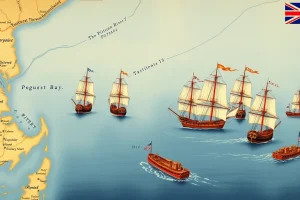
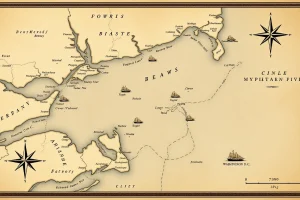
By late May 1814, Barney had assembled a force of approximately 15 to 18 vessels, including the cutter Scorpion as his flagship, along with gunboats, barges, and a lookout boat. He established a base on the Patuxent River. On June 1, while attempting to move down the bay, the flotilla was trapped by a superior British squadron near Cedar Point, forcing Barney to retreat up the Patuxent into St. Leonard’s Creek. British barges attacked on June 10, but Barney counterattacked and drove them off, immobilizing the schooner St. Lawrence. For the rest of June, the British blockaded the creek, and Barney’s men and a few soldiers established shore batteries on the cliffs. On June 26, with the help of U.S. Army and Marine artillery onshore, Barney’s flotilla broke out, firing on the British frigates and allowing the Americans to escape up the Patuxent.
Throughout July, the flotilla moved further upriver, while British land forces and marines raided adjacent counties. By mid-August, the British, now under Rear Admiral George Cockburn and Major General Robert Ross, landed at Benedict, Maryland, and marched toward Washington. Barney’s flotilla, now trapped at Pig Point, was scuttled and burned on August 22 to prevent capture. The flotillamen then joined the American forces assembling at Bladensburg. At the Battle of Bladensburg on August 24, 1814, Barney and his sailors manned a battery of naval guns and held off British infantry for a time, but overall the American line collapsed. Barney was seriously wounded and captured, though later paroled. After the battle, the British burned Washington.
After recovering, Barney and many of his flotillamen were marched to Baltimore to help defend the city. A detachment of about 60 men from the flotilla’s 2nd Naval Regiment, commanded by Sailing Master Solomon Rodman, manned the water battery at Fort McHenry during the British bombardment on September 13–14, 1814.
Why It Matters
The Chesapeake Flotilla, though small and ultimately destroyed, had significant military and symbolic effects. It forced the British to divert resources to counter it, delayed their advance on Washington, and demonstrated that the shallow waters of the bay could be contested. The flotilla’s breakout at St. Leonard’s Creek was a notable American tactical success against a superior force. However, its ultimate inability to stop the British and the subsequent burning of Washington exposed the strategic weakness of the U.S. coastal defense. In historical memory, Barney and his flotillamen are often celebrated for their courage and determination, particularly at Bladensburg, where they briefly checked the British advance. The story of the flotilla also highlights the contributions of the many African Americans and runaway slaves who served in its ranks.
Early Life
Joshua Barney was born on July 6, 1759, on a farm along the Patapsco River near Baltimore, Maryland, one of fourteen children. He took to the sea early, apprenticing under his brother-in-law, a merchant ship captain. By age 15, he had assumed command of a damaged ship after his captain’s death. During the American Revolution, Barney joined the Continental Navy, became a captain, and distinguished himself in several actions, including the capture of the HMS General Monk in 1782. He was captured and escaped multiple times. After the war, he was offered a commission in the new U.S. Navy but declined due to a dispute over seniority.
Role Before the War
In the decades before 1812, Barney engaged in privateering (including service with the French navy in the Caribbean), the slave trade, and various business ventures. He owned enslaved people and was a slave owner for much of his life. His political ambitions were hampered by these affairs and by accusations of disloyalty. By 1812, he had retired to a farm near Elkridge, Maryland, but welcomed the opportunity to return to sea.
Role During the War
Barney commanded the privateer Rossie in 1812, capturing numerous British prizes. In 1813, after proposing his barge plan, he was appointed acting master commandant, later promoted to captain in the Flotilla Service. From early 1814, he organized and led the Chesapeake Flotilla.
Major Actions
The flotilla’s principal engagements were at St. Leonard’s Creek (June 10 and June 26, 1814), followed by the breakout and retreat up the Patuxent. The decisive action in the flotilla’s history was the scuttling at Pig Point and Barney’s subsequent stand at the Battle of Bladensburg, where he was wounded and captured. The flotillamen later participated in the defense of Baltimore, particularly at Fort McHenry.
Contemporary Accounts
Barney’s July 4, 1813 letter to Secretary Jones is a key primary document outlining the rationale for the flotilla. British officers’ reports, particularly those of Cockburn, acknowledged the nuisance posed by the American barges. American newspapers of the day, such as the American & Commercial Daily Advertiser, ran advertisements for flotilla recruits, indicating the force’s public profile.
Later Life
After the war, Barney was released from parole and retired to his farm. He died on December 1, 1818, in Pittsburgh, Pennsylvania, while traveling on business. He is buried in Pittsburgh.
Historical Legacy
Barney is remembered as a bold and capable naval officer, and his flotilla is regarded as an example of asymmetric warfare. The archaeological study of the flotilla’s scuttled vessels, such as the Scorpion, has contributed to a modern appreciation of the campaign. Donald G. Shomette’s book Flotilla remains the standard account. The flotilla’s legacy also includes its diverse crew, including African Americans, who served under Barney.
Primary Sources
Key period documents include Joshua Barney’s letter to Secretary of the Navy William Jones (July 4, 1813), in which he proposed the barge flotilla. This letter is held in the National Archives and is widely quoted in historical works. Official reports from Barney to Jones, such as those describing the June 26, 1814 breakout, are also preserved. British records from Rear Admiral Cockburn’s squadron report the engagements. Additionally, the American & Commercial Daily Advertiser of March 1, 1814, printed a recruitment advertisement for the flotilla, now reproduced by the Maryland State Archives.
Further Reading
- Shomette, Donald G. Flotilla: The Patuxent Naval Campaign in the War of 1812. Johns Hopkins University Press, 2009.
- National Park Service. “The Chesapeake Flotilla.” Fort McHenry National Monument and Historic Shrine. https://www.nps.gov/fomc/learn/historyculture/chesapeake-flotilla.htm
- National Park Service. “Joshua Barney.” Star-Spangled Banner National Historic Trail. https://www.nps.gov/stsp/learn/historyculture/joshua-barney.htm
- Eden, Steven. “Commodore Barney at the Bladensburg Races.” Naval History 24, no. 5 (October 2010).
References
- “The Chesapeake Flotilla.” National Park Service. Fort McHenry National Monument and Historic Shrine. Accessed 2023. https://www.nps.gov/fomc/learn/historyculture/chesapeake-flotilla.htm
- “Joshua Barney.” National Park Service. Star-Spangled Banner National Historic Trail. Accessed 2023. https://www.nps.gov/stsp/learn/historyculture/joshua-barney.htm
- “Barney’s Flotilla.” White House Historical Association. Accessed 2023. https://www.whitehousehistory.org/barneys-flotilla
- Eden, Steven. “Commodore Barney at the Bladensburg Races.” Naval History 24, no. 5 (October 2010). Accessed via USNI. https://www.usni.org/magazines/naval-history-magazine/2010/october/commodore-barney-bladensburg-races
- Shomette, Donald G. Flotilla: The Patuxent Naval Campaign in the War of 1812. Baltimore: Johns Hopkins University Press, 2009.
FAQ
What was the Chesapeake Flotilla?
It was a small fleet of shallow-draft barges and gunboats commanded by Joshua Barney, created in 1814 to defend the Chesapeake Bay against British raids during the War of 1812.
Why was the flotilla scuttled?
On August 22, 1814, with British forces approaching up the Patuxent River, Barney ordered the flotilla burned and scuttled at Pig Point to prevent its capture.
What did Barney do at Bladensburg?
At the Battle of Bladensburg, Barney and his flotillamen manned a battery of naval guns that held off British infantry for a time, but the American line broke; Barney was wounded and captured.
Leave a Reply