
Short Answer
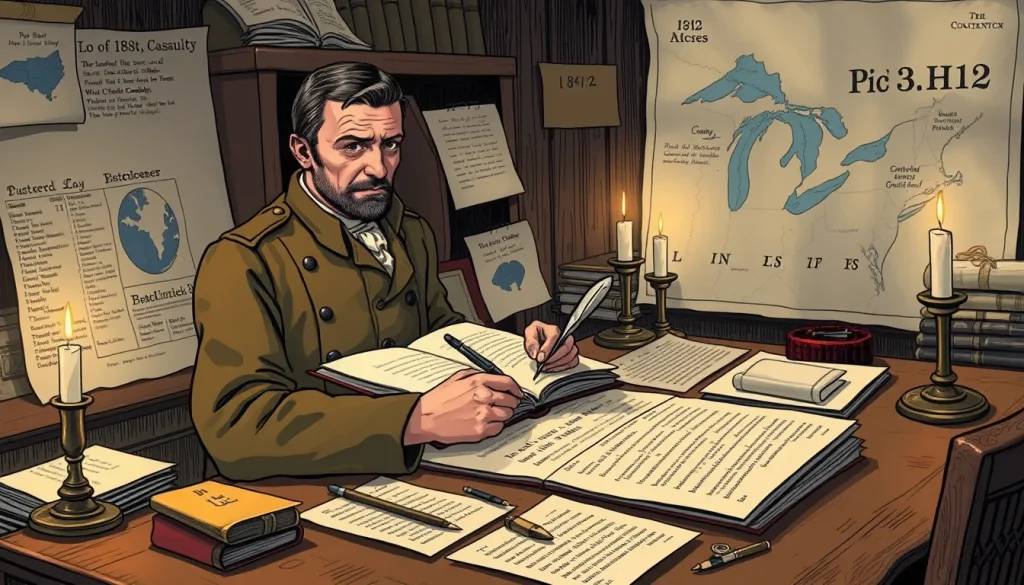
The casualty figures for the War of 1812 (1812–1815) vary sharply among British, American, Canadian, and Indigenous sources. These differences stem from incomplete record-keeping, varying definitions of who counted as a casualty, and the deliberate use of numbers for political and military purposes. Understanding why these figures diverge is essential for interpreting the war’s human cost and its historical memory.
Historical Context
No centralized casualty-recording system existed during the War of 1812. Each military unit maintained muster rolls, and commanders submitted periodic returns listing killed, wounded, missing, and captured soldiers. However, these returns were often delayed, incomplete, or lost in the chaos of campaigning. Disease, which killed far more men than combat did, was frequently not included in battle casualty returns, and desertion was inconsistently tracked. The war spanned multiple frontiers—from the Great Lakes to the Gulf Coast—and involved not only regular armies but also militias and Indigenous allies, whose records were even more sporadic. This patchwork of data collection created inevitable gaps and inconsistencies.
What Happened
Concrete examples illustrate the disparity. At the Battle of Queenston Heights (October 13, 1812), British official returns reported 14 killed, 77 wounded, and 21 missing, while American accounts claimed higher British losses. Conversely, American returns listed 100 killed, 300 wounded, and 100 prisoners, but British observers reported larger American casualties. At the Battle of New Orleans (January 8, 1815), British reports gave 291 killed, 1,267 wounded, and 484 missing, while American leaders, such as Andrew Jackson, initially claimed British losses of over 2,000. The discrepancy arises partly from how prisoners and deserters were categorized. For the entire war, the U.S. War Department reported 2,260 American deaths from all causes, but modern scholars, using pension records and other sources, estimate the true total at around 15,000, with the vast majority dying of disease. British and Canadian losses are similarly uncertain, and Indigenous ally casualties were rarely recorded at all.
Why It Matters
These discrepancies affect our understanding of the war’s severity, the effectiveness of medical care, and the sacrifices made by soldiers and civilians. They also influence national narratives: casualty figures were used to justify military decisions, shape public opinion, and later to support veteran pensions and commemorative efforts. Historians must therefore treat any single number as a product of its time, subject to error and bias. Recognizing why figures differ allows researchers to build more accurate estimates and to appreciate the limitations of the surviving evidence.
Definition
A casualty in military terminology includes anyone who is killed, wounded, missing, captured, or disabled by disease. In the War of 1812, sources often used the term narrowly to mean only those killed or wounded in battle, while excluding deaths from sickness or accidents. This definitional inconsistency is a primary reason why figures differ. A “casualty figure” thus depends on what the compiler chose to count and for what purpose.
Background
Early nineteenth-century armies kept records for administrative and financial reasons, not for historical accuracy. Muster rolls documented soldiers for pay, while returns tracked strength and losses. These documents were compiled by junior officers and often updated weeks after events. The process was manual, handwritten, and vulnerable to errors. Moreover, each nation had its own conventions: the British army counted deaths from disease separately from battle deaths, while the U.S. Army sometimes lumped them together. Civilian and Indigenous casualties were rarely part of any official return, further complicating modern assessments.
How It Worked
Casualty recording in the War of 1812 operated through a chain of paperwork. After an engagement, regimental clerks compiled lists of killed, wounded, and missing from roll calls and officer reports. These were sent to brigade and army headquarters, then consolidated into official returns. In practice, confusion in the field, lack of standardized forms, and urgency of campaigning meant that many returns were rough estimates. Wounded men who died later might not be reclassified, and prisoners taken by the enemy were often listed as missing for weeks. Additionally, commanders sometimes inflated enemy losses to justify claims of victory or deflated their own to avoid morale damage. The absence of a central authority—especially for militias and Indigenous warriors—meant many casualties were never recorded at all.
Competing Viewpoints
Historians debate the reliability of official returns. Some scholars, like Donald Hickey, argue that official figures, despite their flaws, provide a usable baseline. Others, especially military historians like Carl Benn, emphasize that the numbers are so incomplete that they mislead more than they inform. Nationalistic biases also persist: American and British sources often portray the war with different emphases, and casualty figures have been used to support competing interpretations of the war’s outcome. Modern quantitative historians have turned to alternative records, such as pension applications, burial registers, and militia rolls, to cross-check and supplement official counts.
Role in the War of 1812
The war’s diverse combatants and settings magnified the challenges. For example, at the Battle of York (1813), American troops reported burning the town and capturing stores, but British reports of the garrison’s losses differed. At the Battle of the Thames (1813), British and Indigenous casualties were reported in vague terms because many of the dead were not in formal units. The U.S. War Department’s official casualty list for the entire war, published in 1815, was based on incomplete returns and omitted many militia and volunteer deaths. Conversely, British returns for Canadian militia and Indigenous allies were often kept separately and have survived unevenly. These disparities are not just matters of accuracy—they reflect the administrative capacities and political priorities of the warring parties.
Consequences and Historical Interpretation
The practical consequence is that any single figure for War of 1812 casualties must be treated as provisional. Recent scholarship, using demographic methods and record linkage, has revised upward estimates of American deaths, but the numbers remain contested. For Indigenous peoples, the lack of record-keeping means their losses are often only inferable from community memory and fragmentary reports. The discrepancies have encouraged historians to be more critical of official sources and to seek convergence from multiple types of evidence. This approach has led to a more nuanced understanding of the war’s human toll, emphasizing that the true cost was likely greater than contemporary reports acknowledged.
Primary Sources
Key primary sources include official returns such as British “Brigade and Battalion Loss Returns” and American “Return of the Killed, Wounded, and Missing” for individual battles. Newspapers, memoirs, and pension records also provide valuable data. Each source has limitations: official returns are subject to the errors and biases of their compilers, while memoirs may inflate or minimize numbers for personal or national glory. The U.S. National Archives and the Library and Archives Canada hold many of these documents. A verified transcript of a full casualty return is rarely available online, but researchers can consult published editions such as the “Documentary History of the Campaign upon the Niagara Frontier” (Brigadier-General E. A. Cruikshank, 1896–1908) for British and Canadian materials.
Further Reading
- Hickey, Donald R. The War of 1812: A Forgotten Conflict. University of Illinois Press, 1989.
- Benn, Carl. The Iroquois in the War of 1812. University of Toronto Press, 1998.
- Quimby, Robert S. The U.S. Army in the War of 1812: An Operational and Command Study. Michigan State University Press, 1997.
- Giger, Annabelle. “V. Casualty recording in armed conflict: methods and normative issues.” SIPRI Yearbook 2016. Stockholm International Peace Research Institute.
- Jewell, Nicholas P., Michael Spagat, and Britta L. Jewell. “Accounting for Civilian Casualties: From the Past to the Future.” Social Science History 42, no. 3 (2018): 379–410.
- Swed, Ori. “War by numbers: The sociology of counting in armed conflict.” Theory and Society (2026).
References
- Hickey, Donald R. The War of 1812: A Forgotten Conflict. Champaign: University of Illinois Press, 1989.
- Benn, Carl. The Iroquois in the War of 1812. Toronto: University of Toronto Press, 1998.
- Giger, Annabelle. “V. Casualty recording in armed conflict: methods and normative issues.” In SIPRI Yearbook 2016: Armaments, Disarmament and International Security, 247–263. Stockholm: Stockholm International Peace Research Institute, 2016. https://www.sipri.org/sites/default/files/SIPRIYB16c06sV.pdf
- Jewell, Nicholas P., Michael Spagat, and Britta L. Jewell. “Accounting for Civilian Casualties: From the Past to the Future.” Social Science History 42, no. 3 (Fall 2018): 379–410. https://doi.org/10.1017/ssh.2018.9
- Swed, Ori. “War by numbers: The sociology of counting in armed conflict.” Theory and Society (2026). https://doi.org/10.1007/s11186-025-09678-4
FAQ
Why do casualty figures for the War of 1812 differ so much?
Differences arise from incomplete record-keeping, varying definitions of casualties, the exclusion of disease deaths, and the political or military motives of the reporting authorities.
What were the total casualties in the War of 1812?
Estimates vary. The U.S. War Department reported 2,260 deaths, but modern scholars suggest around 15,000 American deaths from all causes, including disease. British, Canadian, and Indigenous totals are less precise.
How do historians reconcile conflicting casualty figures?
Historians cross-reference official returns with pension records, muster rolls, burial documents, and contemporary diaries. They also consider biases and use demographic methods to estimate true numbers.



Leave a Reply