
Short Answer
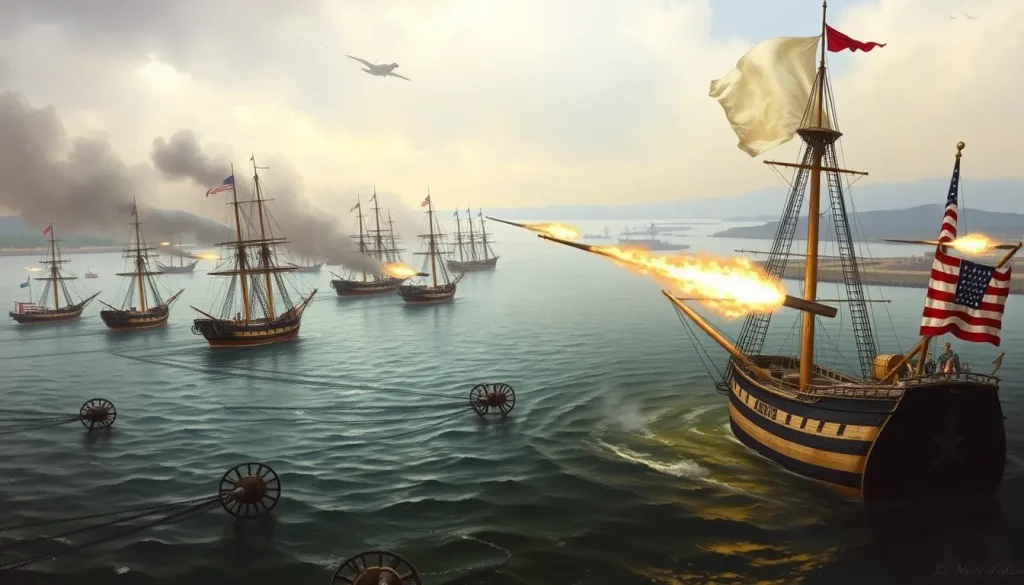
The Battle of Plattsburgh, also known as the Battle of Lake Champlain, was a combined land and naval engagement fought on 11 September 1814 near Plattsburgh, New York, during the War of 1812. It was the last major British attempt to invade the northern United States and ended with a decisive American victory that helped shape the Treaty of Ghent negotiations. The battle is renowned for the innovative naval tactics of Master Commandant Thomas Macdonough, who anchored his squadron in Plattsburgh Bay to compensate for his inferior force.
Historical Context
In 1814, the defeat of Napoleon in Europe freed large numbers of British regulars for service in North America. Lieutenant General Sir George Prevost, Governor General of Canada, received orders to launch offensives into American territory. He chose the Lake Champlain corridor, a historic invasion route, as his main axis of advance. Prevost’s objective was to capture Plattsburgh and then march toward Albany, isolating New England. The British assembled an army of about 11,000 men, many of them veterans of the Peninsular War, and a naval squadron under Captain George Downie to seize control of Lake Champlain. The American defenders at Plattsburgh, commanded by Brigadier General Alexander Macomb, numbered about 3,500, including regulars and militia. The naval force, commanded by Master Commandant Thomas Macdonough, consisted of a small squadron of four principal vessels and ten gunboats. Macdonough prepared a defensive position inside Plattsburgh Bay, where he could use kedge anchors and springs to turn his ships, compensating for their lighter gun weight and lack of maneuverability.
What Happened
On 1 September 1814, Prevost’s army crossed the border from Canada into New York, advancing toward Plattsburgh. The Americans conducted a fighting retreat, skirmishing with the British as they approached. By 6 September, Macomb’s forces had taken up defensive positions along the Saranac River on the outskirts of Plattsburgh. Meanwhile, Macdonough anchored his squadron in a line across Plattsburgh Bay, with springs and kedge anchors rigged to allow his ships to turn without weighing anchor. On the morning of 11 September, Downie’s squadron—consisting of the frigate Confiance, the brig Linnet, the sloops Chubb and Finch, and twelve gunboats—rounded Cumberland Head and advanced into the bay. The British had the advantage in firepower, but Macdonough’s tactical positioning forced them to approach slowly against the wind. The engagement began around 8:00 a.m. The American flagship Saratoga initially took heavy damage from the Confiance, but Macdonough successfully used his spring lines to bring his undamaged broadside to bear. After hours of intense cannonading, the British ships were crippled. Downie was killed early in the action. The Confiance struck her colors, followed by the other British vessels. On land, Prevost had planned to assault Macomb’s defenses once the naval battle was won, but seeing the British squadron destroyed, he called off the attack and ordered a retreat to Canada that evening. The American victory was complete.
Why It Matters
The Battle of Plattsburgh had immediate and long-lasting consequences. It ended the final British invasion of the northern United States and prevented any British territorial claims based on occupation at the peace negotiations then underway at Ghent. The American victory, combined with the successful defense of Baltimore (beginning the next day), denied the British negotiators leverage to demand territory under the principle of uti possidetis. The Treaty of Ghent, signed on 24 December 1814, restored the status quo ante bellum, leaving boundaries unchanged. The battle also bolstered American morale and national identity, following the burning of Washington in August. In the longer term, historians have debated Prevost’s decision to retreat, with many contemporaries and later scholars criticizing his caution, while some, like the Duke of Wellington, supported his prudence. The battle is often cited as a model of tactical innovation and a turning point in the war.
Prelude
Following Napoleon’s abdication in April 1814, Britain dispatched veterans from the Peninsular War to Canada. Prevost organized these troops into a division under Major General Sir Francis de Rottenburg, comprising three brigades. His plan required the navy to gain control of Lake Champlain before advancing on Plattsburgh. The American command had anticipated an invasion and had fortified Plattsburgh, with Macomb reinforcing the earthworks and Macdonough diligently preparing his squadron. Prevost’s army began moving on 1 September, and by 6 September, British troops had driven in American outposts. Prevost paused to await Downie’s squadron, which had been delayed by construction of the Confiance. He pressed Downie to attack before the navy was fully ready, a decision that contributed to the British defeat.
Forces and Commanders
United States: Land forces under Brigadier General Alexander Macomb numbered about 3,500, including regulars from the Army and New York and Vermont militia. Naval forces under Master Commandant Thomas Macdonough included the corvette Saratoga (26 guns), the brig Eagle (20 guns), the schooner Ticonderoga (17 guns), the sloop Preble (7 guns), and ten gunboats.
British: Land forces under Lieutenant General Sir George Prevost numbered about 11,000, including Peninsular veterans from regiments such as the 3rd, 5th, 27th, 39th, 58th, 76th, and 88th Foot, as well as Canadian regulars and militia. Naval forces under Captain George Downie included the frigate Confiance, the brig Linnet, the sloops Chubb and Finch, and twelve gunboats.
Battlefield and Map Context
The engagement took place on and around Lake Champlain, a freshwater lake stretching along the border between New York and Vermont. Plattsburgh Bay is a sheltered anchorage on the western shore, flanked by Cumberland Head to the north and the Saranac River to the south. Macdonough anchored his squadron in a north-south line across the bay, forcing the British to approach from the north and engage at close range. The land defenses consisted of earthworks and redoubts on the west bank of the Saranac River, with the American army occupying a strong position that Prevost’s troops would have to cross the river to assault. The geography of the bay, with its narrow entrance and shallow waters, negated the British advantage in long guns and allowed Macdonough’s carronades to be effective.
Battle Chronology
- 1 September 1814: British army under Prevost crosses the border from Canada into New York.
- 3-5 September: American forces under Macomb conduct a delaying action, skirmishing with the advancing British.
- 6 September: Macomb’s troops withdraw to Plattsburgh and take up defensive positions along the Saranac River.
- 7-10 September: British army arrives and prepares for assault; Downie’s squadron enters the lake but waits for favorable weather.
- 11 September, dawn: Downie’s squadron attacks Plattsburgh Bay; naval battle begins around 8 a.m.
- 11 September, late morning: British squadron surrenders after heavy losses; Prevost cancels land assault and orders retreat.
- 11 September, evening: British army begins withdrawing to Canada.
Casualties and Losses
American casualties were relatively light: approximately 104 killed and 116 wounded in the combined land and naval forces. The British suffered more heavily: about 168 killed, 220 wounded, and 317 captured, with many of the wounded among the naval crews. The British also lost four ships—the Confiance, Linnet, Chubb, and Finch—all of which were captured. Additionally, some 234 British soldiers deserted during the campaign. The total British loss was over 900 when including captured, wounded, and deserters.
Result
The battle was a decisive American victory. The British naval squadron was completely defeated and captured, and the British army retreated to Canada without pressing its attack. The invasion of the Champlain Valley was halted, and the British strategic offensive in the north came to an end. The American victory on Lake Champlain is often cited as one of the most significant naval battles of the war.
Strategic Consequences
The victory at Plattsburgh had immediate strategic impact. It prevented the British from establishing territorial claims in the Champlain Valley and New York, which they could have used at the Ghent peace talks. The British negotiators had hoped to retain occupied territory, but the defeat undermined that position. The Treaty of Ghent, signed on 24 December 1814, did not change the pre-war boundaries. The battle also boosted American confidence and contributed to a sense of national unity. In Canada, the failure at Plattsburgh damaged Prevost’s reputation; he was recalled to Britain and died in 1816 before a court-martial could convene. The battle is remembered as a turning point in the War of 1812.
Primary Accounts
Several primary accounts of the battle exist. Thomas Macdonough’s official report to the Secretary of the Navy, dated 13 September 1814, describes the naval action and his tactical decisions. Alexander Macomb’s report to the War Department details the land defense and the British retreat. British accounts include Captain Daniel Pring’s report and Governor Prevost’s dispatches, which defended his decision to retreat. An eyewitness, J.C. Hubbell, a civilian, recorded a vivid description of the naval bombardment: “The firing was terrific, fairly shaking the ground, and so rapid that it seemed to be one continuous roar, intermingled with the spiteful flashing from the mouths of guns, and dense clouds of smoke soon hung over the two fleets.” These documents provide invaluable insights into the battle but also reflect the perspectives and biases of their authors.
Battlefield Today
The battlefield at Plattsburgh is preserved as part of the Battle of Plattsburgh State Historic Park, located in Plattsburgh, New York. The park includes the Macdonough Monument, a 40-foot obelisk dedicated to the naval commander, and interpretive markers that explain the battle lines. The site includes portions of the American earthworks and the shoreline where the naval engagement occurred. The park is administered by the New York State Office of Parks, Recreation and Historic Preservation and is open to the public. A visitor center provides exhibits on the battle and the War of 1812.
Primary Sources
Key primary sources include:
- Thomas Macdonough’s Official Report (September 13, 1814) – provides a detailed account of the naval battle from the American perspective.
- Alexander Macomb’s Official Report (September 15, 1814) – describes the land defense and British movements.
- Sir George Prevost’s Dispatches – British official reports that explain his retreat and tactical decisions.
- J.C. Hubbell’s Eyewitness Testimony – a civilian account of the naval bombardment, preserved in NPS materials.
- Hugh Reinagle’s Painting “Macdonough’s Victory on Lake Champlain” (1815) – an early artistic representation, now in public domain.
These sources are available in archives such as the Library of Congress, the National Archives (U.S.), and the National Park Service collections.
Further Reading
- Hickey, Donald R. The War of 1812: A Forgotten Conflict. University of Illinois Press, 1989.
- Latimer, Jon. 1812: War with America. Harvard University Press, 2007.
- Lambert, Andrew. The Challenge: Britain Against America in the Naval War of 1812. Faber and Faber, 2012.
- Barnes, James. Naval Actions of the War of 1812. Harper & Brothers, 1896.
- Battle of Plattsburgh Association. Official website and resources.
References
- National Park Service. “Autumn 1814: The British Navy suffers a decisive defeat at the Battle of Lake Champlain.” Accessed 2023. https://www.nps.gov/articles/battle-of-lake-champlain.htm.
- Wikipedia contributors. “Battle of Plattsburgh.” Wikipedia, The Free Encyclopedia. Accessed 2023. https://en.wikipedia.org/wiki/Battle_of_Plattsburgh.
- History.com Editors. “Battle of Plattsburgh.” History.com. Accessed 2023. https://www.history.com/articles/plattsburgh-battle-of.
- Ridler, Jason. “Battle of Plattsburgh.” The Canadian Encyclopedia, 2011 (updated 2026). Accessed 2023. https://prod-front.thecanadianencyclopedia.ca/en/article/battle-of-plattsburgh.
- “Battle of Plattsburgh – War of 1812.” The War of 1812. Accessed 2023. https://thewarof1812.org/battles/battle-of-plattsburgh/.
FAQ
Why is the Battle of Plattsburgh considered decisive?
It ended the last British invasion of the northern United States and denied the British territorial claims at the Ghent peace talks, ensuring the pre-war boundary was restored.
What was Macdonough’s tactical innovation?
He used kedge anchors and spring lines to rotate his ships in place, allowing them to bring fresh broadsides to bear without moving under sail, turning a defensive anchor line into an effective fighting formation.
Did the battle affect the Treaty of Ghent?
Yes, the American victory strengthened the U.S. position in negotiations, preventing British demands based on occupation and contributing to the status quo ante bellum settlement.



Leave a Reply