Short Answer
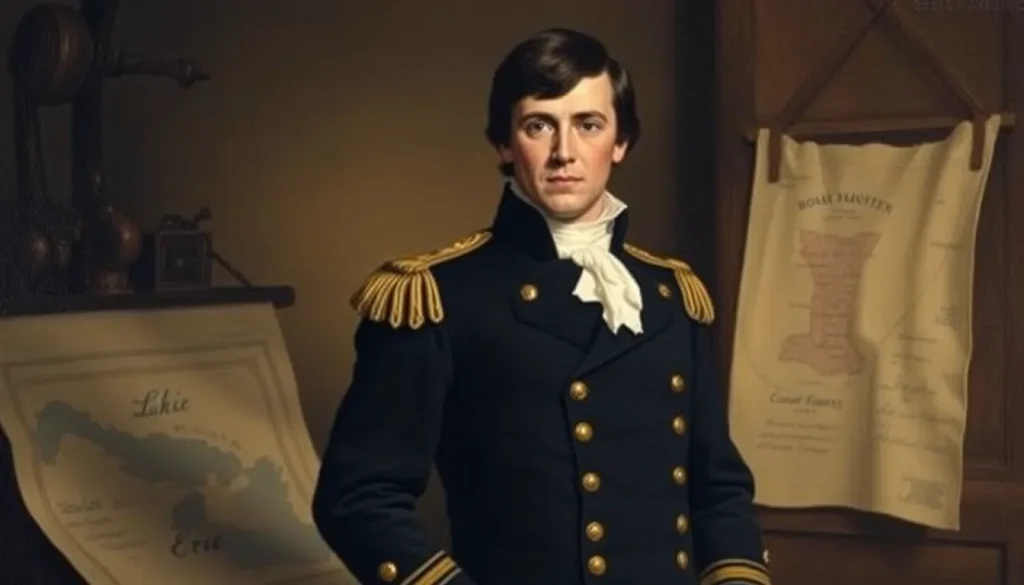
Robert Heriot Barclay (1786–1837) was a Scottish-born officer of the Royal Navy who served with distinction in the Napoleonic Wars before being given command of the British naval squadron on Lake Erie during the War of 1812. He is best known for his defeat and surrender to Master Commandant Oliver Hazard Perry at the Battle of Lake Erie on September 10, 1813, an engagement that gave the United States control of the lake and forced the British to abandon Detroit. Barclay’s career was marked by early promise, severe wounds, and a controversial but ultimately exonerating court martial following the battle.
Historical Context
Control of the Great Lakes was a strategic necessity for both the United States and Great Britain during the War of 1812. Lake Erie, in particular, formed a vital supply line feeding British forces in the Upper Canada frontier and their Indigenous allies. The Royal Navy maintained a small squadron at Amherstburg, while the Americans built a competing fleet at Presque Isle (modern Erie, Pennsylvania). By 1813, the naval race on Lake Erie had become critical to the outcome of the war in the Northwest.
The British high command on the lakes, under Sir James Lucas Yeo, focused on Lake Ontario as the more important theatre, leaving Lake Erie undermanned and undersupplied. This neglect created the conditions for the confrontation on September 10, 1813.
What Happened
Robert Barclay arrived at Kingston on May 5, 1813, after an overland journey from Halifax. He was initially placed in temporary command of the small British squadron on Lake Ontario, but ten days later he was superseded by Captain Sir James Yeo. Yeo offered command of the Lake Erie force to William Mulcaster, who declined, leading Yeo to give the post to Barclay. Barclay reached Amherstburg on June 5, 1813, where he found only a few weakly armed ships and a handful of trained seamen.
Throughout the summer, Barclay struggled to maintain a blockade of the American base at Presque Isle, but shortages of men and supplies forced him to lift it at the end of July. The Americans, under Perry, used the opportunity to cross the sandbar with their new brigs and gain naval superiority. Barclay, pressed by Major General Henry Procter to fight because supplies at Amherstburg were running out, sailed on September 9 to meet Perry. On the following day, the two squadrons engaged near Put-in-Bay. After two hours of fierce fighting, Barclay’s flagship, Detroit, and Queen Charlotte were severely damaged, and Barclay himself was wounded in his right arm and thigh. With most senior officers killed or wounded, Barclay surrendered, and the entire British squadron was captured.
Why It Matters
The Battle of Lake Erie was a decisive American victory that shifted control of the lake to the United States. It forced the British to evacuate Fort Detroit and abandon the western frontier of Upper Canada, and it was a key factor in the American victory at the Battle of the Thames in October 1813. Barclay’s defeat also highlighted the logistical and strategic limits of the Royal Navy on the inland lakes.
For Barclay personally, the loss brought a mandatory court martial, but he was honorably acquitted; the court praised his courage and judgment. Nevertheless, his career never recovered, and he received no further seagoing command of significance.
Early Life
Robert Heriot Barclay was born on September 18, 1786, in Kettle Manse, Fifeshire, Scotland, the son of the Reverend Peter Barclay and Margaret Duddingston. His aunt or uncle relationship to Admiral William Duddingston (likely his maternal uncle) facilitated his entry into the Royal Navy at the age of 11 or 12 in 1798. He served as a midshipman on HMS Anson, then on Victory under Nelson, and later on Swiftsure. He was promoted lieutenant in 1805 and fought at the Battle of Trafalgar aboard Swiftsure, where he helped rescue survivors from the sinking French ship Redoutable.
Role Before the War
Before the War of 1812, Barclay saw extensive service in the Napoleonic Wars. He was present at the capture of numerous French and Spanish vessels, and in 1809 he lost his left arm while leading a boat attack on a French convoy in the Bay of Biscay. After recovering, he served on the North American station, aboard Aeolus and Iphigenia, still a lieutenant. He was sent back to Halifax in 1812 with a recommendation for promotion, but the advancement was slow in coming.
Role During the War
In early 1813, Admiral Sir John Borlase Warren appointed Barclay to the naval command on the Canadian lakes, directing him to lead a party of officers overland to Quebec. He reached Kingston on May 5, 1813, and was soon made commander on Lake Erie after Mulcaster declined. He took command of the small squadron at Amherstburg in June, but he lacked trained sailors, guns, and supplies. He attempted to blockade Perry’s force at Presque Isle but was forced to withdraw due to weather and shortages. After Perry’s brigs crossed the bar, Barclay chose to fight to avoid the collapse of the British supply line.
Major Actions
Barclay’s only major action was the Battle of Lake Erie on September 10, 1813. His squadron consisted of the ship Detroit, the brig Queen Charlotte, and several smaller vessels, outgunned by the American fleet. Despite his force’s disadvantages in men and firepower, Barclay engaged Perry, and for a time his long guns caused heavy damage to the American flagship Lawrence. However, a shift in wind allowed Perry to bring his heavier short-range carronades into effective range, and the British squadron was overwhelmed. Barclay suffered severe wounds and was forced to surrender his surviving ships.
Contemporary Accounts
Barclay’s own official despatch after the battle, addressed to Sir James Yeo, contained the phrase, “I trust that … the honor of His Majesty’s flag has not been tarnished.” The court martial, held in September 1814, acquitted Barclay and praised “the Judgement and Gallantry of Captain Barclay … highly conspicuous and entitled him to the highest Praise.” American accounts, including Perry’s famous report, described the battle as a hard-fought contest. Some British observers criticized Major General Procter for pressuring Barclay into fighting while the British squadron remained unprepared.
Later Life
Barclay returned to Britain after the court martial. He married his cousin, Agnes Cosser, in London on August 11, 1814, and they had several children. He received an annual pension of £200 for his wounds. Although he sought further employment, the Admiralty gave him only a command of a bomb vessel in 1822. He saw no further service after 1824 and retired from active duty. He died in Edinburgh on May 8, 1837.
Historical Legacy
Barclay is remembered primarily for his defeat at Lake Erie, yet many historians credit him with making a determined, if doomed, effort under impossible conditions. He has been portrayed as a brave, one-armed officer who did his best with inadequate resources. The battle he lost proved pivotal in the War of 1812, and his name is permanently associated with the American triumph at Put-in-Bay. Modern assessments emphasize that the British failure on Lake Erie was a strategic and logistical disaster caused by higher command choices, not solely by Barclay’s conduct in action.
Primary Sources
Key primary sources include Barclay’s after-action report of September 1813, in which he described the battle and his reasons for engaging. The court martial proceedings, published in the Naval Chronicle or in official Admiralty records, provide testimonies from surviving officers. Perry’s official report to the Secretary of the Navy, dated September 13, 1813, gives the American perspective. Letters from Barclay to Sir James Yeo and Major-General Procter during the summer of 1813 illuminate the supply crisis and the strategic pressures he faced. These documents are held in the National Archives of the UK and the Library and Archives of Canada, among other repositories.
Further Reading
- Hitsman, J. Mackay. The Incredible War of 1812: A Military History. Toronto: University of Toronto Press, 1965.
- Zaslow, Morris, ed. The Defended Border: Upper Canada and the War of 1812. Toronto: Macmillan, 1964.
- Malcomson, Robert. Lords of the Lake: The Naval War on Lake Ontario, 1812–1814. Toronto: Robin Brass Studio, 1998.
- Caffrey, Kate. The Twilight’s Last Gleaming: Britain vs. America 1812–1815. New York: Stein and Day, 1977.
References
- “Robert Heriot Barclay (U.S. National Park Service).” National Park Service, last updated February 22, 2019. https://www.nps.gov/people/robert-heriot-barclay.htm.
- “Royal Naval Biography/Barclay, Robert Herriot.” Wikisource. Accessed August 2025. https://en.wikisource.org/wiki/Royal_Naval_Biography/Barclay,_Robert_Herriot.
- Ridler, Jason. “Robert Heriot Barclay.” The Canadian Encyclopedia, February 2, 2011 (last edited January 7, 2014). https://thecanadianencyclopedia.ca/en/article/robert-heriot-barclay.
- “Robert Heriot Barclay.” Wikipedia. Accessed August 2025. https://en.wikipedia.org/wiki/Robert_Heriot_Barclay.
- “Robert Heriot Barclay.” American Battlefield Trust. Accessed August 2025. https://www.battlefields.org/learn/biographies/robert-heriot-barclay.
FAQ
Why did Robert Barclay surrender at the Battle of Lake Erie?
After two hours of fighting, his flagship Detroit was crippled, most of his officers were killed or wounded, and the remaining ships were too damaged to continue. With no hope of victory, Barclay surrendered to prevent further loss of life.
Was Barclay court-martialed after losing his squadron?
Yes, as was customary after any loss of a ship. He was tried in September 1814 and exonerated; the court praised his courage and judgment under difficult circumstances.
What happened to Barclay after the War of 1812?
Barclay married Agnes Cosser in 1814, received a pension for his wounds, and remained in the navy but was only given a minor command in 1822. He retired from active service and died in Edinburgh in 1837.


Leave a Reply