Short Answer
Robert Heriot Barclay was a British Royal Navy officer who commanded the Lake Erie squadron during the War of 1812. He is chiefly remembered for his defeat at the Battle of Lake Erie on September 10, 1813, when his entire squadron was captured by American forces under Oliver Hazard Perry. This battle was the first time in British naval history that a squadron had surrendered, and it decisively changed the strategic situation on the Upper Great Lakes.
Historical Context
The War of 1812, fought between the United States and Great Britain, included a significant naval struggle for control of the Great Lakes. Lake Erie was a vital supply route for both sides, linking Upper Canada to the British posts at Detroit and Amherstburg. In 1813, the United States was building a naval force at Presque Isle (present-day Erie, Pennsylvania) under Master Commandant Oliver Hazard Perry, aiming to challenge British control of the lake. Meanwhile, the British had established a naval squadron at Amherstburg, but it suffered from shortages of trained sailors, supplies, and experienced officers. Control of Lake Erie was essential for the British to maintain communication with their western posts and for the Americans to cut British supply lines.
What Happened
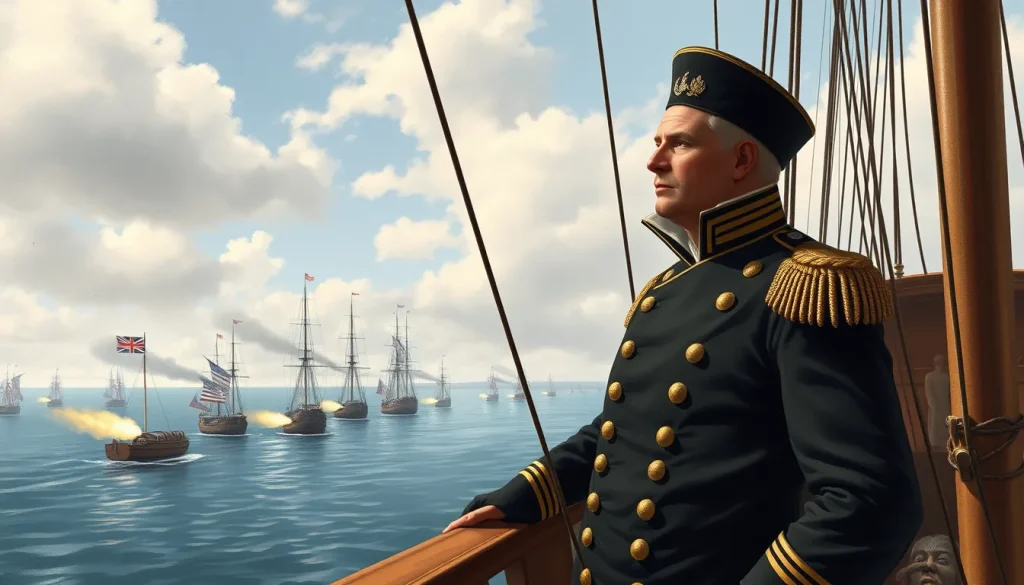
Barclay arrived at Amherstburg in June 1813 to take command of the British squadron on Lake Erie. He found a force of five vessels, including the ship Queen Charlotte and several smaller craft, all poorly equipped and undermanned. Barclay was also hampered by a lack of support from his superior, Commodore Sir James Lucas Yeo, who focused on Lake Ontario. In early August, Perry successfully floated his two new brigs, USS Lawrence and USS Niagara, over the sandbar at Presque Isle, giving the Americans numerical and firepower superiority. Barclay, short of supplies and urged by Major General Henry Procter to act, sortied from Amherstburg on September 9. The two squadrons met on September 10 near Put-in-Bay within the Bass Islands. The British initially held the advantage with long guns, but shifts in wind allowed Perry to close, resulting in a brutal close-range engagement. After two hours, British resistance collapsed. Barclay was severely wounded, losing the use of his remaining arm and suffering a thigh injury. He surrendered his flagship Detroit and the Queen Charlotte to Perry in the first such surrender in British naval history.
Why It Matters
The Battle of Lake Erie had immediate and far-reaching consequences. American control of the lake forced the British to evacuate Fort Detroit and abandon Amherstburg. It also cut off British supply lines, leading to Major General Procter’s retreat and eventual defeat at the Battle of the Thames in October 1813. The victory boosted American morale and secured the northwest frontier. For Barclay, the defeat led to a court-martial, though he was exonerated due to his bravery and the poor condition of his squadron. The battle also demonstrated the importance of naval power in the Great Lakes theater and became a central event in American commemorations of the war. Historians view Barclay as a capable officer placed in an impossible situation, and his defeat is often attributed to lack of resources and support rather than personal incompetence.
Early Life
Robert Heriot Barclay was born on September 18, 1786, at Kettle Manse in Fife, Scotland, the son of Reverend Peter Barclay. His middle name came from a family friend. At age 12, he entered the Royal Navy as a midshipman, influenced by his uncle, Admiral William Duddingston. He served on the frigate HMS Anson, participating in captures of French and Spanish vessels.
Role Before the War
Barclay was promoted to lieutenant in 1805 and fought at the Battle of Trafalgar aboard HMS Swiftsure. In 1807, while serving on the frigate HMS Diana, he lost his left arm in an attack on a French convoy. Despite the injury, he continued in the navy and was sent to North America in 1813, initially to the Halifax station.
Role During the War
In early 1813, Barclay was ordered to the Great Lakes. He was appointed to command the naval forces on Lake Erie after another officer declined the post because of the poor condition of the vessels. He arrived at Amherstburg in June 1813, taking command of a small squadron. He worked to prepare the fleet, but faced shortages of men, guns, and supplies, and was pressured by the military commander Procter to engage the Americans.
Major Actions
Barclay’s major action was the Battle of Lake Erie. He had organized a blockade of Presque Isle to prevent Perry’s ships from entering the lake, but was forced to lift it due to lack of support. On September 10, 1813, his squadron met Perry’s force. Barclay fought bravely, but his ships were outgunned and after his severe wounds, he ordered the surrender. He lost his flagship and the entire squadron, along with over 400 casualties.
Contemporary Accounts
Barclay reported his defeat in a letter to the Admiralty, stating he trusted the honour of His Majesty’s flag had not been tarnished. Perry’s report to the American government praised the courage of both sides. The court-martial that followed found that Barclay and his men conducted themselves gallantly, blaming the loss on the lack of trained officers and seamen.
Later Life
After recovering from his wounds, Barclay returned to England and married Agnes Cossar in 1815. He was granted a pension and remained in the navy, but received no further major commands. He was promoted to post-captain in 1824, but he never served at sea again. He died in Edinburgh on May 8, 1837.
Historical Legacy
Barclay’s legacy is tied almost entirely to his defeat at Lake Erie. Historians now view the battle as a testament to the challenges of naval warfare on the Great Lakes, and Barclay as an officer who did his best with insufficient resources. His surrender is often compared to Perry’s famous victory, and the battle remains a subject of study in naval history.
Primary Sources
Key primary sources include Barclay’s official report of September 10, 1813, printed in the London Gazette. Perry’s victory dispatch is equally important. The court-martial records, held at the National Archives in Britain, provide detailed testimony. Barclay’s letters and the correspondence of Commodore Yeo are also valuable. A limitation is that these sources reflect official perspectives and the chaos of battle; later memoirs fill gaps but are less contemporary.
Further Reading
- Skaggs, David Curtis. The Battle of Lake Erie and Its Aftermath: A Reassessment. Kent State University Press, 1990.
- Hickey, Donald R. The War of 1812: A Forgotten Conflict. University of Illinois Press, 1989.
- Ridler, Jason. “Robert Heriot Barclay.” The Canadian Encyclopedia.
- National Park Service. “Robert Heriot Barclay.” Perry’s Victory & International Peace Memorial.
- American Battlefield Trust. “Robert Heriot Barclay.”
References
- National Park Service. “Robert Heriot Barclay.” Perry’s Victory & International Peace Memorial. https://www.nps.gov/people/robert-heriot-barclay.htm
- National Park Service. “Robert Heriot Barclay – Perry’s Victory & International Peace Memorial.” https://nps.gov/pevi/learn/historyculture/robert-heriott-barclay.htm
- American Battlefield Trust. “Robert Heriot Barclay.” https://www.battlefields.org/learn/biographies/robert-heriot-barclay
- Ridler, Jason. “Robert Heriot Barclay.” The Canadian Encyclopedia. https://thecanadianencyclopedia.ca/en/article/robert-heriot-barclay
- “Robert Heriot Barclay, Esq.” Royal Naval Biography, via Wikisource. https://en.wikisource.org/wiki/Royal_Naval_Biography/Barclay,_Robert_Herriot
FAQ
Why did Robert Heriot Barclay lose the Battle of Lake Erie?
Barclay was outnumbered and outgunned, with a poorly equipped squadron. He lacked trained seamen and support from his superior, Commodore Yeo. He was also pressured into battle by General Procter. His courage was not in question, but his resources were insufficient.
What happened to Barclay after his defeat?
Barclay was severely wounded and later court-martialed. He was exonerated with praise for his gallantry. He returned to England, married, and received a pension. He was promoted to post-captain in 1824 but never held a major naval command again.
How did the Battle of Lake Erie affect the War of 1812?
American control of Lake Erie forced the British to evacuate Detroit and Amherstburg, leading to the Battle of the Thames and the death of Tecumseh. It secured the American northwest frontier and boosted American morale.
Leave a Reply