
Short Answer
The War of 1812, fought between the United States and Great Britain from June 1812 to February 1815, produced a death toll that remains imprecise. Official American military records count 2,260 deaths, but these figures are incomplete and represent only a fraction of the human cost when British, Canadian, Indigenous, and civilian losses are included. Historians therefore rely on estimates, which range from roughly 15,000 to 25,000 total deaths.
Historical Context
The War of 1812 arose from long-standing disputes over maritime rights, impresment of American sailors, British support for Indigenous resistance to American expansion, and broader conflicts stemming from the Napoleonic Wars. The United States declared war on June 18, 1812, with campaigns fought along the U.S.-Canadian frontier, in the Old Northwest, on the Atlantic coast, and on the high seas. Military engagements were often small scale, but disease, harsh living conditions, and inadequate medical care exacted a heavy toll. Record-keeping was uneven across all belligerents, and no central authority compiled comprehensive casualty lists, particularly for militia, Native American allies, and civilians who experienced raids and sieges.
What Happened
The war saw major campaigns including the failed American invasions of Canada in 1812 and 1813, the naval battles on the Great Lakes such as the Battle of Lake Erie in September 1813, and the Chesapeake Bay raids culminating in the Burning of Washington in August 1814. The final major engagement, the Battle of New Orleans in January 1815, occurred after the Treaty of Ghent had been signed but before news reached the United States. Throughout these operations, deaths resulted not only from battlefield wounds but also from contagious diseases like dysentery, typhus, and influenza, which often killed more soldiers than combat. The Royal Navy’s blockade also contributed to civilian suffering and mortality through food shortages and economic hardship. On the American side, official returns compiled later by the Department of Defense recorded 1,950 Army, 265 Navy, and 45 Marine deaths, totaling 2,260. These numbers, however, exclude deaths among state militia and volunteer units not documented in regular muster rolls, as well as deaths from disease that occurred after the nominal end of service.
Why It Matters
The death toll of the War of 1812, while small compared to the American Civil War or the World Wars, had significant implications for the United States and its neighbors. It shaped public perception of the conflict as a costly and ultimately ambiguous venture, contributing to the post-war “Era of Good Feelings” and a growing sense of national identity. For Britain, Canada, and Indigenous nations, the war’s casualties underscored the human cost of imperial and frontier disputes. The difficulty of establishing precise casualty numbers also matters for historians: it reveals the limits of military bureaucracies in the early nineteenth century and complicates efforts to measure the war’s true impact on communities. Accurate or not, casualty figures have been used to argue whether the war was a “victory” or a “draw,” and they influence how the war is remembered in each country.
Definition
“Deaths in the War of 1812” encompasses all fatalities attributable to the conflict, including military personnel (regular, militia, volunteer, and naval forces), Indigenous combatants and non-combatants, civilians killed in raids, naval privateers and merchant sailors, and those who died from war-related disease or accident. The official U.S. figure of 2,260 counts only regular armed forces’ deaths as recorded in later tabulations, and it does not include militia or non-battle deaths. Broader estimates attempt to cover all categories, but they are inherently approximate due to missing records.
Background
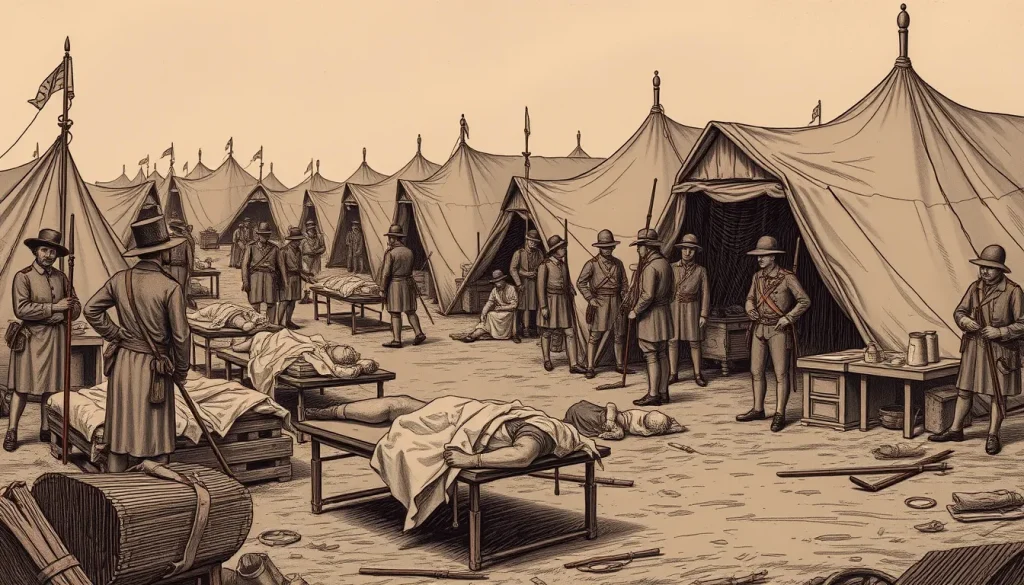
Casualty recording in the early nineteenth century was inconsistent. The U.S. War Department maintained muster rolls for regular army units, but many militia and state troops were poorly documented. The Navy kept logs, but not all losses were reported. British and Canadian forces had similar limitations, and Indigenous warriors, who played significant roles on both sides, left no centralized rolls. Civilians, especially in frontier regions and the Chesapeake, suffered deaths that often went unrecorded. Disease was a major killer; in fact, for every soldier killed in battle, several often died from illness, especially in the cramped and unsanitary conditions of camps and ships. These factors make it impossible to produce a definitive number.
How It Worked
Contemporary accounting of deaths relied on unit commanders submitting reports to superiors, but standards varied. Battle deaths were often counted on the field or in subsequent reports, but deaths from sickness might be noted only in hospital registers. The U.S. Army’s returns tracked strength and losses, but they frequently omitted militia. After the war, scholars and government agencies such as the Department of Defense compiled statistical tables from surviving records. The Historical Statistics of the United States, a standard reference, reports 2,260 total deaths for U.S. military forces based on those compilations. That number, however, represents only battle deaths; the table leaves “other deaths” blank, reflecting the absence of reliable data. Modern historians use those official numbers as a baseline, then add estimates for militia, non-combatant, and foreign casualties derived from partial returns, memoirs, and local histories.
Competing Viewpoints
The most commonly cited official figure is 2,260 American military deaths, drawn from U.S. government tables. This is the minimum certain count for Americans. However, many historians argue this is far too low because it omits militia and disease deaths; some suggest total American military deaths may have exceeded 5,000. British and Canadian military losses are typically estimated at around 4,000, but again records are incomplete. Indigenous losses are even less documented, with estimates ranging from several hundred to several thousand. Civilian deaths from warfare, disease, and displacement may have been substantial along the Niagara frontier and in the Chesapeake region. The American Battlefield Trust, a reputable organization, places the overall death toll at approximately 15,000 for all sides, while other sources propose up to 25,000. The wide range reflects the lack of comprehensive data and the different methodologies used to extrapolate from fragmentary evidence.
Role in the War of 1812
Casualty figures influenced the course and outcome of the war. High numbers of sick soldiers often reduced effective strength more than combat did, affecting strategic decisions. The United States’ inability to sustain large armies during invasions of Canada was partly due to disease and desertion, not just enemy action. British commanders also faced attrition from the harsh environment. The death toll also shaped public opinion at home: wartime losses, especially the burning of Washington, fueled both resolve and criticism of the government. For Indigenous peoples, who suffered disproportionately, the war’s casualties contributed to their later loss of territory and political standing.
Consequences and Historical Interpretation
In the aftermath, casualty numbers became a political tool. Federalists used reports of deaths to oppose the war, while supporters pointed to victories like Baltimore and New Orleans as justification. After the war, American leaders touted the conflict as a successful defense of national sovereignty, and the relatively small official death count reinforced a narrative of victory. Historians today view the limited data as a reminder of the war’s ambiguity: it settled few issues and left many deaths unrecorded. The comparison to later, more thoroughly documented conflicts highlights how modern standards of military bureaucracy emerged only in the mid-nineteenth century. The uncertainty itself is a key insight into the era’s limits of state power and record-keeping.
Primary Sources
Historical Statistics of the United States, Millennial Edition, presents compiled data on U.S. military personnel and casualties for the war. This table, prepared from official records, gives the figure of 2,260 deaths and is a foundational reference for American losses. The Congressional Research Service report, “American War and Military Operations Casualties: Lists and Statistics,” also provides the same numbers, noting that pre-World War I data are based on incomplete records. The American Battlefield Trust’s “War of 1812 Quick Facts” (battlefields.org) offers a widely cited estimate of 15,000 total deaths, which historians often use as a rough benchmark. These sources are useful for understanding the official counts and their limitations, but they do not fully capture the human cost, especially for non-U.S. participants.
Further Reading
- American Battlefield Trust, “War of 1812 Quick Facts.” battlefields.org
- Historical Statistics of the United States, Millennial Edition, Table Ed1-5, Cambridge University Press.
- Congressional Research Service, “American War and Military Operations Casualties: Lists and Statistics,” RL32492, 2012.
- Donald R. Hickey, The War of 1812: A Forgotten Conflict (University of Illinois Press, 1989).
- J. C. A. Stagg, The War of 1812: Conflict for a Continent (Cambridge University Press, 2012).
References
- “War of 1812 Quick Facts,” American Battlefield Trust, accessed 2025. https://www.battlefields.org/learn/articles/war-of-1812-faqs
- “American War and Military Operations Casualties: Lists and Statistics,” Congressional Research Service, RL32492, 2012. https://www.everycrsreport.com/files/20121115_RL32492_f79da945073a75ac56b6e82608bff811a60308f6.pdf
- “Military personnel and casualties, by war and branch of service: 1775-1991,” Historical Statistics of the United States, Millennial Edition, Table Ed1-5, Cambridge University Press.
FAQ
How many American soldiers died in the War of 1812?
Official records list 2,260 deaths among U.S. regular forces: 1,950 in the Army, 265 in the Navy, and 45 in the Marine Corps. These figures likely undercount the true total, especially deaths from disease among militia and state troops.
What was the total death toll of the War of 1812?
The total number of deaths, including British, Canadian, Indigenous, and civilian losses, is not precisely known. Historians estimate the combined total at between 15,000 and 25,000.
Why are casualty figures for the War of 1812 so uncertain?
Records were incomplete and inconsistently kept. Many deaths from disease went unreported, and no comprehensive registry existed for militia, Indigenous forces, or civilians.

Leave a Reply