
Short Answer
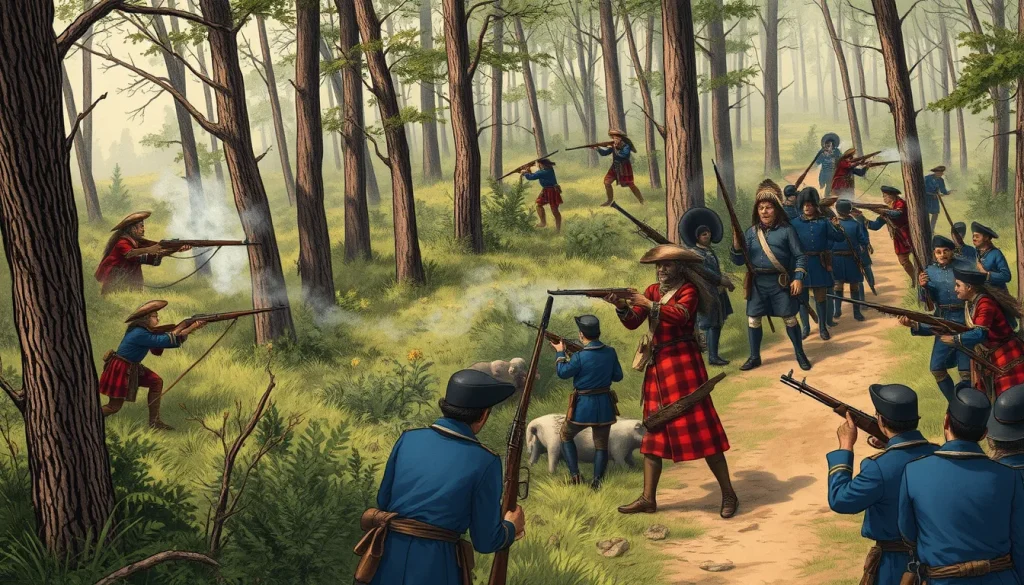
The Indigenous warriors at the Battle of Beaver Dams (24 June 1813) were primarily Mohawk (Kanyen’kehà:ka) forces from Kahnawake and the Grand River, who, directed by British Indian Department officers, ambushed and compelled the surrender of an American column near present-day Thorold, Ontario. Their use of woodland warfare and psychological intimidation proved decisive in a British victory that secured the Niagara Peninsula for the remainder of the campaign. The engagement is significant for demonstrating the indispensable role of Indigenous allies in the British war effort and for the enduring debate over who deserved credit for the victory.
Historical Context
The War of 1812 pitted the United States against Great Britain, with British North America (later Canada) as a principal theatre. On the Niagara frontier, American forces sought to conquer Upper Canada. In May 1813, the Americans captured Fort George, forcing the British under Brigadier General John Vincent to withdraw. The American commander, Major General Henry Dearborn, planned to destroy the British advanced post at Beaver Dams, a strategic point on the portage route. The British relied heavily on Indigenous allies, recruited through the Indian Department, to supplement their small regular forces. Indigenous nations, particularly the Kanyen’kehà:ka (Mohawk) of the Grand River and the Seven Nations of Canada, had their own reasons to resist American expansion, making them crucial partners.
What Happened
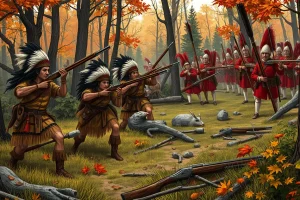
On the night of 23–24 June 1813, an American force of about 500 men under Lieutenant Colonel Charles G. Boerstler marched from Fort George toward Beaver Dams. The march was detected by Indigenous scouts, and Laura Secord, a local resident, also carried a warning to British Lieutenant James FitzGibbon. On the morning of 24 June, a force of about 300 Kanyen’kehà:ka warriors from Kahnawake led by Captain Dominique Ducharme, later joined by about 100 more under Captain William Johnson Kerr, ambushed the Americans in a wooded area near Beaver Dams. After three hours of intense fire from the woods, the Americans, suffering heavy casualties and fearing an indiscriminate massacre, surrendered to FitzGibbon and his small detachment of the 49th Regiment, who had arrived to demand their capitulation.
Why It Matters
The American defeat at Beaver Dams ended major offensive operations from Fort George, leaving the British in control of the Niagara frontier for the rest of 1813. The victory was achieved almost entirely by Indigenous warriors, a fact acknowledged by FitzGibbon himself, who later noted that the credit belonged to them. The battle reinforced the effectiveness of traditional Indigenous warfare and solidified the British dependence on their Indigenous alliance system. In Canadian historical memory, the engagement became a celebrated example of loyalty and courage, though the role of Indigenous fighters was often overshadowed by narratives focused on Laura Secord. Later historians have reassessed the battle, emphasizing the Indigenous contribution and the complex politics of colonial alliances.
Prelude
After the American capture of Fort George, the British established an outpost at Beaver Dams under Lieutenant James FitzGibbon. American Brigadier General John Parker Boyd planned a raiding expedition to destroy this post. Boerstler’s column included detachments from the 6th, 13th, 14th, and 23rd U.S. Infantry, as well as cavalry and artillery. The plan was kept secret, but the Americans lodged in Queenston, where local residents overheard conversations and reported them to FitzGibbon. Laura Secord is credited with walking 30 kilometres to warn FitzGibbon, but FitzGibbon remained skeptical until Indigenous scouts confirmed the American movement. The Indigenous warriors, already mobilized and eager to defend their lands, were essential in providing intelligence and preparing the ambush.
Forces and Commanders
The Indigenous forces at Beaver Dams comprised two main groups: approximately 300 Kanyen’kehà:ka (Mohawk) warriors from Kahnawake (Caughnawaga) and other communities in Lower Canada, commanded by Captain Dominique Ducharme of the Indian Department; and roughly 100 Kanyen’kehà:ka and other Six Nations warriors from the Grand River, led by Captain William Johnson Kerr. Some sources also mention the presence of John Norton, a Six Nations war chief, although his participation is disputed. These warriors were skilled in guerrilla tactics and forest warfare. The British regular contingent was small: FitzGibbon and about 50 men of the 49th Regiment. The American force, numbering about 500, was composed of regular infantry, dragoons, and one artillery piece.
Battlefield and Map Context
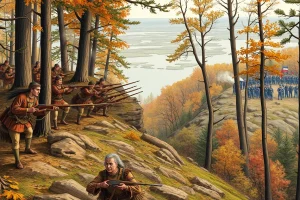
The engagement took place along the trail to Beaver Dams, near the present-day intersection of Old Thorold Stone Road and Davis Road in Thorold, Ontario. The Americans marched along a road bordered by dense woods and swampy ground, which allowed the Indigenous warriors to approach unseen and fire from cover. The terrain prevented the Americans from effectively deploying their artillery or cavalry. The battlefield was about 1.5 miles from the British outpost at DeCou’s house, where FitzGibbon was stationed. The modern Battle of Beaver Dams Park preserves a portion of the battlefield.
Battle Chronology
Early on 24 June, Boerstler’s column marched from Queenston. Around 8 a.m., they encountered the first skirmish, as Ducharme’s warriors attacked from the rear. Kerr’s warriors soon joined, surrounding the column in a half-circle. For three hours, the Indigenous forces fired from the woods, preventing the Americans from advancing or retreating. Boerstler was wounded and his men suffered mounting casualties. Around noon, FitzGibbon arrived with his small party and, using a bluff that he commanded a larger force and feared he could not control the Indigenous warriors, demanded surrender. Boerstler, seeing no recourse, capitulated. The surrender was formally executed by Major P.W. De Haren of the 104th Regiment, who arrived with reinforcements.
Casualties and Losses
Reports of Indigenous casualties vary. A contemporary report cited five killed and twenty to twenty-five wounded, while a later memorial at the battlefield lists fifteen killed and twenty-five wounded. American casualties were more substantial: twenty-five killed and about fifty wounded, including Boerstler. The Americans lost over 460 prisoners. The Indigenous losses were suffered almost exclusively among the warriors; the British regulars had none.
Result
The surrender of Boerstler’s entire force was a stunning success for the British and their Indigenous allies. The victory was achieved primarily by the Indigenous warriors, who had forced the Americans to surrender by their relentless and frightening attack. FitzGibbon later acknowledged that the credit was due to the Indigenous forces, not to him. The battle demonstrated the devastating effectiveness of Indigenous warfare in the forested terrain of the Niagara Peninsula.
Strategic Consequences
The defeat at Beaver Dams effectively ended American offensive operations from Fort George. The Americans remained confined to the fort and its immediate vicinity, unable to control the surrounding countryside. British control of the Niagara frontier was solidified, and the American command under Major General Henry Dearborn was discredited, leading to his replacement. The victory also strengthened British resolve and demonstrated the value of Indigenous alliances, which continued to be crucial in subsequent campaigns such as Châteauguay and Crysler’s Farm.
Primary Accounts
Lieutenant James FitzGibbon wrote after the battle, crediting the Indigenous warriors and noting that he had used the threat of their ferocity to secure the surrender. John Norton, a Mohawk war chief, also asserted that the battle was won by the Indigenous forces, and complained that FitzGibbon received undue credit. Captain Dominique Ducharme later provided accounts of his role. These documents are important primary sources, but they reflect the biases of their authors. FitzGibbon’s report is the official British account, while Norton’s version highlights Indigenous grievances about recognition.
Battlefield Today
The Battle of Beaver Dams was designated a National Historic Site of Canada in 1921. A cairn erected by the Historic Sites and Monuments Board of Canada in 1923 commemorates the engagement and is located in Battle of Beaver Dams Park, off Sullivan Avenue in Thorold, Ontario. The inscription on the plaque acknowledges the role of the Iroquois warriors, but it primarily emphasizes Laura Secord’s warning and the surrender to FitzGibbon, reflecting the historical narrative that has been revised in recent years. The park includes interpretive panels that outline the battle and its Indigenous participants.
Primary Sources
The key primary sources include Lieutenant James FitzGibbon’s post-battle report to his superiors, which explicitly credits the Indigenous warriors for the victory. This report, dated June 1813, is available in the British military correspondence and colonial records. John Norton’s memoir, written in the 1820s, provides an Indigenous perspective and disputes the credit given to FitzGibbon. Captain Dominique Ducharme’s later accounts, recorded in pension and departmental files, offer another view. The General Order of July 6, 1813, issued by the British commander, recognized the Indigenous contribution and authorized compensation for the wounded and families of fallen warriors. The memorial plaque at Battle of Beaver Dams Park, though a modern inscription, reflects the evolving interpretation of the battle.
Further Reading
- Ridler, Jason. “Battle of Beaver Dams.” The Canadian Encyclopedia, 2011, updated 2023.
- “Exhibit: Indigenous Contributions to the War of 1812.” Government of Canada, Crown-Indigenous Relations and Northern Affairs Canada.
- “Battle of Beaver Dams Memorial.” Veterans Affairs Canada.
- “Dominique Ducharme.” The Canadian Encyclopedia.
- Benn, Carl. The Iroquois in the War of 1812. University of Toronto Press, 1998.
References
- Ridler, Jason. “Battle of Beaver Dams.” The Canadian Encyclopedia. Accessed 2025. https://thecanadianencyclopedia.ca/index.php/en/article/battle-of-beaver-dams.
- “Exhibit: Indigenous Contributions to the War of 1812.” Government of Canada. Accessed 2025. https://rcaanc-cirnac.gc.ca/eng/1348771334472/1607906032957.
- “Battle of Beaver Dams Memorial.” Veterans Affairs Canada. Accessed 2025. https://veterans.gc.ca/en/remembrance/memorials/canada/battle-beaver-dams-memorial.
- “Dominique Ducharme.” The Canadian Encyclopedia. Accessed 2025. https://thecanadianencyclopedia.ca/en/article/dominique-ducharme.
- Chosa, Blake. “War of 1812, Battle of Beaver Dams.” Military History of the Upper Great Lakes, 2019. https://ss.sites.mtu.edu/mhugl/2019/10/31/war-of-1812-battle-of-beaver-dams/.
FAQ
What was the role of Indigenous warriors at the Battle of Beaver Dams?
Indigenous warriors, primarily Mohawk from Kahnawake and the Grand River, formed the bulk of the attacking force. They ambushed the American column, engaged in a three-hour firefight from the woods, and were instrumental in forcing the surrender through relentless attacks and psychological intimidation.
Why is there controversy over who deserved credit for the victory?
Lieutenant James FitzGibbon received the formal surrender, but he and others admitted that the Indigenous warriors did the real fighting. Later, FitzGibbon was credited more widely, while Indigenous leaders like John Norton and Dominique Ducharme asserted that the Indigenous forces were responsible. This dispute reflects broader issues of colonial recognition and the neglect of Indigenous contributions.
What was the strategic significance of the battle?
The defeat ended American offensive operations from Fort George, leaving the British in control of the Niagara frontier for the remainder of 1813. It also demonstrated the importance of Indigenous alliances to the British war effort and contributed to the dismissal of American commander Henry Dearborn.

Leave a Reply