
Short Answer
The War of 1812 revealed a striking gap between American political ambitions and military capacity. When the United States declared war on Great Britain in June 1812, the U.S. Army was small, under-funded, and poorly organized—a shadow of the force needed to invade British North America. Its unpreparedness resulted from decades of governmental neglect, reliance on an unreliable militia system, and a shortage of experienced officers, all of which shaped the disastrous campaigns of the first war year.
Historical Context
During the Napoleonic Wars, Britain’s blockade of France and the Royal Navy’s practice of impressing suspected British deserters from American ships inflamed U.S. opinion. Western settlers also blamed British support for Indian resistance for frontier violence. In response, President James Madison and a coalition of young “War Hawks” sought to pressure Britain by invading Canada, assuming that a quick conquest would force concessions. Yet the U.S. military had been hollowed out during Thomas Jefferson’s presidency (1801–1809), when economy and a philosophical distrust of standing armies reduced spending on the regular forces. The army consisted of a few thousand regulars, while state militias provided the bulk of potential manpower but were unreliable and legally restricted in federal service. Political divisions—especially Federalist opposition in New England—further hampered coherent war planning and funding.
What Happened
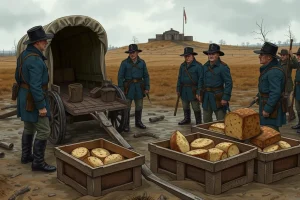
In 1812, the U.S. Army had a paper strength of about 35,000, but actual numbers were far lower: the regular army numbered roughly 12,000, many of whom were new recruits with little training. The command structure was top-heavy with aging Revolutionary War veterans: Henry Dearborn, senior major general, was 61; William Hull was 58; James Wilkinson was 55 and notorious for intrigue. The War Department under Secretary William Eustis was small and inefficient, lacking a proper staff or quartermaster corps. The army had no engineer corps after 1802 except a few cadets, and artillery horses had been sold in 1808 to save money.
When American forces launched invasions of Canada in 1812, their unpreparedness was exposed. General Hull’s army surrendered at Detroit on August 16 without a fight, fearing massacre by Indigenous warriors. General Van Rensselaer’s New York militia refused to cross the Niagara River at Queenston Heights, failing to support the regulars who had taken the heights. Another invasion attempt under Alexander Smyth disintegrated amid confusion. The militia, called out for federal service, could legally refuse to serve beyond U.S. borders. Supply failures left troops short of clothing, food, and ammunition. These disasters forced a reorganization in late 1812 and early 1813, but the army remained weak through 1813–1814, until the rise of officers like Jacob Brown and Winfield Scott, who instilled professionalism and drill.
Why It Matters
The unpreparedness of the U.S. Army in 1812 determined the course of the war’s first two years. It allowed the British to retain Canada and to seize the initiative in the West and on the Niagara frontier. The failures also shaped American military reforms: after the war, Congress increased the regular army’s size and established a more professional officer corps. The conflict revealed the inadequacy of a reliance on militia and underscored the need for a standing army. Historians debate the balance of causes—ideological, political, and administrative—but agree that the army’s weakness was the root of early American defeats and contributed to the war’s ambiguous outcome.
Definition
Unpreparedness, in this context, refers to the U.S. Army’s lack of sufficient trained soldiers, competent officers, equipment, logistics, and strategic planning to wage an offensive war against Great Britain in 1812. It was not a single shortcoming but a systemic condition arising from decades of neglect.
Background
After the Revolutionary War, the United States demobilized most of its army. The Constitution allowed a small regular force, but political leaders, especially Jeffersonian Republicans, preferred a citizen militia to a standing army. In 1802, the Military Peace Establishment Act reduced the army to about 2,800 men, and Jefferson used it mostly for frontier exploration and road building. The Navy was also reduced. Meanwhile, British and French seizures of American neutral trade escalated after 1805, but the U.S. Army remained a weak constabulary of scattered garrisons.
How It Worked
The U.S. Army in 1812 was organized into regiments of infantry, rifles, light artillery, dragoons, and a corps of engineers, but with no permanent headquarters staff or supply department. The Secretary of War oversaw operations through a small clerical staff. The officer corps was filled largely by political appointment, and promotions were slow, leading to elderly leaders. The militia, regulated by the 1792 Militia Act, obligated all able-bodied white men aged 18–45 to enroll, but training was irregular and often nonexistent. The Constitution gave Congress the power to call out the militia, but states controlled its training, and the Supreme Court later affirmed that federal service could not compel state militia to serve outside U.S. borders.
Competing Viewpoints
Historians disagree on why the army was so unprepared. One school emphasizes Jeffersonian ideology: Thomas Jefferson’s belief in limited government and a citizen-soldier ideal starved the regular army. Another stresses administrative incompetence: Secretary of War Eustis and President Madison were weak war managers. A third view points to political polarization: Federalist opposition to war and sectional distrust undercut national mobilization. Others argue that the army was simply too small and untrained because the nation had been at peace and no existential threat existed. These perspectives are not mutually exclusive; military historian John Carland (2012) called it an “army in decline.”
Role in the War of 1812
The unprepared U.S. Army shaped the war’s first two years. In 1812, the invasion of Canada failed at Detroit, Queenston Heights, and along the Niagara frontier. In 1813, the army’s shortcomings persisted, though victories at York and Fort George were achieved largely by naval superiority and local numerical advantage. The army’s weakness also allowed British and Indigenous forces to capture Fort Mackinac, Fort Dearborn, and other posts. By 1814, with the fall of Napoleon, Britain sent veteran reinforcements, and the U.S. Army, now reorganized, performed creditably at Chippewa, Lundy’s Lane, and Plattsburgh, but the war ended in a stalemate.
Consequences and Historical Interpretation
The immediate consequences of unpreparedness were the loss of Detroit, the failure of the Canadian campaigns, and the humiliation of the burning of Washington in 1814. In the longer term, the war prompted Congress to increase the regular army to 10,000 men (reduced later), establish the General Staff, and improve officer education, leading to the founding of the U.S. Military Academy at West Point as a lasting institution. Historians interpret the unpreparedness as a major cause of the war’s outcome: the United States achieved none of its stated objectives (end impressment, respect for neutral rights, Indian aggression) but managed to preserve its territorial integrity. The army’s evolution from a neglected frontier constabulary to a more professional force is seen as a key legacy of the war.
Primary Sources
Key primary sources include the official message of President Madison to Congress on June 1, 1812, requesting a declaration of war; the reports of Secretary of War William Eustis to Congress on army strength and supply deficiencies; the court-martial records of General William Hull after the surrender of Detroit; and the letters of officers like Winfield Scott complaining of lack of training. Also important are state militia returns and the 1802 Military Peace Establishment Act. These sources show the small size and poor condition of the army, but as official documents they may understate errors or bias criticism. For example, Hull’s court-martial blamed him for failures that were partly systemic, while later memoirs emphasize individual bravery and leadership.
Further Reading
- Steven J. Rauch, The Campaign of 1812 (U.S. Army Center of Military History, 2013).
- John M. Carland, “The Simplest Thing is Difficult: The United States Army and the War of 1812,” Canadian Military History 12, no. 2 (2003).
- David and Jeanne T. Heidler, “Driven by distraction: Political dissent and military unpreparedness,” NPS Articles (2015).
- Gary H. Nobbs Jr., “Failure on All Fronts: The United States Army in the First Year of the War of 1812,” MA thesis, SUNY Buffalo State (2021).
- Donald R. Hickey, The War of 1812: A Forgotten Conflict (University of Illinois Press, 1989).
References
- Rauch, Steven J. The Campaign of 1812. U.S. Army Center of Military History, 2013. https://history.army.mil/Portals/143/Images/Publications/Publication%20By%20Title%20Images/C%20Pdf/CMH_Pub_74-2.pdf
- Nobbs, Gary H., Jr. “Failure on All Fronts: The United States Army in the First Year of the War of 1812.” MA thesis, SUNY Buffalo State, 2021. https://digitalcommons.buffalostate.edu/history_theses/50
- Heidler, David, and Jeanne T. Heidler. “Driven by distraction: Political dissent and military unpreparedness.” U.S. National Park Service, 2015. https://www.nps.gov/articles/driven-by-distraction.htm
- Carland, John M. “The Simplest Thing is Difficult: The United States Army and the War of 1812.” Canadian Military History 12, no. 2 (2003). http://scholars.wlu.ca/cmh/vol12/iss2/3
- Martin, David Alan. “Mr. Jefferson’s Army in Mr. Madison’s War: Atrophy, Policy, and Legacy in the War of 1812.” MA thesis, University of Southern Mississippi, 2016. https://aquila.usm.edu/masters_theses/204
FAQ
Why did the U.S. army have so few troops in 1812?
The army had been deliberately kept small by Thomas Jefferson and his successors, who preferred a militia and distrusted standing armies. By 1812, the regular army numbered about 12,000, many of them raw recruits, and lacked supplies.
Was the militia a reliable military force in 1812?
Generally no. State militias were poorly trained, often refused to serve outside U.S. borders, and lacked discipline. At Queenston Heights, the militia refused to cross into Canada, contributing to American defeat.
How did unpreparedness affect the outcome of the War of 1812?
It caused early American defeats in Canada and the West, allowed British incursions, and contributed to the burning of Washington. Yet by 1814 the regular army had improved, and the war ended without American victory but also without loss of territory.

Leave a Reply