
Short Answer
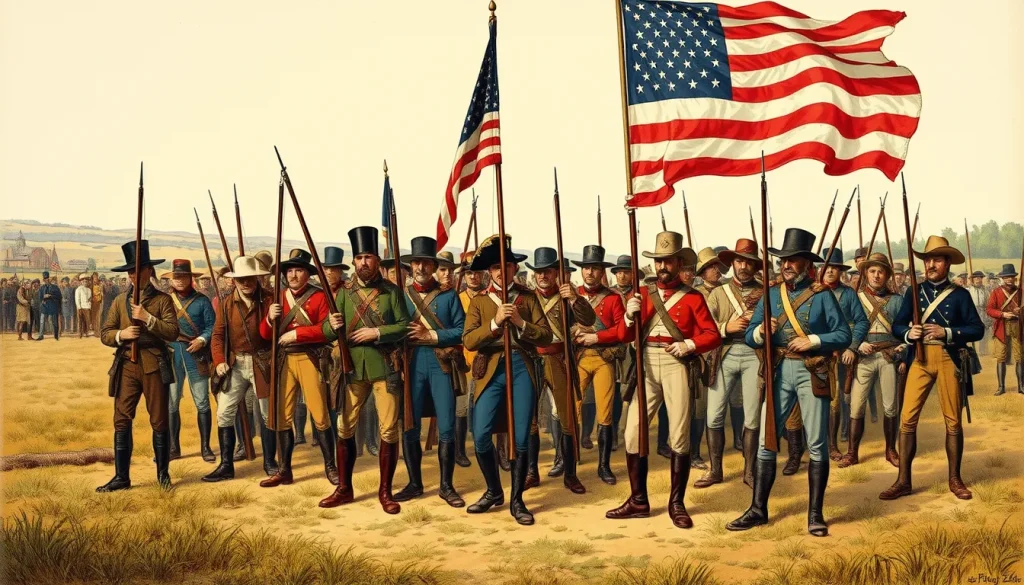
State militias in the first year of the War of 1812 (1812) were the primary manpower reserve of the United States, called upon to supplement a small regular army. Their service was marked by legal constraints, logistical unpreparedness, and significant operational failures, especially in the invasion attempts of Upper Canada. The militia’s performance during 1812 shaped American strategy and led to long-term debates over the nation’s military system.
Historical Context
The United States entered the War of 1812 with a regular army of only about 12,000 men, a force far too small to meet the challenges of a war with Great Britain. The national defense thus depended on the state-organized militia, as authorized under the Militia Acts of 1792. Each state maintained its own militia system under the constitutional principle that Congress could call forth the militia to execute federal laws, suppress insurrections, and repel invasions, but the states retained control over officering and training. In practice, the militia was a poorly equipped and minimally trained body of citizen-soldiers, uneven in quality and deeply divided over questions of federal authority. The political climate of 1812, marred by sectional disagreements over the war, further complicated the federal government’s ability to mobilize and direct these forces.
What Happened
Following the U.S. declaration of war on June 18, 1812, President James Madison called for 100,000 militia to be placed on active duty, though far fewer were actually mustered. The states responded with varying degrees of enthusiasm; many militia units had to be organized and equipped from scratch. In July 1812, Brigadier General William Hull invaded Upper Canada from Detroit with a force that included regulars and Ohio militia, but after supply lines were threatened, he retreated and eventually surrendered Detroit without a fight on August 16, a disaster largely attributed to militia indiscipline and lack of confidence. In the Niagara campaign, Major General Stephen Van Rensselaer’s attack at Queenston Heights on October 13 achieved initial success but failed when the New York militia, citing constitutional scruples, refused to cross the Niagara River into British territory. Similarly, an expedition against Montreal under General Henry Dearborn in November stalled when militia units declined to leave U.S. soil. These failures highlighted the militia’s statutory limitation: militiamen could not be compelled to serve outside the United States, and their terms of service were often too short to sustain campaigns.
Why It Matters
The first-year experience with state militias exposed systemic weaknesses that had immediate and long-term consequences. Militarily, the inability to mount effective invasions of Canada forced the United States to shift to a defensive posture on the northern frontier and contributed to the loss of key posts like Detroit. Politically, the failures intensified the debate concerning federal versus state control of military forces and fueled criticism of the Madison administration’s war leadership. In the long run, the poor performance of the militia in 1812 influenced calls for military reform, though it would take a generation before the militia system was substantially overhauled. Historians have often viewed the militia’s role in 1812 as a crucial factor in the war’s disappointing early results, while also noting that some militia performed bravely in defensive engagements.
Definition
In the context of early U.S. military history, a state militia was a body of citizens who were required by law to perform military service in defense of their state and the nation. Subject to call by the governor and, under constitutional provisions, by the president, the militia was organized at the state level and composed of all able-bodied white males aged 18 to 45, though compulsory service was rarely enforced and volunteer companies formed the effective core.
Background
The American colonies had long relied on local militias, and the post-Revolutionary republic adopted this system as a check against standing armies. The Militia Act of 1792 prescribed universal enrollment and required the states to organize and arm their militia, but compliance was sporadic. By 1812, most state militia organizations existed largely on paper, with only a few uniformed volunteer companies maintaining regular training. The federal government distributed arms to the states, but shortages and poor maintenance were common.
How It Worked
When the president called out the militia, the request was transmitted to state governors, who were responsible for ordering units into federal service. The federal government paid and supplied the troops only when they were actually mustered into national service; prior to that, the state bore the cost. Militia officers were appointed by state governors or elected by the men, and their commissions were state-based. The terms of service were limited, often to three or six months, and the troops were generally permitted to elect their own non-commissioned officers. This diffuse chain of command often led to disputes over seniority, jurisdiction, and obedience.
Competing Viewpoints
Contemporaries disagreed sharply over the militia’s value and the limits of federal authority. Democratic-Republicans, who dominated the Madison administration, generally favored the militia as a bulwark against a professional army, while Federalists warned of the dangers of an unprepared citizenry. A central legal question concerned whether the president could compel state militias to serve beyond U.S. borders; the Constitution authorized the militia to “execute the laws of the Union, suppress insurrections, and repel invasions,” but many states and constitutional commentators held that this did not include offensive operations on foreign soil. This interpretation crippled invasion plans.
Role in the War of 1812
State militias formed the bulk of the American forces in 1812, especially in the northern theaters. In the western campaign, Ohio and Kentucky militias accompanied Hull and later formed part of reinforcing columns. In New York, the militia at Queenston Heights refused to cross the Niagara River, leaving those already engaged at a disadvantage. In November, militia around Lake Champlain declined to advance toward Montreal. Despite these failures, militia units did serve in skirmishes and provided frontier defense. The only significant American success in 1812—the naval victories—involved no militia, while the land campaigns underscored the militia’s limitations.
Consequences and Historical Interpretation
Historians have generally interpreted the first-year militia performance as a major factor in the war’s early defeats. Some scholars, such as Donald Hickey, emphasize that the militia’s unreliability in offensive operations, coupled with poor leadership and logistics, doomed the invasion strategy. Others point to the militia’s effectiveness in defensive roles and argue that its failures were compounded by the federal government’s ambiguous authority and inadequate preparation. The experience accelerated the creation of a more standardized volunteer force in 1813, and it contributed to later arguments for military professionalism. In historical memory, the militia of 1812 has often been denigrated, but recent studies have highlighted the complexity of the situation, including the political pressures governors faced and the real constitutional qualms of many soldiers.
Primary Sources
The most valuable contemporary documents include the official correspondence of Secretary of War William Eustis (1812) and the reports of generals Hull, Van Rensselaer, and Dearborn, which are preserved in the National Archives and published in The Papers of the War Department. Governor Daniel D. Tompkins of New York issued numerous orders and letters detailing militia calls and the constitutional objections. The journal of Major General Van Rensselaer (1812) provides a first-hand account of the Queenston Heights affair. Militia soldiers’ letters and diaries, such as those collected in The War of 1812: Writings from America’s Second War of Independence (Library of America, 2013), offer personal perspectives. These sources are limited by the authors’ political views and the incomplete nature of records from a chaotic year.
Further Reading
- Hickey, Donald R. The War of 1812: A Forgotten Conflict. University of Illinois Press, 1989.
- Mahon, John K. History of the Militia and the National Guard. Macmillan, 1983.
- Stagg, J.C.A. The War of 1812: Conflict for a Continent. Cambridge University Press, 2012.
- Gilpin, Alec R. The War of 1812 in the Old Northwest. Michigan State University Press, 2012.
- Tompkins, Daniel D. Public Papers of Daniel D. Tompkins. (State of New York, 1898).
References
- Hickey, Donald R. The War of 1812: A Forgotten Conflict. University of Illinois Press, 1989.
- Mahon, John K. History of the Militia and the National Guard. Macmillan, 1983.
- Stagg, J.C.A. The War of 1812: Conflict for a Continent. Cambridge University Press, 2012.
- Gilpin, Alec R. The War of 1812 in the Old Northwest. Michigan State University Press, 2012.
- Tompkins, Daniel D. Public Papers of Daniel D. Tompkins. State of New York, 1898.
- Van Rensselaer, Stephen. “Narrative of the Battle of Queenstown.” American State Papers, Military Affairs, Vol. 1.
FAQ
Why did state militias refuse to cross into Canada in 1812?
Many militiamen and state officials believed the federal government had no constitutional authority to compel militia to serve outside U.S. territory. The Constitution only authorized militia use to execute laws, suppress insurrections, and repel invasions, which they interpreted as defensive actions within the United States.
What was the condition of the state militias at the start of the War of 1812?
Most state militias were poorly organized, under-equipped, and rarely trained. The 1792 Militia Act required universal service, but by 1812 only a small number of volunteer uniformed companies were effective, and supplies of arms and ammunition were often inadequate.
How did the militia's performance in 1812 affect the war effort?
The militia's limitations severely hampered American invasion plans. The surrenders and failures in Canada were partly due to militia unreliability, which forced the U.S. to rely more on volunteers and regulars in later years, and contributed to a shift in military policy.


Leave a Reply