
Short Answer
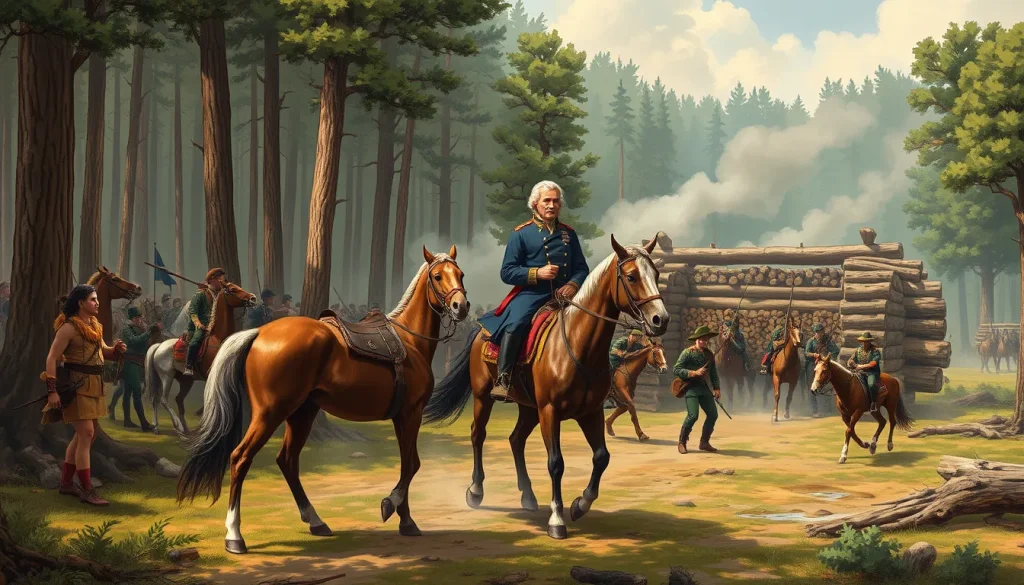
The Creek War of 1813–1814 was a military conflict in the American South fought between the United States and a faction of the Creek Nation known as the Red Sticks, who were allied with the British during the War of 1812. Major General Andrew Jackson of Tennessee commanded American forces against the Red Sticks, orchestrating a campaign that culminated in a decisive victory at the Battle of Horseshoe Bend in March 1814. This war not only shattered Creek power but also laid the groundwork for Jackson’s national career and the forced removal of southeastern Native Americans decades later.
Historical Context
After the American Revolution, white settlement expanded into Creek homelands in present-day Georgia and Alabama, leading to a series of treaties that eroded Creek territory. The Creek Nation itself was divided: Lower Creeks, who lived closer to white settlements, adopted farming and trade, while Upper Creeks, more isolated, resented the loss of land and cultural change. The Shawnee leader Tecumseh, who sought a pan-Indian alliance against the United States, visited Creek towns in 1811 and called for armed resistance. His message, combined with a religious revival led by prophets, intensified divisions among the Creeks. A militant faction, the Red Sticks, emerged, and internal strife escalated into civil war. The outbreak of the War of 1812 between the United States and Britain further complicated matters, as Americans feared a British-allied Indian assault on the southern frontier.
What Happened
The conflict ignited on August 30, 1813, when Red Stick warriors attacked Fort Mims in the Mississippi Territory, killing hundreds of settlers, militia, and friendly Creeks. The massacre galvanized American authorities. Tennessee Governor Willie Blount ordered Major General Andrew Jackson, who had recently recovered from a duel-related wound, to suppress the Red Sticks. Jackson mobilized militia, regulars, and allied Cherokee and Lower Creek warriors, advancing into Creek territory and constructing supply depots like Fort Strother.
Jackson’s campaign began in November 1813. On November 3, Colonel John Coffee attacked the town of Tallushatchee, destroying it. Six days later, Jackson’s force relieved a besieged friendly Creek town at Talladega, killing many Red Sticks. In late November, Georgia militia under General John Floyd struck the towns of Autosee and Tallassee, while Mississippi militia under Ferdinand Claiborne attacked the Holy Ground on the Alabama River. Despite these successes, supply shortages and expiring enlistments forced a temporary pause. Jackson resumed operations in January 1814, but a Red Stick counterattack at Emuckfau Creek on January 22 forced him to retreat to Fort Strother.
In March 1814, Jackson again advanced toward the main Red Stick stronghold at Tohopeka, a fortified position on a horseshoe bend of the Tallapoosa River. On March 27, his force of about 3,300 men—including the 39th U.S. Infantry, militia, and allied Creeks and Cherokees—attacked. While an artillery barrage pounded the breastwork, a detachment crossed the river and attacked from the rear. The frontal assault broke through, and the Red Sticks were slaughtered. Of the estimated 1,000 warriors, roughly 750 were killed. The Battle of Horseshoe Bend effectively ended the Creek War, though some Red Sticks fled to Spanish Florida.
A few months later, Jackson negotiated the Treaty of Fort Jackson (August 9, 1814), forcing the Creek Nation—including allies—to cede more than 20 million acres of land to the United States. President later ordered the removal of remaining Creeks to Indian Territory in the 1830s.
Why It Matters
The Creek War had immediate and lasting consequences. It eliminated Creek resistance in the Deep South, opening millions of acres to white settlement and cotton cultivation, which accelerated the expansion of slavery. It also strengthened Andrew Jackson’s reputation as a decisive military leader, paving his path to the presidency in 1828. For the Creeks and other southern tribes, the war marked the beginning of a tragic era of dispossession, culminating in the Trail of Tears in the 1830s. Historians view the Creek War as a critical episode within the War of 1812, demonstrating how the conflict with Britain intertwined with ongoing Indian wars and territorial expansion. The war also exposed the brutality of frontier warfare, with acts of violence committed by both sides.
Early Life
Andrew Jackson was born in March 1767 in the Waxhaws region along the Carolina frontier. He endured a rough childhood, his father dying before his birth and his mother and brothers perishing during the American Revolution. After the war, Jackson studied law and moved north to Tennessee, becoming a wealthy landowner, merchant, and judge. He developed a reputation for hot-tempered decisiveness and a deep animosity toward Indians and British influence.
Role Before the War
Jackson’s prewar career included service as a delegate to the Tennessee constitutional convention and as a U.S. congressman and senator. He also served as a judge on the Tennessee Superior Court. During the War of 1812, he first offered his militia forces for Federal service, leading a campaign in 1813 that briefly clashed with U.S. troops before being ordered to disband. He remained politically active, aligned with the Democratic-Republican faction of Governor Blount.
Role During the War
After Fort Mims, Jackson was placed in command of the Southwest military district with authority to raise and direct forces against the Creeks. His determination overcame severe logistical difficulties, though his troops suffered from desertion and supply shortages. Jackson personally led key operations, including the decisive assault at Horseshoe Bend, which demonstrated his tactical boldness and ruthlessness.
Major Actions
Jackson’s major military actions during the Creek War included the destruction of Tallushatchee (November 3, 1813), the victory at Talladega (November 9, 1813), and his campaigns along the Coosa and Tallapoosa rivers in early 1814. His most significant achievement was the Battle of Horseshoe Bend (March 27, 1814), where his forces annihilated the main Red Stick army, breaking Creek resistance. He also negotiated the Treaty of Fort Jackson, demanding and receiving massive land cessions.
Contemporary Accounts
Contemporary American military reports and letters praised Jackson’s leadership, though some criticized his harsh methods. An aide, John Reid, later co-wrote a biography glorifying his exploits. Creek oral tradition and surviving accounts from Cherokee and Lower Creek allies tell a different story, emphasizing the devastating loss of life and the betrayal of allies who were forced to cede land. British and Spanish observers also noted the campaign’s impact on the southern frontier.
Later Life
After the Creek War, Jackson became a national hero. He was appointed major general in the U.S. Army and won the Battle of New Orleans in 1815, sealing his fame. He subsequently led campaigns against Seminole and other Indian groups, and served as governor of Florida. Elected president in 1828 and 1832, he promoted Indian removal policies, directly leading to the forced relocation of the Five Civilized Tribes, including the Creeks, in the 1830s.
Historical Legacy
Historians assess Jackson’s legacy critically. Some view him as a decisive patriot who secured American expansion, while others emphasize his brutality and role in the dispossession and suffering of Native peoples. The Creek War is often seen as a brutal example of American militarism, and Jackson’s actions there are linked to later genocidal policies. Modern scholarship seeks to center the perspectives of the Creeks and other tribes, recognizing that the war was not merely a military contest but a catastrophic event that destroyed a civilization’s way of life.
Primary Sources
Key primary sources include Jackson’s official reports and correspondence, notably his letters to Governor Blount and the War Department during the campaign. The Treaty of Fort Jackson (1814) is a surviving legal document. Contemporary journals and diaries by soldiers, such as those of Captain John Gordon, provide eyewitness details. Red Stick accounts are lacking in written form, but oral traditions and later interviews offer native perspectives. The National Archives and the Library of Congress hold many of these documents.
Further Reading
- A Brutal Reckoning: Andrew Jackson, the Creek Indians, and the Epic War for the American South by Peter Cozzens
- The Creek War: 1813-1814 by Richard D. Blackmon (U.S. Army Center of Military History)
- Andrew Jackson: His Life and Times by H.W. Brands
- The Creek War: A Forgotten Conflict articles from the American Battlefield Trust
- Encyclopedia of Alabama: Creek War of 1813-14 (online)
References
- The Creek Indian War – National Museum of American History, https://americanhistory.si.edu/explore/exhibitions/price-of-freedom/online/eastern-indian-wars/creek-indian-war
- The Creek War of 1813-1814 – American Battlefield Trust, https://www.battlefields.org/learn/articles/creek-war-1813-1814
- The Creek War 1813–1814, by Richard D. Blackmon, U.S. Army Center of Military History, https://www.govinfo.gov/content/pkg/GOVPUB-D114-PURL-gpo53888/pdf/GOVPUB-D114-PURL-gpo53888.pdf
- Brutal Reckoning in the Creek War – American Heritage, https://www.americanheritage.com/brutal-reckoning-creek-war
FAQ
What was Andrew Jackson's role in the Creek War?
Andrew Jackson commanded American forces in the Creek War (1813-1814), leading campaigns that culminated in the decisive Battle of Horseshoe Bend and the Treaty of Fort Jackson, which ceded millions of acres of Creek land.
Why did the Creek War happen?
The Creek War resulted from a combination of factors, including American expansion into Creek territory, internal Creek divisions over accommodation and cultural change, and Tecumseh's pan-Indian movement during the War of 1812.
What was the outcome of the Battle of Horseshoe Bend?
The Battle of Horseshoe Bend (March 27, 1814) was a decisive U.S. victory. Andrew Jackson's forces, including Cherokee and Lower Creek allies, killed over 700 Red Stick warriors, effectively ending Creek resistance.
Leave a Reply