

Short Answer
The capture of Detroit on 16 August 1812 stands as one of the most consequential episodes of the War of 1812. It was achieved through the collaboration of Major General Isaac Brock, commander of British forces in Upper Canada, and the Shawnee leader Tecumseh, whose Indigenous confederacy had allied with the British. Their meeting at Amherstburg and the subsequent assault on Fort Detroit forced the surrender of an American garrison nearly twice their size, securing the western frontier for Britain and transforming the war’s opening months.
Historical Context
The War of 1812 began against a backdrop of longstanding tensions between Britain and the United States over impressment, maritime neutral rights, and American expansion into Indigenous lands. In the Northwest Territory, American settlers pressured Indigenous nations, and Tecumseh had been building a pan-Indian confederacy to resist further land cessions. When war was declared on 18 June 1812, American strategists assumed that Upper Canada would fall quickly, with Detroit serving as the staging point for an invasion.
Brigadier General William Hull, governor of Michigan Territory, led an American force across the Detroit River into Canada on 12 July 1812. His invasion was cautious and ineffective, and his supply lines from Ohio were threatened by British and Indigenous raiders. News of the fall of Fort Mackinac to the British on 17 July further demoralized his army. Hull retreated back to Detroit on 8 August, leaving the initiative to the British.
Major General Isaac Brock, administrator of Upper Canada, faced daunting odds. His regular force was small—about 1,200 men—and he had to rely on militia that was often reluctant to fight. Recognizing the need for decisive action, Brock moved west to confront Hull.
What Happened
Brock left York (Toronto) on 6 August and reached Amherstburg on 13 August, where he met with Tecumseh and his warriors. The two leaders quickly established mutual respect. Brock found Tecumseh an astute and capable commander, while Tecumseh saw in Brock a decisive ally. Together they planned an attack on Detroit.
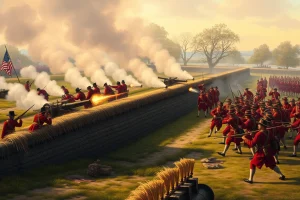
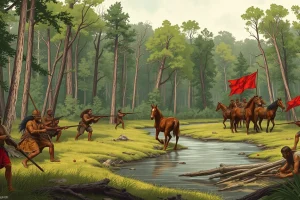
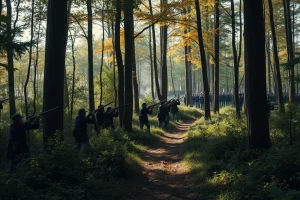
On 15 August, Brock sent Hull a surrender demand, emphasizing that he could not control his Indigenous allies once fighting began. Hull refused, and that night British artillery on the Canadian shore bombarded Fort Detroit. The next morning, Brock’s force of about 330 regulars, 400 militia (dressed in surplus red coats), and 600 Indigenous warriors crossed the Detroit River and landed south of the fort. Tecumseh orchestrated a clever display, marching his warriors repeatedly through clearing in the woods to give the impression of a much larger force. Hull, fearing an assault and especially the fate of the women and children inside, including his own daughter, surrendered the fort without a general engagement.
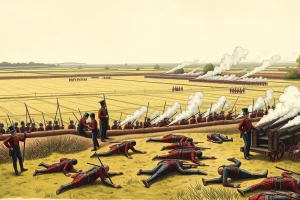
The surrender yielded over 2,500 American prisoners, 33 pieces of artillery, the brig Adams, and abundant military stores. British casualties were only two wounded, while the Americans lost seven killed and the rest captured. The entire Michigan Territory fell under British control.
Why It Matters
The fall of Detroit was a stunning early victory for the British and their Indigenous allies. It shattered American confidence in the war and preserved Upper Canada from immediate invasion. For Tecumseh, the victory strengthened his confederacy and demonstrated the value of alliance with Britain. For Brock, it secured his reputation as a bold and effective commander and bolstered militia morale. The event also underscored the critical importance of Indigenous alliances in the war, a factor often underestimated by American planners.
Historians debate Hull’s decision to surrender, with some condemning his cowardice and others noting his legitimate fears of an Indigenous massacre. The victory delayed American plans in the Northwest and forced them to regroup, prolonging the war in that theater. Brock and Tecumseh’s alliance, forged at Detroit, would continue until Brock’s death at Queenston Heights in October 1812, but the memory of their cooperation remained central to the war’s narrative.
Prelude
The immediate prelude to the Detroit campaign was Hull’s abortive invasion of Canada. After occupying Sandwich (Windsor) without opposition, Hull issued a proclamation threatening Canadian militia with attack by Indigenous warriors—a move that backfired by alienating potential supporters. British and Indigenous raids cut his supply line, culminating in the ambush of an American detachment at Brownstown on 5 August. Hull then retreated to Detroit, where he awaited reinforcement.
Brock, meanwhile, had prorogued the Upper Canada legislature and gathered volunteers. He arrived at Amherstburg on 13 August, having traveled about 300 miles in a week. His arrival electrified the garrison and the local Indigenous forces.
Forces and Commanders
British and Allied forces under Major General Isaac Brock numbered approximately 1,330 men: 330 regular infantry of the 41st Foot, 400 Canadian militia, and about 600 Indigenous warriors led by Tecumseh and other chiefs, including Roundhead and St. John. Tecumseh commanded a force composed of Shawnee, Wyandot, Ojibwa, and other nations.
American forces at Fort Detroit numbered about 2,500, commanded by Brigadier General William Hull. The garrison included the U.S. Regiment of Artillerists, the 4th U.S. Infantry, and Ohio militia. Despite superior numbers and strong fortifications, Hull was plagued by low morale, supply shortages, and distrust of his leadership.
Battlefield and Map Context
Fort Detroit stood on the north bank of the Detroit River, a narrow strait linking Lake Erie to Lake Huron. The fort was a square enclosure with earthen walls, a ditch, and a double row of pickets. The river was about 1,200 yards wide at that point, and the Canadian shore was elevated, allowing British artillery to bombard the fort. The surrounding terrain included dense woods that concealed the movements of Tecumseh’s warriors.
Modern location: The site is in present-day Detroit, Michigan, near the riverfront. The fort itself no longer exists, but the area is marked by historic plaques and the Detroit International Riverfront.
Battle Chronology
13 August: Brock arrives at Amherstburg, meets Tecumseh.
14 August: Brock reviews forces and finalizes plans.
15 August: Brock sends surrender demand; Hull refuses. British artillery opens fire in the evening.
16 August: British and Indigenous forces cross the river and land south of the fort. Hull surrenders after the advance begins. The formal surrender is signed.
Casualties and Losses
British and Indigenous casualties: two wounded (from the bombardment). American casualties: seven killed, 2,493 captured, along with 33 cannon, the brig Adams, and all stores. Hull also surrendered the Michigan Territory.
Result
The capture of Detroit was a decisive British and Indigenous victory. It eliminated the American threat to Upper Canada in the west, secured the allegiance of many Indigenous nations to the British cause, and handed the Americans a humiliating defeat. Hull was later court-martialed and sentenced to death, but President Madison remitted the sentence in recognition of his Revolutionary War service.
Strategic Consequences
The immediate strategic consequence was the collapse of American control over the Northwest. Michigan Territory became an occupied zone, and Ohio and Indiana were exposed to raids. The victory forced the Americans to allocate resources to rebuild their western armies, delaying further invasions of Canada. For the British, it validated Brock’s offensive strategy and boosted militia enlistments. For Tecumseh, it confirmed that alliance with Britain could defend Indigenous homelands, though the long-term consequences of that alliance would later shift.
The victory also influenced international opinion and undermined the American case for the war. It demonstrated the strength of the British position in a region many had assumed would fall easily.
Primary Accounts
Several primary sources shed light on the event. Brock’s official report to Governor General Sir George Prevost, dated 17 August 1812, describes his movements and the surrender. Tecumseh left no written account, but his words and actions were recorded by British officers and later historians. Hull’s court-martial testimony, published in 1814, provides an American perspective, though it is necessarily defensive. Contemporary letters, such as those written by militia officers and civilian observers, add detail. These accounts must be weighed for bias—Brock’s report emphasizes his own success, while Hull’s testimony seeks to justify his decision.
Battlefield Today
The site of Fort Detroit is now part of the city of Detroit. No fortifications remain, but the Detroit Historical Society and the National Park Service interpret the event. A historical marker commemorates the surrender location. The Canadian side of the river, near Amherstburg, is also preserved at Fort Malden National Historic Site, which was the British base for the operation. The battlefield landscape has been heavily altered by urban development, but the river itself remains a visible feature.
Primary Sources
Primary documents include:
- Isaac Brock’s report to Prevost, 17 August 1812, published in Select British Documents of the Canadian War of 1812.
- William Hull’s court-martial proceedings, which contain his testimony and the testimony of other American officers.
- Letters of Tecumseh as recorded by British officers, such as those of Major-General Roger Hale Sheaffe.
- Contemporary newspaper accounts from both sides, such as the Quebec Mercury and American papers.
These sources are available in archives such as Library and Archives Canada and the U.S. National Archives.
Further Reading
- Hickey, Donald R. The War of 1812: A Forgotten Conflict. University of Illinois Press, 2012.
- Latimer, Jon. 1812: War with America. Harvard University Press, 2007.
- Benn, Carl. The War of 1812. Osprey Publishing, 2002.
- Dictionary of Canadian Biography, entries for Brock and Tecumseh.
- National Park Service, “Isaac Brock and Tecumseh.”
References
- “Summer 1812: British General Isaac Brock and Shawnee Leader Tecumseh form an alliance,” U.S. National Park Service, accessed 2023. [URL]
- “The Fall of Detroit – War of 1812,” The War of 1812 Website, accessed 2023. [URL]
- “Capture of Detroit,” Canada History Society, accessed 2023. [URL]
- “Brock at Detroit,” Upper Canada History, accessed 2023. [URL]
- “BROCK, Sir ISAAC,” Dictionary of Canadian Biography, accessed 2023. [URL]
FAQ
How did Brock and Tecumseh cooperate at Detroit?
Brock supplied the disciplined British regulars and militia, while Tecumseh's warriors provided intelligence and psychological pressure. Tecumseh's tactic of marching his warriors in a loop through gaps in the woods exaggerated their numbers, contributing to Hull's decision to surrender.
Why did Hull surrender so quickly?
Hull feared an assault by a much larger force than actually existed, and he was especially concerned about the safety of women and children, including his own daughter, if the fort were taken. His supply lines were cut, and his army's morale was low after a failed invasion.
What was the significance of the Detroit victory for Native peoples?
It demonstrated the military value of the British-Indigenous alliance and secured Tecumseh's influence. For many Indigenous nations, it was a temporary check on American expansion, but the long-term outcome of the war eventually left them facing increased American settlement.

Leave a Reply