
Short Answer
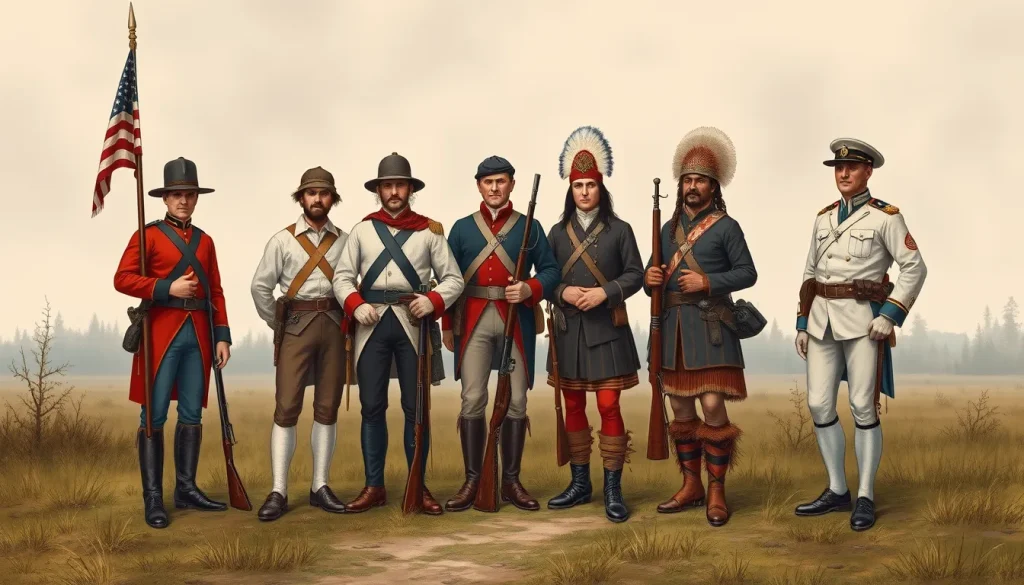
The people doing the fighting included regular soldiers, militia, volunteers, sailors, marines, privateers, First Nations warriors, Métis fighters, and Black combatants on both sides. Women and other civilians sustained military operations, protected households, and experienced raids, occupation, displacement, and the search for freedom.
The diplomatic description—United States against Britain—is accurate. Understanding the participants requires a wider view of the communities, alliances, and different objectives behind those two principal powers. ^1
The Two Main Belligerents
The United States
President James Madison led the American government when Congress declared war on Britain on June 18, 1812. American grievances included British restrictions on maritime trade and the impressment of sailors from American vessels. American expansion and conflict over Indigenous territory also shaped the war.
The government directed several campaigns rather than a single unified offensive. American forces invaded British North America, fought in the Great Lakes region, defended coastal communities, and confronted enemies in the South.
However, the government’s decision did not represent unanimous public agreement. Opposition was especially important among Federalists and in parts of New England, where disrupted trade threatened livelihoods. Political disagreement also affected the relationship between state authorities and federal military leaders.
Americans fought the war, but Americans did not all support it. That distinction helps explain why recruitment, funding, militia mobilization, and coordination became persistent difficulties. ^7
The United Kingdom
The formal British state in 1812 was the United Kingdom of Great Britain and Ireland. Calling its forces simply “English” is too narrow: British military service drew on a wider kingdom and empire.
Britain was simultaneously fighting Napoleon’s France. Its leaders had to protect maritime commerce, sustain European campaigns, and defend North American possessions. The American war therefore competed with other major demands for soldiers, ships, and resources.
As Napoleon’s position deteriorated, Britain could redirect more forces toward North America. This helped enable the stronger British offensives of 1814.
British objectives and available resources changed during the conflict. Early defense of colonial territory developed alongside blockade, coastal raids, and later attacks on American positions. Reading every British operation as part of an identical plan obscures that change over time. ^9
Who Served in the American Forces?
Regular Army Soldiers
The United States Army supplied the standing military force under federal authority. Its regular soldiers served in infantry, artillery, and other military roles.
At the beginning of the war, the army was too small and widely dispersed for the campaigns American leaders hoped to undertake. Rapid expansion did not immediately solve problems of training, leadership, equipment, or supply.
“Regular” described organizational status, rather than guaranteeing effectiveness. Some American regular units performed poorly early in the conflict. Others improved substantially through training and experience.
That improvement became especially visible at Chippawa in July 1814, where American regulars defeated British regulars. The battle demonstrates why American military performance should be assessed by campaign and period, rather than reduced to a single judgment about the entire army. ^48
State Militia and Volunteers
Militia were locally organized citizen soldiers called into service. They supplemented the regular army and played a particularly important role in defending communities.
Their service obligations, training, equipment, and willingness to operate far from home varied. Short service terms made prolonged campaigns difficult. Disputes over authority also complicated cooperation between state organizations and federal commanders.
At Queenston Heights, some American militia refused to cross into Canada. Such episodes exposed the difference between mobilizing men and creating a force capable of conducting an invasion.
Nevertheless, militia were not uniformly ineffective. In the Chesapeake, they carried much of the responsibility for local defense because regular troops were concentrated elsewhere. Their performance depended on preparation, leadership, terrain, and the task assigned.
Volunteer formations also contributed. The terms “militia,” “volunteers,” and “regulars” should not be treated as interchangeable descriptions of every American soldier. ^10
Sailors and the United States Navy
American sailors fought aboard ocean-going warships, smaller coastal vessels, and squadrons constructed for inland waters.
The Navy’s successes against British frigates attracted public attention, but its work extended beyond famous ship duels. Naval forces attacked commerce, protected positions, supported armies, and contested control of lakes that carried essential supplies.
The inland squadrons were particularly important. Oliver Hazard Perry’s victory on Lake Erie enabled American advances in the northwest. Thomas Macdonough’s victory on Lake Champlain helped stop the British invasion of northern New York.
Sailors therefore influenced both maritime and land warfare. A ship’s crew might determine whether an army could move supplies, maintain a position, or continue an offensive. ^13
Marines and Flotillamen
The U.S. Marine Corps served alongside naval forces and participated in fighting ashore.
The Chesapeake Flotilla supplied another important group of American combatants. These sailors operated small vessels suited to regional waterways and later fought on land.
At Bladensburg on August 24, 1814, Commodore Joshua Barney’s flotillamen and U.S. Marines resisted the British advance even as other American positions collapsed. Their stand could not prevent defeat or the subsequent occupation of Washington.
The episode shows why “army battle” can be an incomplete description. Naval personnel and marines could play substantial roles in a land engagement. ^15
Privateers
Privateers were privately operated armed vessels authorized by a government to attack enemy shipping. Their crews participated in the war without serving aboard ordinary government warships.
They sought captured vessels and cargoes that could become valuable prizes through legal proceedings. Privateering combined strategic disruption with commercial incentives.
American privateers expanded the maritime pressure the United States could apply despite its small navy. Their attacks threatened British merchant shipping and made protection of commerce more difficult.
A privateer should be distinguished from a pirate. Government authorization and the legal treatment of captures were central to privateering. Individual conduct could still raise legal disputes, and authorization did not make every action lawful.
For the question of who fought, the key point is that significant maritime combat occurred outside the regular navy. ^16
Revenue Cutter Crews
The Revenue Cutter Service also participated in the conflict. Its vessels belonged to the Treasury Department and performed duties connected with customs enforcement and protection of commerce.
During the war, cutter crews encountered enemy vessels and undertook defensive operations despite their small ships and limited armament.
These men form part of the history later inherited by the U.S. Coast Guard. Calling them “Coast Guardsmen” without explanation can obscure the institution under which they actually served.
Their experience also illustrates the breadth of wartime participation: a service established for revenue enforcement could become involved in armed conflict when national commerce and coastal waters were threatened. ^17
Who Fought for Britain and British North America?
British Regulars and Naval Forces
British regular troops provided an essential part of the defense of British North America. Their commanders worked with colonial units and Indigenous allies, often under difficult conditions of distance and supply.
The Royal Navy operated at sea and in coastal waters. Its blockade sought to restrict American commerce, while ships supported raids and the movement of troops. British landing forces could include soldiers, sailors, and marines.
The Navy’s global strength did not guarantee success in every encounter. American frigates won notable individual battles, and American squadrons defeated British forces on important inland waters. Nevertheless, Britain’s wider naval power remained a major constraint on the United States.
The participants in a British campaign therefore depended on its location. A frontier engagement, a lake battle, and a coastal expedition could involve quite different combinations of forces. ^18
Canadian Militia, Fencibles, and Other Local Units
People living in British North America contributed through militia and locally raised military formations.
These included English-speaking and French-speaking inhabitants, as well as communities with different backgrounds and relationships to British rule. Defending a farm, settlement, or province could provide a more immediate motive than a distant imperial dispute.
The military labels matter:
- Militia included local men with military obligations, with varying forms of mobilization.
- Fencibles were regular troops raised for geographically restricted service.
- Canadian Voltigeurs were a locally raised light infantry corps associated with Charles-Michel de Salaberry.
At Châteauguay, Canadian Fencibles, Voltigeurs, militia, and Indigenous fighters contributed to the defense. The battle illustrates the combined character of colonial warfare.
Describing every locally recruited soldier as a militiaman erases meaningful differences in organization, service, and preparation. ^20
Was Canada a Country Fighting the United States?
Canada was not yet the independent confederation established in 1867. The relevant territories were British colonies, including Upper Canada and Lower Canada.
People from those colonies fought, but their service occurred within the defense of British North America. Britain was the principal sovereign belligerent opposing the United States.
The familiar phrase “America versus Canada” can be useful shorthand for fighting across the border, but it is incomplete. It leaves out British regulars, naval forces, Indigenous nations, and the political status of the colonies.
Equally, saying “only Britain fought” would erase colonial participation. The accurate description recognizes both the British state and the people and units recruited in its North American possessions. ^22
Black Soldiers in Upper Canada
Black men participated in the defense of Upper Canada through both integrated militia units and a separately organized company.
A Black militia company formed in 1812 participated at Queenston Heights. It later became known by several names, including the Colored Corps, a historical designation used in contemporary records.
For some Black residents, defending Upper Canada also meant protecting a place that offered greater security from American slavery. That motive should be understood alongside the limits of freedom in the British Empire at the time.
Their service challenges depictions of the Canadian defense as exclusively white. It also provides a distinct history from that of African Americans who escaped to British naval forces in the Chesapeake. ^23
Indigenous Nations Were Central Participants
Independent Interests Behind Military Alliances
Indigenous participation was fundamental to the war. Many nations and communities sought to protect homelands, political autonomy, trade relationships, and cultural life against expanding American settlement.
An alliance with Britain did not mean that Indigenous peoples shared every British objective or accepted British ownership of their territory. Cooperation developed where interests overlapped.
Nor did Indigenous peoples act as a single bloc. Communities debated participation, considered neutrality, and assessed the risks of relying on either imperial or American promises.
The wars over Indigenous land had begun before the Anglo-American declaration and continued afterward. Their origins cannot be explained entirely through disputes about sailors or maritime trade.
Indigenous nations should be understood as participants with their own political purposes, rather than as an anonymous supporting category attached to one country. ^24
Tecumseh and His Allies
Tecumseh, a Shawnee leader, worked to build cooperation among Indigenous nations against American expansion. His movement connected resistance in the northwest with broader efforts to protect Indigenous territory.
During the War of 1812, he cooperated with British forces. His alliance with Isaac Brock contributed to the American surrender at Detroit.
Tecumseh’s authority was influential but not universal. His movement did not include every Indigenous community, and the people who joined it retained their own local interests.
His death at the Battle of the Thames on October 5, 1813, severely weakened the prospects of the confederacy. It did not end all Indigenous resistance.
Understanding Tecumseh as a leader pursuing Indigenous survival and autonomy gives a fuller explanation of his role than describing him simply as a British ally. ^26
First Nations and Métis Fighters
The defense of British North America involved warriors from many communities. Participants included members of Shawnee, Ojibwe, Odawa, Potawatomi, Haudenosaunee, Dakota, and other nations.
Their contributions varied across the western Great Lakes, Niagara frontier, and St. Lawrence region. They fought in engagements such as Detroit, Queenston Heights, Beaver Dams, and Châteauguay.
Métis fighters also participated, particularly within the networks connecting western communities, transport, and the fur trade.
British Indian Department officials sometimes served as intermediaries between Indigenous leaders and military commanders. Communication and negotiation were necessary because these forces came from different political and social organizations.
A list of participating nations is not a claim that every member fought, that every community made the same decision, or that alliances remained unchanged throughout the war. ^4
Haudenosaunee Communities and Divided Loyalties
Haudenosaunee participation demonstrates the difficulty of assigning an entire people to one side.
Communities across the border confronted pressure from both Britain and the United States. Some initially sought neutrality, hoping to avoid another destructive conflict between outside powers.
John Norton, also known as Teyoninhokarawen, led warriors allied with Britain and participated in several Niagara engagements. Other Haudenosaunee communities followed different courses.
The decision to fight could divide people connected through kinship and shared political traditions. National labels on a modern map do not adequately explain those relationships.
Neutrality also carried risks: an approaching invasion could threaten a community whether or not it wished to enter the war. These choices deserve to be treated as political decisions, rather than automatic reactions to British or American demands. ^28
Indigenous Allies of the United States
Some Indigenous communities cooperated with American forces.
Cherokee and Creek allies served with Andrew Jackson during the Creek War. Choctaw fighters also participated in southern operations, including the New Orleans campaign.
These alliances had local explanations. Communities might seek protection against rivals, preserve relationships with American authorities, or judge cooperation to be the least dangerous available option.
Serving alongside the United States did not guarantee security afterward. Military cooperation and the defense of Indigenous land could pull in different directions.
The presence of Indigenous allies on both sides is one reason the conflict cannot be reduced to “Americans fighting Native Americans.” Indigenous political decisions and divisions shaped who fought whom. ^30
The Creek War and Red Stick Fighters
The Creek War of 1813–1814 overlapped with the War of 1812 but had its own origins in Muscogee political divisions, resistance to American influence, and struggles over land and authority.
Red Stick fighters opposed forces that included American soldiers and militia, Cherokee warriors, and Creek allies of the United States.
At Horseshoe Bend on March 27, 1814, Jackson’s army attacked the Red Stick position. Menawa was among the defenders’ principal leaders.
This was not simply a battle between an American army and a British army. Indigenous combatants fought on both sides, while the wider Anglo-American war influenced supplies, diplomacy, and opportunities.
The distinction matters because collapsing the Creek War into the British-American conflict hides the specific disagreements and threats confronting Muscogee communities. ^32
Black Combatants and the Struggle for Freedom
Service With the United States
Free and enslaved Black men served in American military operations, including aboard naval vessels and privateers.
Their experiences differed. Free men could pursue work, recognition, or community defense. Enslaved men faced coercion and restricted choices; some hoped military service would lead to freedom.
Examples include Charles Ball, who served with the Chesapeake Flotilla; George Roberts, a gunner aboard the privateer Chasseur; and Frederick Hall, who enlisted under the name William Williams and defended Fort McHenry.
These examples establish participation without implying equal access to military service. Racial exclusions, inconsistent policies, and incomplete records make sweeping claims about Black enlistment unreliable. ^34
Colonial Marines and Freedom Seekers
Other Black men fought with Britain after escaping American slavery.
British naval presence created opportunities for enslaved people to reach ships and military protection. Admiral Alexander Cochrane’s proclamation of April 2, 1814, encouraged people to seek refuge and offered opportunities for military service or resettlement.
Formerly enslaved recruits entered the Corps of Colonial Marines and participated in British Chesapeake operations. Their local knowledge helped British forces navigate waterways and roads.
Women, children, and other relatives also sought refuge, although they were not members of the combat unit. Separating these groups prevents the mistaken assumption that every person escaping to Britain became a soldier.
For the recruits, military service could be a means of securing freedom for themselves and their families. Their decisions cannot be understood solely through American patriotism or British imperial strategy. ^35
Military Service Did Not End Racial Inequality
Black participation exposed a central contradiction: governments sought military assistance while maintaining unequal societies.
American service did not produce general emancipation or racial equality. British assistance to freedom seekers also did not mean that slavery had ended throughout the British Empire.
The outcomes depended on individual circumstances, location, and the terms under which people served or escaped.
Remembering Black combatants therefore requires examining both military contributions and the freedom—or continued restriction—that followed. Participation in a national war did not automatically deliver the rights associated with national belonging. ^36
New Orleans: A Coalition of Different Participants
The defense of New Orleans brought together regular troops, militia, naval personnel, free Black soldiers, Indigenous allies, and men associated with Jean Lafitte’s Baratarian network.
The free men of color were an important part of Jackson’s force. Their service reflected negotiations over status and recognition within a society marked by slavery and racial hierarchy.
Baratarian artillerymen contributed experience with guns. Their cooperation followed complicated dealings with American officials, rather than a simple transition from outlaw activity to uncomplicated patriotism.
Choctaw fighters supplied another part of the campaign’s defense.
New Orleans is a useful example of how an army under one commander could contain participants whose backgrounds, legal positions, and reasons for fighting differed substantially. Jackson’s command did not make those differences disappear. ^37^31
Women, Families, and Other Civilians
Most women were outside formal military enlistment, but the war depended on labor beyond the ranks.
Army laundresses performed difficult work for military communities. Women also managed households and livelihoods disrupted by absent family members, raids, and occupation.
Some aided wounded soldiers or produced military supplies. Mary Pickersgill and her team made the flag associated with Fort McHenry. Enslaved women such as Lucy Hall sought freedom through escape to British protection with their families.
The surviving evidence is uneven. Letters and diaries often preserve the experiences of literate, relatively prosperous women more clearly than those of servants, farmworkers, enslaved women, or Indigenous women.
These participants should be recognized without automatically describing them as combatants. Fighting, supporting a military force, and surviving the war were related but distinct experiences. ^39
Important Leaders and What They Represented
| Leader | Role in the conflict |
|---|---|
| James Madison | U.S. president directing the government’s war policy |
| William Henry Harrison | American commander associated with the northwestern campaigns |
| Winfield Scott | American officer whose training and leadership contributed to improved regular troops |
| Oliver Hazard Perry | American naval commander at Lake Erie |
| Thomas Macdonough | American naval commander at Lake Champlain |
| Isaac Brock | British commander in Upper Canada and ally of Tecumseh |
| George Prevost | Governor-general and senior British commander in North America |
| Charles-Michel de Salaberry | Commander of Canadian defenders at Châteauguay |
| Tecumseh | Shawnee leader seeking broader Indigenous cooperation against American expansion |
| John Norton | Haudenosaunee war leader allied with Britain |
| Andrew Jackson | American commander in the Creek War and New Orleans campaign |
| Menawa | Red Stick leader at Horseshoe Bend |
| Robert Ross | British commander in the 1814 Chesapeake campaign |
These names help identify campaigns, but prominent commanders are not a substitute for the history of ordinary participants. Soldiers, sailors, warriors, laborers, and families made their plans possible and bore much of the cost. ^7^26^33^42^14
France, Spain, and the Wider Setting
Did France Fight Alongside the United States?
France’s war with Britain shaped the circumstances of the War of 1812. Maritime restrictions and Britain’s European commitments influenced American grievances and opportunities.
However, Napoleon’s France was not an American military ally in the War of 1812 through a shared alliance or joint campaign. The two conflicts overlapped strategically without becoming one coordinated war effort.
Napoleon’s defeat in 1814 altered the balance by freeing Britain to redirect forces. France therefore belongs in the explanation of the wider setting rather than in a simple list of American battlefield allies. ^45
What About Spain?
Spain controlled Florida, which became entangled in southern warfare.
British activity in Spanish territory, Indigenous resistance, and American operations made the region strategically important. Jackson attacked Pensacola in November 1814 even though Spain was neutral in the Anglo-American war.
Spanish officials, territory, and local forces thus belong in the history of the southern theater. Their involvement should not be simplified into an assumption that Spain fought throughout the conflict as an equal principal belligerent beside Britain. ^46
Why the Participants Matter
Identifying who fought changes how the war’s outcome is understood.
For the United States and Britain, the Treaty of Ghent ended their conflict and provided for restoration of conquered territory. For Canadian colonists, successful defense helped preserve British North America.
For many Indigenous nations, the consequences included weakened alliances and greater vulnerability to American expansion. For some formerly enslaved people, British protection opened a route to freedom; for others, military contribution brought little lasting improvement.
These outcomes were not identical. A national account centered on a famous victory can obscure what the same conflict meant for another participant.
The question “Who fought?” therefore leads directly to another: whose objectives and experiences are being used to judge the war? ^2^36
Common Misconceptions
It Was Only Americans Against British Soldiers
The principal states were the United States and Britain, but combat involved colonial units, Indigenous allies, Black participants, sailors, marines, and privateers.
All Indigenous Peoples Supported Britain
Some allied with Britain, some cooperated with the United States, and others sought neutrality. Decisions varied within and between communities.
Canadian Forces Were All Militia
The defense included militia, locally raised regular formations, British regulars, and other forces. “Canadian” describes origin or connection; “militia” describes a form of military organization.
Everyone Had the Same Reason for Fighting
National policy, wages, local defense, political obligations, protection of land, and the pursuit of freedom could motivate different participants—even within a single force. ^3^25
Was This the Same as Napoleon’s Invasion of Russia?
No. Both began in 1812, but they were distinct conflicts. Britain’s war against Napoleon affected the resources and strategy available for its war with the United States. ^45
References and Further Reading
FAQ
Did Canada fight in the War of 1812 as its own country?
No. Canada was not an independent state until 1867. The war's Canadian participants were British subjects in the provinces of Upper Canada, Lower Canada, New Brunswick, Nova Scotia, and Newfoundland, serving in British regular units, fencibles, provincial corps, and militia.
Did Indigenous nations fight on both sides?
Yes. Most nations in the Great Lakes and Ohio country allied with Britain, including Tecumseh's confederacy and the Six Nations of the Grand River, but the Cherokee, Choctaw, and White Stick Creeks fought alongside the United States, notably at Horseshoe Bend in 1814.
Did African Americans serve in the war?
Yes, on both sides. Free and enslaved Black men served in US forces, including Louisiana's battalion of free men of color at New Orleans, while the British recruited formerly enslaved men into the Corps of Colonial Marines in 1814.
Was Spain a belligerent?
Spain was Britain's ally against Napoleon and allowed British forces to use Pensacola in Spanish Florida as a base; Andrew Jackson seized the town in November 1814. Spain itself did not formally wage war against the United States.


Leave a Reply