
Short Answer
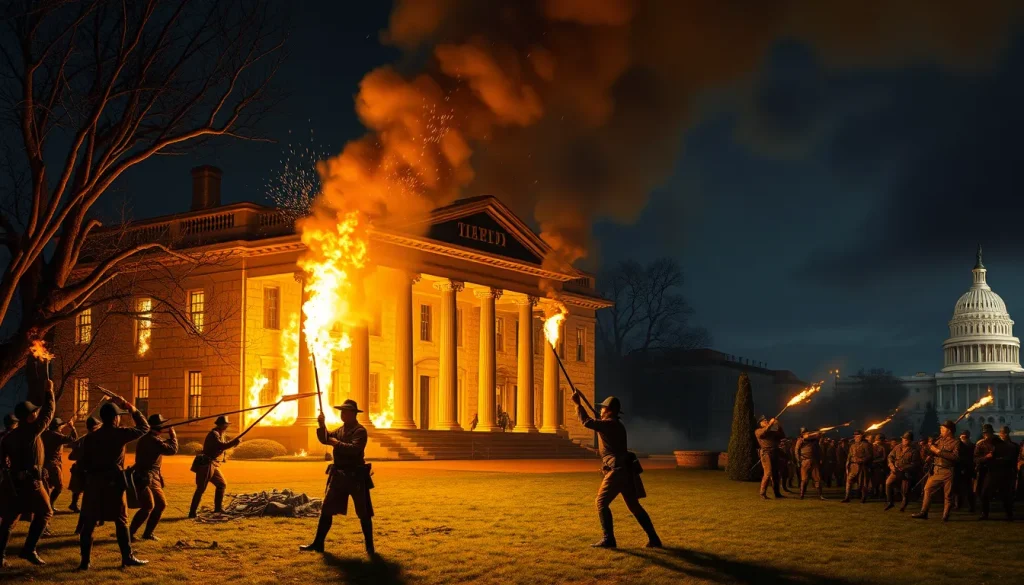
The White House, then known as the President’s House, was burned by British forces on August 24–25, 1814, during the War of 1812. It was an act of retaliation for American destruction of public buildings in Upper Canada, particularly the capital at York (Toronto) and the town of Newark (Niagara-on-the-Lake). The burning was the only time in American history that a foreign power captured and occupied the U.S. capital, and it profoundly humiliated the Madison administration while galvanizing American determination to continue the war.
Historical Context
The War of 1812 began in June 1812 with the United States declaring war on Great Britain, in part over impressment, trade restrictions, and British support for Indigenous resistance to American expansion. The U.S. invasion of Canada was intended to pressure Britain, but the campaigns were poorly executed. In April 1813, American forces captured York, the capital of Upper Canada, and burned the parliament buildings. In December 1813, American troops burned the town of Newark, leaving hundreds of civilians homeless in freezing temperatures. These actions created a strong desire for retaliation within the British military and public.
By 1814, Britain was able to send veteran troops from the Napoleonic Wars to the Chesapeake Bay, where Rear-Admiral George Cockburn and Major-General Robert Ross planned a raid to capture Washington. American defenses were weak: the capital lacked fortifications, and President James Madison’s administration had not prepared for a direct attack.
What Happened
After landing at Benedict, Maryland, on August 20, 1814, a British force of about 4,500 men marched toward Washington. On August 24, they defeated American defenders at the Battle of Bladensburg, after which the U.S. forces fled in chaos. President Madison and most of the government evacuated the city. First Lady Dolley Madison oversaw the removal of a full-length portrait of George Washington and other valuables before she left.
That evening, British troops entered Washington. They set fire to the Capitol, the President’s House, the Treasury, the War and State Departments, and the navy yard, including a frigate under construction. The destruction was largely directed at public buildings; private property was generally spared, and looting was forbidden. The Patent Office was spared after its superintendent argued that its contents were private intellectual property. A violent thunderstorm on August 25 extinguished some flames, but the damage was immense. The British withdrew after one day, returning to their ships.
Why It Matters
The burning of Washington stunned the American public and the federal government. It exposed the weakness of the capital’s defenses and the failure of the Madison administration to foresee the threat. The episode intensified Federalist criticism and contributed to the Hartford Convention. Paradoxically, it also fueled a surge of national pride and defiance, helping to inspire successful resistance at Baltimore three weeks later. The rebuilding of the White House and Capitol became a symbol of American resilience, and the charred walls of the President’s House were painted white, giving the building its familiar name.
Historians interpret the burning as a key event in the War of 1812 that humiliated the United States but also strengthened national identity. It remains a powerful reminder of the consequences of war and the vulnerability of democratic institutions.
Definition
The burning of the White House refers to the deliberate destruction by British troops of the President’s House and other public buildings in Washington, D.C., on August 24–25, 1814. It was an act of military retaliation, ordered by Major-General Robert Ross and Rear-Admiral George Cockburn, and carried out by approximately 4,500 soldiers and sailors during the British occupation of the capital.
Background
The British decision to burn Washington was a direct response to American attacks on Upper Canada. The most cited justifications were the burning of the parliament buildings at York (April 27, 1813) and the destruction of Newark (December 10, 1813). British officials and military leaders considered these acts to be violations of the laws of war, especially the Newark episode, which left hundreds of families homeless in winter. The British saw the burning of public buildings as a proportional retaliation. Additionally, the Chesapeake campaign was intended to relieve pressure on British forces in Canada and to bring the war to the American mainland.
How It Worked
After the Battle of Bladensburg, the British encountered no organized resistance in Washington. They systematically targeted government structures, using flammable materials and gunpowder to ignite the Capitol, the President’s House, the Treasury, the War and State Departments, the arsenal, and the navy yard. Troops were ordered to avoid private homes; they entered the President’s House, reportedly eating leftover food from the dinner table, before setting it ablaze. A group of about 100 soldiers and sailors carried out the work, directed by officers. When a violent thunderstorm struck on the night of August 25, it extinguished some flames, but the damage was done. The British then withdrew, having achieved their objective.
Competing Viewpoints
British accounts emphasized the retaliation for American outrages in Canada and the discipline exercised in sparing private property. Major-General Ross explicitly instructed his troops to destroy public buildings, stating that this was necessary to ensure the army could retire without loss of time. Many British officers and soldiers, including veterans of the Napoleonic Wars, saw the burning as legitimate punishment for American misconduct. American accounts, by contrast, condemned the burning as wanton and uncivilized, focusing on the destruction of the Library of Congress and the national humiliation. Some contemporary observers acknowledged that the British had stayed their hand against private property, but they still viewed the act as an atrocity. Historians continue to debate whether the burning was a lawful reprisal or an excessive and destructive act, though most agree that it was specifically a retaliation for American actions in Canada.
Role in the War of 1812
The burning of Washington occurred during a decisive period of the war, when British forces had the upper hand. It demonstrated Britain’s ability to strike at the American capital and severely weakened the credibility of the Madison administration. The event also prompted a wave of patriotic fervor, helping to unify the nation behind the war effort. Three weeks later, the successful defense of Baltimore, celebrated in “The Star-Spangled Banner,” was partially fueled by the outrage over Washington’s destruction. The burning did not lead to an immediate end to the war, but it influenced the negotiations of the Treaty of Ghent by reinforcing British military superiority while also strengthening American resolve. The war ended in a stalemate in December 1814.
Consequences and Historical Interpretation
The immediate consequences of the burning included the evacuation of the government, extensive property damage, and a political crisis. The President’s House was rebuilt between 1815 and 1817; James Monroe moved in in 1817, and the building’s white-painted walls became the source of its nickname. The Capitol was reconstructed and expanded, and the Library of Congress was re-established with the purchase of Thomas Jefferson’s library. In the longer term, the burning became a central narrative in American history, symbolizing both national resilience and the horrors of war. Historians like Donald R. Hickey and Anthony S. Pitch have examined the event in detail, emphasizing its role in shaping American national identity. The burning of Washington is now widely remembered as a decisive moment in the War of 1812, and its causes—especially the retaliation for American actions in Canada—are recognized as a crucial part of the story.
Primary Sources
Key primary sources include: Ross’s report to Earl Bathurst (August 30, 1814), recounting the burning of public buildings; Cockburn’s letters and accounts, which provide British perspective; Dolley Madison’s letters to her sister, describing her escape and the rescue of the Washington portrait; and American newspapers and eyewitness accounts from residents of Washington who remained. Each source offers valuable insight, but readers must account for the biases and limitations—British reports may exaggerate restraint, while American accounts may emphasize destruction. The National Archives and the Library of Congress hold many of these documents.
Further Reading
- Pitch, Anthony S. The Burning of Washington: The British Invasion of 1814. Naval Institute Press, 1998.
- Hickey, Donald R. The War of 1812: A Forgotten Conflict. University of Illinois Press, 1989.
- White House Historical Association. “Days of Destruction: The President’s House.” whitehousehistory.org.
- National Park Service. “Complete the destruction of the public buildings with the least possible delay.” nps.gov.
References
- National Park Service. “Complete the destruction of the public buildings with the least possible delay.” nps.gov/articles/burning-the-capital.htm.
- thewarof1812.org. “The Burning of Washington – War of 1812.” thewarof1812.org/battles/the-burning-of-washington/.
- HISTORY.com Editors. “British troops set fire to the White House.” History.com, November 16, 2009.
- White House Historical Association. “Days of Destruction: The President’s House.” whitehousehistory.org.
- Architect of the Capitol. “A Most Magnificent Ruin: The Burning of the Capitol during the War of 1812.” aoc.gov.
FAQ
Why did the British burn the White House?
The British burned the White House (President's House) as retaliation for American destruction of public buildings in Upper Canada, especially at York and Newark. The attack was ordered by British commanders to punish the United States and weaken morale.
Did the British intend to burn the entire city?
No. The British deliberately targeted government and military buildings, sparing most private property. Their orders were to destroy public structures, and they generally enforced strict discipline, with looting forbidden.
How long did the British occupy Washington?
The British occupied Washington for about 24 hours, from the evening of August 24 to the night of August 25, 1814. After completing the destruction and being interrupted by a thunderstorm, they withdrew to their ships in the Chesapeake.
What happened to the White House after the fire?
The President's House was gutted but the sandstone exterior survived. It was rebuilt and painted white, which led to the informal name "White House." President James Monroe moved into the restored building in 1817.



Leave a Reply