
Short Answer
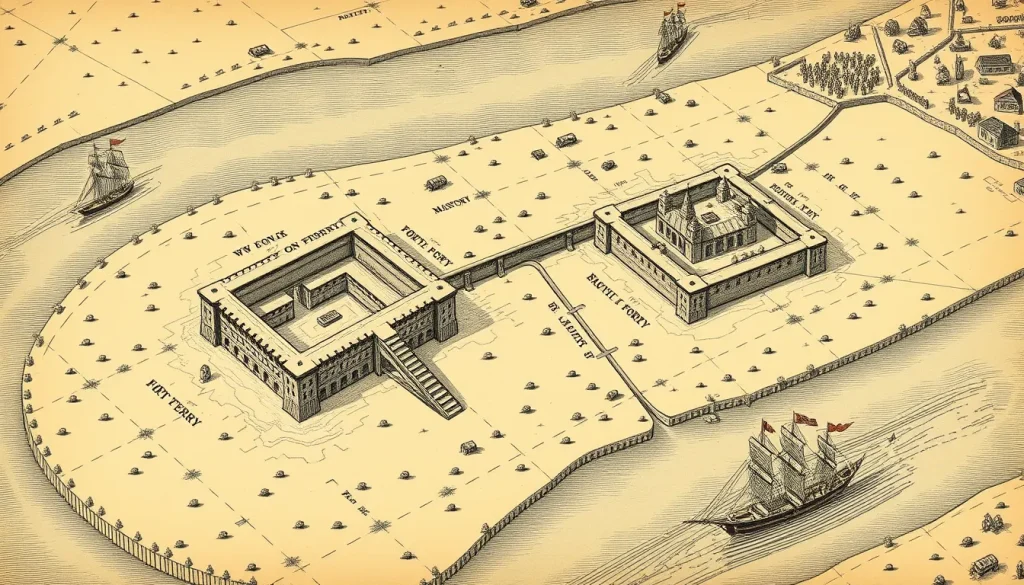
The fortifications of the War of 1812 comprised the system of permanent and temporary defensive works that shaped the conflict’s military operations across North America. Ranging from masonry fortresses such as Fort McHenry and the Citadel of Quebec to hastily constructed earthworks and palisades along the Great Lakes frontier, these installations protected harbors, supply routes, and strategic chokepoints. Their design, condition, and tactical use influenced both offensive campaigns and defensive stands from 1812 to 1815. Many of these forts survive today as national historic sites, underscoring their military and cultural legacy.
Historical Context
By the outbreak of the War of 1812, both the United States and British North America possessed fortifications that reflected earlier imperial rivalries and the post-Revolutionary settlement. The United States, fearing European powers, had begun a program of coastal fortification in the 1790s, with the U.S. Army Corps of Engineers constructing masonry forts at key harbors such as Baltimore, New York, and Philadelphia. These forts, including Fort McHenry, Fort Mifflin, and Castle Williams, were among the most modern in the Western Hemisphere. In British North America, the fortress of Quebec was the only permanent fortification of first rank, while Halifax served as a vital naval base and was heavily fortified. The frontier posts in Upper Canada—Fort St. Joseph, Fort Malden (formerly Fort Amherstburg), and Fort George—were built after 1796 to replace those relinquished under the Jay Treaty. These were often modest, temporary works serving as supply depots and Indian Department meeting places, with limited defensive strength. The outbreak of war in June 1812 found many of these installations neglected, undermanned, or still under construction, forcing commanders to improvise.
What Happened
During the war, fortifications played a central role in several major operations and were the focus of siege, bombardment, and occupation. On the Niagara frontier, the British Fort George initially served as headquarters for Major-General Isaac Brock before being captured by an American amphibious assault in May 1813. The Americans then constructed their own earthworks on the site, only to abandon them in December 1813 when British forces recaptured the position. Across the Niagara River, Fort Niagara changed hands multiple times, with the British capturing it in December 1813 and holding it until war’s end. In the northwest, Fort Detroit surrendered without a shot in August 1812 after an American garrison under General William Hull, fearing a massacre, capitulated; the British later used Fort Malden as a base for expeditions. On the Atlantic coast, the British bombardment of Fort McHenry in September 1814 proved unsuccessful, inspiring Francis Scott Key’s “Star-Spangled Banner.” The fortress of Quebec was never attacked directly, but it served as the linchpin of British strategy, allowing Governor General George Prevost to reinforce the Canadas. Fort St. Joseph, on the far western frontier, witnessed the first offensive act of the war—the British capture of Fort Mackinac in July 1812. Throughout the conflict, both sides built new works, such as the British Fort Mississauga at Niagara, Fort Wellington near Prescott, and the American Fort Meigs in Ohio, often adapting to technological changes like heavier artillery and improved earthworks.
Why It Matters
The fortifications of the War of 1812 had immediate strategic consequences: they protected key cities, controlled lines of communication, and provided bases for offensive operations. The successful defense of Baltimore at Fort McHenry bolstered American morale and contributed to the end of British pressure on the Chesapeake. In contrast, the fall of Fort Detroit and the capture of Fort George demonstrated the fragility of even supposedly defensible positions when leadership and support were lacking. Over time, the war convinced both nations to invest heavily in static defenses; the United States accelerated its third-system coastal fortifications, while Britain strengthened and expanded the works at Halifax and Quebec, and rebuilt frontier forts. The preservation of these sites today—many as national historic sites in Canada and the United States—reflects their role in shaping national identities and the memory of the war. Historians have debated their effectiveness, with some arguing that they were more significant as symbols and rallying points than as actual military barriers.
Definition
Fortifications are military constructions designed to protect a position from enemy attack, often involving walls, ramparts, ditches, and artillery placements. During the War of 1812, they ranged from permanent masonry star forts to temporary earthworks and wooden palisades. Their purpose was to defend strategic locations, control movement, and deter or withstand sieges.
Background
Fortifications in North America evolved from European military engineering traditions, particularly the trace italienne star fort designed to resist cannon fire. The American Revolution and subsequent conflicts left a legacy of older works, but by 1812, many were obsolete. The U.S. Corps of Engineers, established in 1802, oversaw the construction of modern masonry forts, while British Royal Engineers were responsible for Canadian defenses. The Peace of Paris (1783) and the Jay Treaty (1794) led the British to abandon posts in American territory, prompting the construction of new fortifications in Canada to maintain influence and defend the Great Lakes connection.
How It Worked
Fortifications operated through layered defensive elements: a ditch or dry moat, a rampart or wall, a parapet with embrasures for cannons, and often bastions that allowed defenders to fire along the walls. Permanent forts were typically built of stone and brick, while temporary works used earth and timber. The placement of batteries and the layout of the fort determined its defensive capability. Garrisons manned the walls and operated artillery, supported by ammunition magazines, barracks, and supply stores. Naval forts also featured waterfront batteries to command harbors and river mouths.
Competing Viewpoints
British and American planners held differing views on the best use of fortifications. American strategy emphasized coastal defense, protecting trade and cities, while British strategy focused on holding the St. Lawrence and Great Lakes to defend the Canadian colonies. Within both camps, there were debates about whether to rely on fortifications or pursue aggressive offensives. Some commanders argued that forts were liabilities that could fall and tie up troops, while others saw them as essential bases. Indigenous allies, who often provided crucial support, viewed forts as places of trade and ceremony rather than purely military structures, and their cooperation depended on these roles being sustained.
Role in the War of 1812
Fortifications were decisive in many operations. The American surrender of Fort Detroit in 1812 was a major turning point, while the British defense of Quebec and Halifax kept supply lines open. On the Niagara frontier, the capture and recapture of Fort George and Fort Niagara shaped the fighting. The American successful defense of Fort McHenry in 1814 protected Baltimore and became a national symbol. In the southwest, Fort Bowyer and the works at New Orleans played roles in the final British offensive. The war also saw the construction of new forts, such as Fort Meigs, which withstood sieges, and Fort Mississauga, which never fell.
Consequences and Historical Interpretation
After the war, both nations accelerated fortification programs. The United States invested heavily in a third system of coastal forts, while Britain upgraded the works at Halifax, Quebec, and the Great Lakes. These fortifications helped deter future invasions and contributed to the long peace between the United States and the British Empire. Historians have interpreted them through several lenses: some emphasize their technological innovation, others their strategic effectiveness, and some point to their limited impact on the war’s outcome, which was largely determined by naval control and troop morale. The preservation of many of these sites, often with reconstructed earthworks and buildings, reflects the desire to commemorate the conflict and its participants.
Primary Sources
Primary sources for the study of War of 1812 fortifications include official reports from the U.S. War Department and British Ordnance, such as the Secretary of War’s annual reports and the correspondence of Royal Engineers like Gother Mann and Ralph Henry Bruyeres. Military orders, correspondence between generals and engineers, contemporary maps and plans, and archaeological reports from Parks Canada provide direct evidence of construction, use, and condition. The National Park Service’s historical handbooks and Parks Canada’s commemorative documents are valuable secondary sources that contain primary documentation. Limitations include the loss of some records and the bias of official reports that often exaggerated the strength or weaknesses of forts for political reasons.
Further Reading
- Chartrand, René. Forts of the War of 1812. Osprey Publishing, 2012.
- Hickey, Donald R. The War of 1812: A Forgotten Conflict. University of Illinois Press, 1989.
- Elting, John R. Amateurs to Arms! A Military History of the War of 1812. Da Capo Press, 1995.
- Last, Joseph H. “What We Have Learned: A Retrospective on Parks Canada War of 1812 Military Sites Archaeology.” Northeast Historical Archaeology, vol. 44, 2017.
- National Park Service. “Historical Handbook: Fort McHenry.” n.d.
- Parks Canada. “Fort George National Historic Site.” Canada.ca.
- National Park Service. “Fortifications of Quebec National Historic Site.” n.d.
References
- Chartrand, René. Forts of the War of 1812. Osprey Publishing, 2012. https://www.ospreypublishing.com/us/forts-of-the-war-of-1812-9781849085762/
- Last, Joseph H. “What We Have Learned: A Retrospective on Parks Canada War of 1812 Military Sites Archaeology.” Northeast Historical Archaeology 44 (2017). https://orb.binghamton.edu/neha/vol44/iss1/2
- National Park Service. “Fortifications of Quebec National Historic Site.” https://www.nps.gov/places/fortifications-of-quebec.htm
- National Park Service. “Historical Handbook: Fort McHenry.” http://www.npshistory.com/handbooks/historical/5/hh5a.htm
- Parks Canada. “Fort George National Historic Site of Canada.” https://www.pc.gc.ca/apps/dfhd/page_nhs_eng.aspx?id=432
FAQ
What was the most important fortification in Canada during the War of 1812?
The fortress of Quebec was the only permanent fortification of first rank in Canada at the start of the war. It served as the seat of government and a vital stronghold for British operations.
How did fortifications influence the outcome of the War of 1812?
Fortifications protected key cities and supply routes, shaped sieges, and provided bases for campaigns. For example, the defense of Fort McHenry prevented a British victory in Baltimore, while the fall of Fort Detroit demoralized the Americans.
Which side had better fortifications?
Neither side had a systematic advantage. American coastal forts were more modern, but British frontier posts were strategically placed. The quality and maintenance of individual works varied widely, and the war revealed that leadership and troop morale often mattered more than stone and timber.

Leave a Reply