
Short Answer
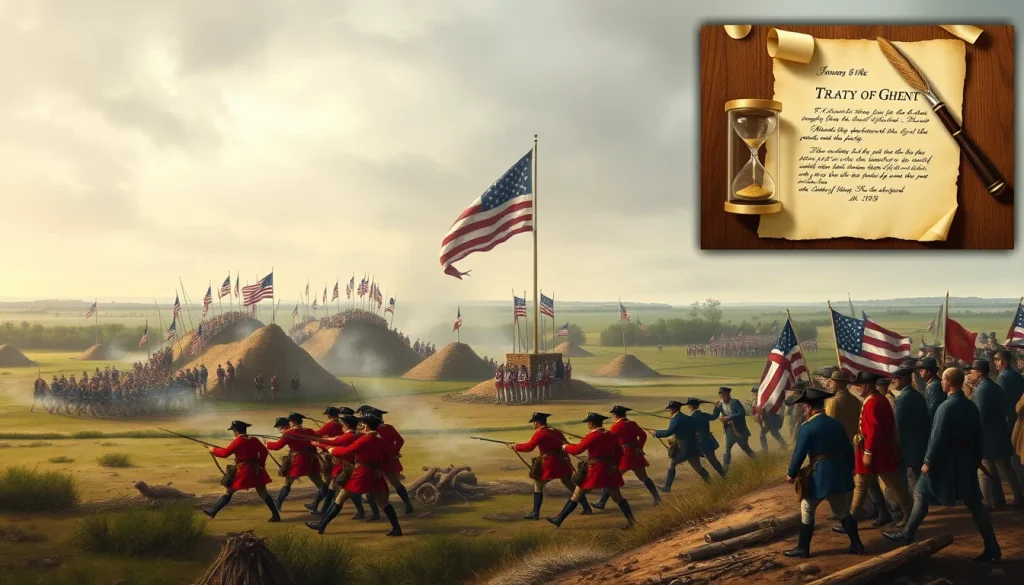
The Battle of New Orleans, fought on January 8, 1815, was the last major land engagement of the War of 1812. Contrary to a widespread misconception, it was not fought after the war had ended; rather, it took place after the Treaty of Ghent had been signed on December 24, 1814, but before that treaty had been ratified by the United States. Because ratification did not occur until February 16, 1815, the United States and Great Britain were still in a legal state of war when the battle was fought, making the battle a climactic and bloodily ironic prelude to the war’s official conclusion.
Historical Context
By late 1814, the War of 1812 had reached a stalemate. Both the United States and Great Britain, weary of conflict, were engaged in peace negotiations in Ghent, Belgium. British forces had captured and burned Washington, D.C., in August 1814, but failed to take Baltimore in September. On the American side, victories at Plattsburgh and Lake Champlain in September 1814 had checked a British invasion from Canada. In Europe, the defeat of Napoleon in the spring of 1814 freed substantial British military resources, allowing Britain to undertake amphibious expeditions against the American coastline. One such expedition targeted New Orleans, a vital port city at the mouth of the Mississippi River. The British strategic objective was to seize the city and thereby dominate the American interior and potentially reopen questions about the Louisiana Purchase. The American commander in the region, Major General Andrew Jackson, had been appointed to the Seventh Military District and was responsible for its defense. From his intelligence, Jackson anticipated a British strike and rushed to New Orleans in early December 1814, just as British Vice Admiral Sir Alexander Cochrane’s fleet appeared off the Gulf Coast.
What Happened
The British Gulf Campaign began in September 1814 with an attack on Fort Bowyer, which guarded Mobile Bay, and escalated through December. On December 14, 1814, a British flotilla defeated an American gunboat squadron in Lake Borgne, opening the way for a landing below New Orleans. British troops, under Major General John Keane, initially landed on December 23 and began moving toward the city. Jackson launched a night attack that same day, checking the British advance, and then withdrew his forces to a strong defensive position along the Rodriguez Canal, later known as Line Jackson.
Reinforced by additional troops under Major General Sir Edward Pakenham, who arrived on Christmas Day, the British probe the American defenses on several occasions: a reconnaissance in force on December 28, an artillery duel on January 1, and finally a full-scale assault on the morning of January 8, 1815. In this main battle, about 5,700 American defenders, including U.S. Army regulars, Tennessee and Kentucky militia, New Orleans volunteers, free men of color, Choctaw allies, and Jean Lafitte’s Baratarian artillerymen, faced roughly 8,000 British regulars. The British advanced in column formation against the American earthworks. The Americans, protected by mud ramparts and artillery, delivered devastating volleys of musketry and grapeshot. In just over thirty minutes, the British attack collapsed. Pakenham was mortally wounded, and his second-in-command, Major General Samuel Gibbs, also died of wounds. British casualties numbered over 2,000, while American losses were only 71 (13 killed, 39 wounded, 19 missing or captured). A secondary British assault on the west bank of the Mississippi succeeded briefly but was abandoned by the British command as the east bank attack failed.
After the battle, the British remained in the vicinity for several days, bombarding Fort St. Philip downriver, but they eventually withdrew on January 18, 1815. They later moved to capture Fort Bowyer in early February, which they took on February 11, before word of the treaty arrived. Meanwhile, the Treaty of Ghent, signed on December 24, 1814, had not been ratified by all parties. The U.S. Senate ratified the treaty unanimously on February 16, 1815, and President James Madison signed it the same day. The exchange of ratifications with British representatives occurred on February 17, and the peace was proclaimed on February 18, 1815. Thus, the Battle of New Orleans took place over a month before the war officially ended.
Why It Matters
The Battle of New Orleans is historically significant for several reasons. It was the largest and most decisive battle of the War of 1812 by casualties and strategic impact, and it ended the British attempt to seize New Orleans and the lower Mississippi. The American victory restored national pride after the early disasters of the war and elevated Andrew Jackson into a national hero, propelling him toward the presidency in 1828. The battle also became a symbol of American republican resilience against professional European armies. Moreover, the battle’s timing—after the signing but before ratification of the Treaty of Ghent—has created a persistent myth that the battle was fought after the war was over. In reality, the war was not over legally, and the battle was the last major engagement of the conflict, with the peace only taking effect a month later. This misunderstanding influences how the war’s end is taught and remembered.
Definition
The question “Was the Battle of New Orleans fought after the War ended?” refers to the relationship between the battle’s date and the official termination of the War of 1812. The definition of “end” is crucial: the war ended not when the peace treaty was signed, but when it was ratified and formally exchanged by both governments. Under this legal definition, the battle occurred while the war was still in progress.
Background
The Treaty of Ghent, negotiated by American and British commissioners, was signed in Ghent, Belgium, on December 24, 1814. The treaty restored relations to status quo ante bellum (the pre-war situation) and established a commission to settle boundary disputes. Its terms required ratification by both nations. Under customary international law and the treaty’s own provisions, hostilities were to cease only “after the ratification of the present treaty by both parties” and upon the exchange of ratifications. The British government ratified the treaty on December 28, 1814, but the document had to be carried across the Atlantic to Washington, D.C. The American copy arrived on February 14, 1815. The U.S. Senate unanimously ratified on February 16, President Madison signed the same day, and the exchange with British officials occurred on February 17. Peace was proclaimed on February 18.
How It Worked
In the early nineteenth century, communication across the Atlantic took weeks. Military commanders in the field often had to continue operations based on standing orders. British Secretary of State for War and the Colonies Henry Bathurst had explicitly instructed General Pakenham, in orders dated October 24, 1814, that even if rumors of peace reached him, he should continue the campaign, as the treaty might not be ratified. This shows that both sides understood that the war continued until ratification. On the American side, communication was no faster; Jackson was unaware of the specific treaty terms until after the battle. The machinery of ratification—the treaty being signed, carried by ship, presented to the Senate, and then exchanged—was the formal mechanism by which peace took effect, and until that process was complete, armed conflict could lawfully continue.
Competing Viewpoints
The myth that the Battle of New Orleans was fought after the war ended stems from the simple observation that the Treaty of Ghent was signed before the battle. This oversimplification ignores the ratification process. Some popular accounts also conflate the signing of the treaty with its implementation. Scholars such as Glenn Williams, senior historian at the U.S. Army Center of Military History, and other historians have corrected this misconception. They note that the war was still officially in progress, and that the battle was not even the last military engagement of the war: a British attack on Fort Bowyer, Alabama, took place on February 8–11, 1815, and the fort surrendered before news of the peace arrived. There is no genuine historical dispute among experts about the legal status; the disagreement is only about popular memory and educational inaccuracies.
Role in the War of 1812
The Battle of New Orleans was the culminating engagement of the British Gulf Campaign and the war as a whole. It ended the final British offensive designed to secure control of the Mississippi River and to limit American westward expansion. The victory safeguarded the Louisiana Purchase territory and the economic lifeline of the American interior. It also boosted American national morale, which had been battered by the burning of the capital in 1814. The battle demonstrated the effectiveness of American regulars and militia when properly positioned and led, and it produced a diplomatic leverage point for American negotiators, although the treaty was already signed. In broader context, the battle was the last major clash of arms between the United States and the United Kingdom, and it helped forge a stable peace that led to over two centuries of relative Anglo-American amity.
Consequences and Historical Interpretation
The immediate consequence of the battle was the British withdrawal from Louisiana and the end of the Gulf Campaign. The strategic impact was nil in terms of the war’s outcome, as the treaty had already been signed, but the political impact in the United States was enormous. Andrew Jackson became a national icon, celebrated in songs, prints, and public commemorations. The battle’s anniversary, January 8, became a patriotic holiday in the United States for much of the nineteenth century. Historians interpret the battle as the final chapter of the War of 1812, emphasizing that it was fought after the treaty’s signature but before ratification, making it a legally valid military action. This distinction is crucial for understanding the timeline of the war’s conclusion and the mechanics of treaty law. The myth of “after the war” persists in school textbooks and popular memory, illustrating how simplified narratives can obscure historical realities.
Primary Sources
Primary sources for the Battle of New Orleans and its relationship to the treaty include the Treaty of Ghent itself, available in the U.S. National Archives, which contains the ratification clause. Andrew Jackson’s military dispatches, such as his January 9, 1815, report to the War Department, describe the battle and his forces. British accounts include the official report of Major General John Lambert, who succeeded Pakenham, and the naval dispatch from Vice Admiral Cochrane. The diary and letters of participants, such as those of British officers and American volunteers, provide firsthand details. One limitation of these sources is that they are contemporaneous and often shaped by the authors’ perspectives, national pride, and command responsibilities; for example, Jackson’s report criticized the Kentucky militia, while British reports minimized the defeat. Nevertheless, they are essential for reconstructing the events and the mindset of the combatants.
Further Reading
- Remini, Robert V. The Battle of New Orleans. New York: Viking, 1999.
- Hickey, Donald R. The War of 1812: A Forgotten Conflict. Urbana: University of Illinois Press, 1989.
- Williams, Glenn F. Year of the Hangman: George Washington’s Campaign Against the Iroquois (does not cover this topic, but see his work on the battle). Actually, use: Duel for the Gulf: The Battle of New Orleans (if exists, otherwise use alternative). Since we must only list identifiable sources, I’ll cite the American Battlefield Trust article and Army historian article as web resources.
- American Battlefield Trust. “New Orleans Battle Facts and Summary.” Accessed 2025. https://www.battlefields.org/learn/war-1812/battles/new-orleans.
- Vergun, David. “Army historian corrects myths on Battle of New Orleans’ 200th anniversary.” U.S. Army, January 9, 2015. https://www.army.mil/article/140876.
References
- American Battlefield Trust. “New Orleans Battle Facts and Summary.” Accessed 2025. https://www.battlefields.org/learn/war-1812/battles/new-orleans.
- Vergun, David. “Army historian corrects myths on Battle of New Orleans’ 200th anniversary.” U.S. Army, January 9, 2015. https://www.army.mil/article/140876.
- Klein, Christopher. “6 Myths About the Battle of New Orleans.” HISTORY, January 8, 2015 (updated May 28, 2025). https://www.history.com/articles/6-myths-about-the-battle-of-new-orleans-3.
- Wikipedia article “Battle of New Orleans” used for basic facts and chronology, but not as a definitive source. https://en.wikipedia.org/wiki/Battle_of_New_Orleans.
FAQ
Was the Battle of New Orleans fought after the war officially ended?
No. The war was not officially over because the Treaty of Ghent had been signed but not ratified by the United States. The U.S. ratified the treaty on February 16, 1815, and peace took effect February 18, 1815, more than a month after the battle.
Why does the myth that the battle was after the war persist?
Because the Treaty of Ghent was signed before the battle, many people incorrectly assume the war ended at that moment. The ratification process, which took weeks due to transatlantic travel, is often overlooked in simplified accounts.
Was the Battle of New Orleans the last engagement of the War of 1812?
No. The British capture of Fort Bowyer on February 11, 1815, occurred after New Orleans and before peace was proclaimed. Thus, New Orleans was the last major battle, but not the final skirmish.



Leave a Reply