
Short Answer
The Battle of Lundy’s Lane, fought on the evening of July 25, 1814, near Niagara Falls, is often described as the bloodiest engagement of the War of 1812. In just over five hours of fighting, the two sides suffered combined casualties exceeding 1,700 killed, wounded, or missing, a staggering number for a battle that involved roughly 4,000 to 5,000 men. The extraordinary bloodshed stemmed from a combination of tactical miscalculations, the close-range nature of musket and bayonet combat, and the stubborn determination of both armies to hold the crucial high ground at Lundy’s Lane.
Historical Context
The War of 1812, fought between the United States and Great Britain, had reached a critical point by the summer of 1814. With the defeat of Napoleon in Europe, Britain was able to reinforce its North American colonies with veteran regulars. The U.S. government, seeking to secure its northern frontier and force a favorable peace, launched a renewed invasion of Upper Canada. In July 1814, Major General Jacob Brown led an American army of about 4,500 men across the Niagara River, capturing Fort Erie on July 3. The Americans then advanced northward, defeating a British force at the Battle of Chippawa on July 5. After this victory, Brown’s army occupied a position along the Chippawa River, while the British under Lieutenant General Gordon Drummond and Major General Phineas Riall regrouped.
The Niagara Frontier was a critical theater. Control of the Niagara Peninsula would give the Americans a direct route to Lake Ontario and cut Upper Canada in half. By late July, both armies were actively maneuvering. Brown, concerned about his supply lines, withdrew from the Queenston area to Chippawa. British forces under Riall advanced south to Lundy’s Lane—a low ridge running west from the Portage Road, about a mile from the Niagara River—to observe the American movements. On July 25, Drummond arrived with reinforcements and ordered the reoccupation of Lundy’s Lane, anticipating an American attack.
What Happened
On the afternoon of July 25, an American brigade under Brigadier General Winfield Scott advanced up the Portage Road from Chippawa. Spotting British forces forming on the high ground at Lundy’s Lane, Scott dispatched a messenger to Brown and prepared to attack. By 7 p.m., Scott’s roughly 1,000 regulars emerged from the woods into an open field facing the British position, where artillery had been placed on the crest. The British guns opened fire, and Scott’s brigade began to take casualties. Scott ordered the 25th Infantry to flank the British left, which succeeded in pushing back two battalions and capturing the wounded Riall.
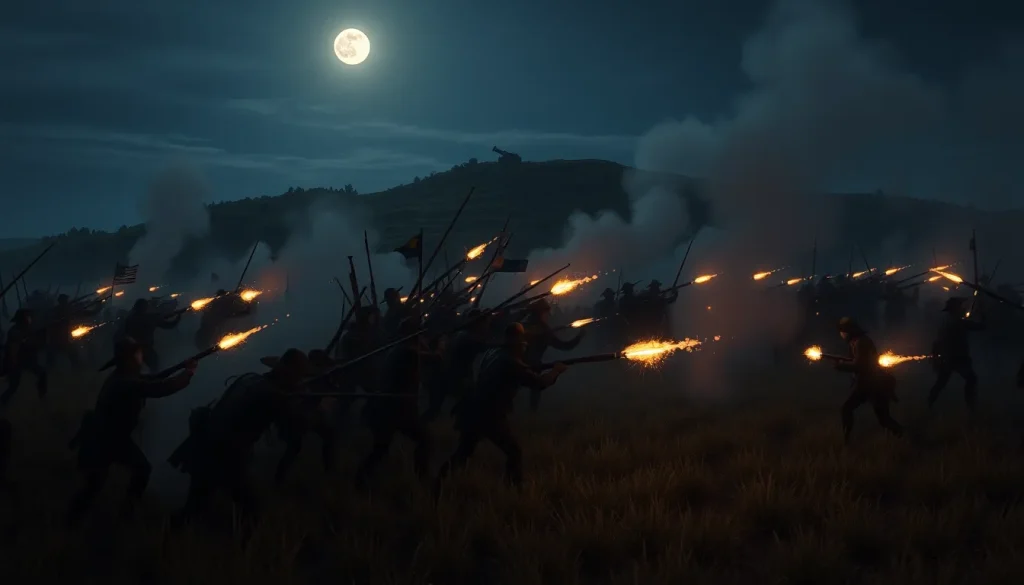
Meanwhile, Brown arrived with the American main body—about 1,500 additional troops—and launched repeated assaults against the British center. The fighting continued after darkness fell, turning into a brutal close-quarters melee. American forces, particularly the 21st Infantry under Lieutenant Colonel James Miller, managed to storm the hill and capture the British artillery. However, the British, led by Drummond, counterattacked three times in a desperate attempt to recapture their guns. The combat was so intense that opposing soldiers fired at point-blank range, using bayonets in the flash-lit darkness. By midnight, both armies were exhausted and low on ammunition. Brown, badly wounded, ordered a retreat to Chippawa. The British forces, also spent, did not pursue. The battlefield was left strewn with dead and wounded from both sides.
Why It Matters
The Battle of Lundy’s Lane halted the American invasion of Upper Canada. The high casualties forced Brown to withdraw to Fort Erie, which the British then besieged. Although the siege would be lifted, the Americans ultimately abandoned the Niagara campaign in November 1814. The battle proved that U.S. regulars could fight on equal terms with British veterans, but it also demonstrated the awful cost of such confrontation. The memory of Lundy’s Lane—where, as one British participant recalled, “the dead and dying lay in every direction”—cemented its reputation as the bloodiest battle of the war. Historians have since debated whether the tactical decisions of Brown and Scott were justified given the heavy losses, or whether the battle was a preventable tragedy.
Definition
“Bloody” in the context of Lundy’s Lane refers to the exceptionally high number of casualties relative to the size of the forces engaged. Approximately 850 Americans and 878 British/Canadian casualties were reported, a rate of about 20–25% of the men engaged. This was far higher than typical battles of the period, which often had casualty rates of 10–15%. The term also captures the harrowing nature of the fighting itself—close-range volleys, bayonet charges, and the chaos of night combat.
Background
The bloodiness of Lundy’s Lane was not accidental. Both armies were composed largely of trained regulars who had proven their discipline at Chippawa and in the European campaigns. The tactical doctrines of the era emphasized volley fire and bayonet charges delivered at close range. The geography of the battlefield—a low ridge with a church and cemetery, surrounded by open fields and woods—made concealment difficult and forced frontal assaults. Additionally, the meeting engagement at Lundy’s Lane was unplanned; neither side expected to fight a major action there, so neither prepared defensive works or planned withdrawal routes. When battle came, both commanders felt compelled to hold the ground, leading to a standoff that escalated into a prolonged fight.
How It Worked
Several specific factors made the battle exceptionally bloody. First, the artillery played a central role. The British arrayed five guns on the crest, which dominated the open approaches and inflicted severe losses on American infantry as they advanced. When the Americans captured these guns, they turned them on the British, and the ensuing artillery duels at short range produced horrific casualties. Second, darkness magnified confusion and prevented tactical control. Units lost their way, fired at muzzle flashes, and sometimes engaged friendly forces. Third, the close range of engagement meant that most casualties came from musket fire at distances of less than 50 yards, where aimed fire was difficult but mass volleys were deadly. Finally, the determination of both commanders to win at all costs led to repeated frontal assaults—Brown launched multiple attacks on the British center, and Drummond counterattacked three times—each producing high casualties without decisive gain.
Competing Viewpoints
Historians differ over the blame for the bloodshed. Some argue that Winfield Scott’s decision to attack before Brown’s main force arrived was reckless and unnecessarily exposed his brigade. Others contend that Scott had no choice, because retreating in the face of the British position might have allowed the British to attack his army at a disadvantage. Similarly, Gordon Drummond’s decision to recapture his artillery at all costs has been criticized as wasteful of his infantry, but defended as essential to maintain morale and prevent a rout. The British also faced challenges of command coordination, while the Americans suffered from ambiguous orders. Ultimately, the heavy casualties can be attributed to a combination of tactical errors, the nature of night fighting, and the mutual refusal to yield.
Role in the War of 1812
The Battle of Lundy’s Lane was a decisive moment in the War of 1812’s Niagara campaign. By checking the American advance, it preserved British control of the Niagara Peninsula and the crucial supply line to Lake Ontario. The battle also demonstrated the improved proficiency of the U.S. Army, which had been rebuilt after early defeats. However, the loss of so many seasoned American soldiers weakened the overall war effort and contributed to the eventual withdrawal of U.S. forces from Canadian territory. On the British side, the victory, albeit costly, boosted morale and helped secure the Canadian border, reinforcing the perception that Upper Canada could be defended.
Consequences and Historical Interpretation
Immediately after the battle, both sides claimed victory: the Americans because they captured the British guns and withdrew in good order; the British because they held the field and forced the Americans to retreat. Modern scholarship tends to view it as a British tactical victory and an American strategic defeat. The battle’s high casualty rate had long-term effects: it sapped American resources and morale, and it contributed to the war’s unpopularity in the United States. In Canada, Lundy’s Lane became a symbol of sacrifice and resistance. Today, the battlefield is a historic site, and the church and cemetery that witnessed the fighting stand as memorials. Historians continue to study Lundy’s Lane as an example of how a single engagement can alter the course of a campaign, and how the fog of war can turn a chance encounter into a bloodbath.
Primary Sources
Contemporary accounts of the battle include official reports submitted by commanding officers. Major General Jacob Brown’s report to U.S. Secretary of War John Armstrong, dated July 27, 1814, describes the American movements and the capture of the British guns. Lieutenant General Gordon Drummond’s dispatch to the British Governor General, dated July 27, 1814, provides the British narrative, emphasizing the successful defense and recapture of the position. Winfield Scott himself wrote a memoir, Memoirs of Lieut.-General Scott (1864), which includes his recollections of the battle, though written decades later and colored by hindsight. Another useful source is the diary of Private William Dunlop, who served in the British 89th Foot and left vivid impressions of the night fighting. These sources carry biases—each commander sought to justify his actions—but together they allow historians to reconstruct events.
Further Reading
- Donald E. Graves, The Niagara Campaign of 1814: The Battle of Chippawa and Lundy’s Lane (1993)
- J. Mackay Hitsman, The Incredible War of 1812: A Military History (1965)
- The Canadian Encyclopedia, “Battle of Lundy’s Lane”
- American Battlefield Trust, “Lundy’s Lane Battle Facts and Summary”
References
- Wes Turner, “Battle of Lundy’s Lane,” The Canadian Encyclopedia, last edited March 4, 2015, https://thecanadianencyclopedia.ca/en/article/battle-of-lundys-lane.
- American Battlefield Trust, “Lundy’s Lane Battle Facts and Summary,” accessed [date], https://www.battlefields.org/learn/war-1812/battles/lundys-lane.
- Niagara Falls Museums, “The Battle of Lundy’s Lane Walking Tour,” accessed [date], https://nfexchange.ca/files/Museum/PDFs/lundys-lane-walking-tour.pdf.
- Mason Winfield, “Dispatches from the War of 1812: A Desperation That Bordered on Madness,” Buffalo Rising, August 28, 2014, reprinted at https://buffaloah.com/a/h/war1812/mw/mw7/mw7.html.
FAQ
How many casualties were there at the Battle of Lundy's Lane?
The Americans suffered approximately 853 casualties, while the British and Canadian forces reported about 878 killed, wounded, or missing, for a combined total of roughly 1,700.
Why was darkness a factor in the high casualties?
The battle began after 7 p.m. and continued until around midnight. In the darkness, troops lost formation, fired at muzzle flashes, and sometimes engaged friendly units, leading to chaos and increased close-quarter combat with bayonets and muskets.
What was the strategic outcome of Lundy's Lane?
Although tactically inconclusive, the battle halted the American invasion of Upper Canada. The Americans were forced to retreat to Fort Erie, which they later abandoned, ending the Niagara campaign and leaving the British in control of the peninsula.



Leave a Reply