Short Answer
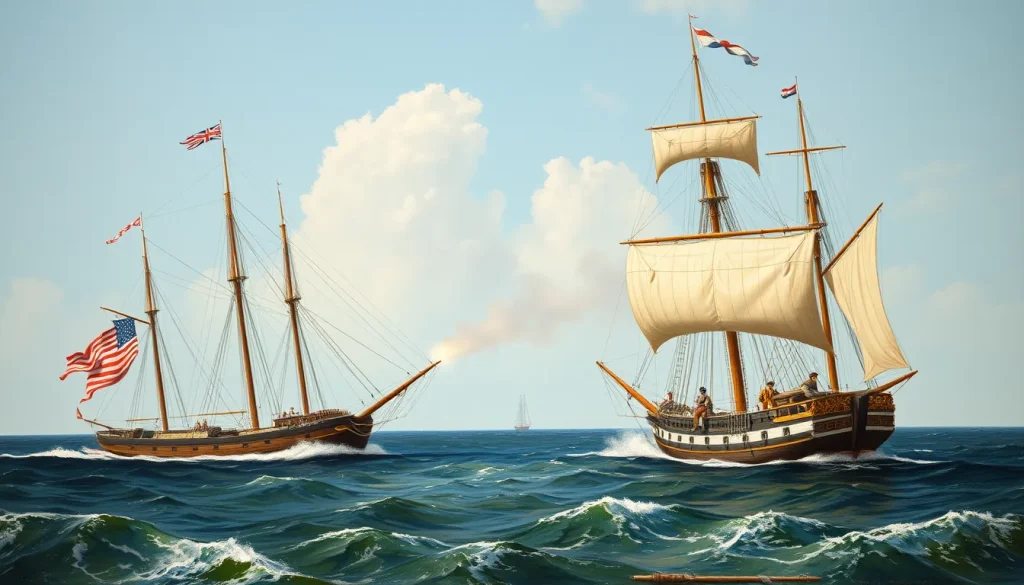
The engagement between the American sloop-of-war USS Peacock and the British brig-sloop HMS Epervier occurred on 29 April 1814, approximately fifteen miles off the east coast of Florida near present-day Sebastian. It was one of the most one-sided single-ship actions of the War of 1812, ending in the capture of the British vessel and a significant sum of specie after a forty-two-minute fight. The action demonstrated the continuing quality of American naval gunnery and seamanship even as the broader naval war remained dominated by the Royal Navy’s blockade.
Historical Context
By 1814, the War of 1812 had reached a stalemate on land, while at sea the Royal Navy maintained a comprehensive blockade of the American coast. Nevertheless, the U.S. Navy had earned a remarkable record in single-ship duels, including victories by the Constitution, United States, and Hornet. American sloops and brigs also achieved successes, as with Wasp over Frolic and Hornet over Peacock (the British ship of that name). The new USS Peacock was named in deliberate irony after that earlier British loss. The West Indies trade route, through the Bahama Channel, carried valuable convoys protected by small warships, offering American cruisers opportunities for prizes and strategic disruption.
What Happened
USS Peacock, commanded by Master Commandant Lewis Warrington, had sailed from St. Mary’s, Georgia, in early April 1814 on a commerce-raiding cruise in the Bahama Channel. On the morning of 29 April, lookouts spotted a convoy consisting of a British brig and two merchant vessels under the escort of the British brig-sloop HMS Epervier, commanded by Commander Richard Wales. Epervier was returning from Havana to Halifax carrying $118,000 in specie. The two warships closed, and at about 11:00 a.m. they exchanged broadsides. Early fire from Epervier disabled Peacock’s foreyard, but the American vessel’s gunnery quickly took effect. Epervier’s carronades malfunctioned as their fighting bolts and breeching bolts gave way, and her rigging and hull were soon badly damaged. After forty-two minutes, with five feet of water in her hold, her main-topmast over the side, and forty-five shot holes in her hull, Epervier struck her colours. The Americans suffered only two wounded, while the British lost eight killed and fifteen wounded. Warrington transferred the specie and prisoners to Peacock, and the prize was taken to Savannah, arriving on 4 May despite attempts by British frigates to retake it.
Why It Matters
The capture of Epervier was hailed in the United States as further proof of American naval superiority in ship-to-ship combat. The seizure of $118,000 in gold and silver—eventually distributed as prize money—provided tangible economic benefit and boosted morale. Strategically, however, the action had little effect on the overall course of the war; the Royal Navy continued its blockade, and the United States failed to break British command of the sea. Historians have viewed the action as illustrating the strengths and limits of American naval power: individual ships excelled, but the British numerical superiority ultimately proved decisive.
Prelude
The Peacock was a new sloop-of-war launched at New York in September 1813, designed to outfight and outsail comparable Royal Navy brigs. After delivering munitions to St. Mary’s, Georgia, she sailed on 1 April 1814 to raid the Bahama Channel, the route for Jamaican convoys. Epervier, built in 1812, had previously captured the American privateer Alfred in February 1814 and was escorting a small convoy from Havana to Halifax. Her crew had recently been implicated in a mutiny plot, and she carried a heavy treasure that made her a prime target for American cruisers.
Forces and Commanders
USS Peacock was a sloop-of-war of 509 tons, measuring 118 feet in length, with an armament of eighteen 32-pounder carronades and (by some accounts) two long 18-pounders. Her crew numbered about 160. She was commanded by Master Commandant Lewis Warrington, with First Lieutenant John B. Nicholson and Second Lieutenant Samuel Henley. HMS Epervier was a brig-sloop of 477 tons, about 107 feet long, mounting eighteen 32-pounder carronades (though William James reports sixteen 32s and two 18s), with a crew of 128 men. Commander Richard Wales was her captain. In size and armament, the two vessels were closely matched, though Peacock had a longer hull, a broader beam, and likely better sailing qualities.
Battlefield and Map Context
The engagement took place in the Atlantic Ocean about fifteen miles east of the Florida coast, near latitude 27°47′ N and longitude 80°09′ W, a position approximately opposite the present-day town of Sebastian, Florida. The area was part of the Bahama Channel, a busy shipping lane used by vessels travelling between the Caribbean and Northern Europe. The sea was relatively smooth, with a light breeze from the southeast. No land was visible from the engagement site, and the nearest Spanish-controlled territory lay a few miles to the west.
Battle Chronology
At about 7:30 a.m. on 29 April, Peacock sighted the convoy. Epervier intercepted, and by 10:00 the two warships were within half gun-shot. As Peacock attempted to gain a raking position, Epervier fired her starboard broadside, disabling Peacock’s foreyard and causing some rigging damage. The American ship then kept away and engaged with her larboard guns, delivering a steady fire of star and bar shot that cut away Epervier’s rigging and dismasted her. Despite Epervier’s attempt to board, her carronades continually broke loose from their mountings, and her resistance weakened. At 11:05 Epervier struck her colours, having taken forty-five shot holes in her hull and with water rising in her hold. The entire action lasted forty-two minutes.
Casualties and Losses
American casualties were remarkably light: none killed and only two wounded, neither seriously. The Peacock herself suffered damage to her foreyard, a few cut backstays, and some shot holes in her sails; no round shot struck her hull. British losses were more heavy: eight killed and fifteen wounded, including the first lieutenant, who lost an arm. Epervier was captured with $118,000 in specie, her hull and rigging severely damaged. She was taken to Savannah as a prize, where she was condemned and later sold, the proceeds going to the American captors.
Result
The engagement ended in a decisive American victory. Epervier was captured, her crew taken prisoner, and her cargo—including the specie—secured. Warrington brought the prize into Savannah on 4 May 1814, eluding two British frigates that chased him and his prize. The captured vessel was subsequently sold, and the American crew received prize money under the law governing captures by equal-force vessels.
Strategic Consequences
In the short term, the capture deprived the British of a convoy escort and a significant sum of money and boosted American morale and confidence. It also demonstrated that American naval skill extended beyond the heavy frigate class to smaller vessels. Nevertheless, the action did not alter the strategic balance: the Royal Navy continued its blockade of American ports, and the U.S. Navy was too small to seriously threaten British control of the seas. The victory contributed to the American narrative of naval valour, but by 1814 the war at sea had become one of attrition, with Britain’s overwhelming numerical superiority proving decisive.
Primary Accounts
The two most important contemporary accounts are Captain Lewis Warrington’s official report to Secretary of the Navy William Jones, dated 29 April 1814, and Lieutenant John B. Nicholson’s subsequent report from Savannah. Warrington’s report provides detailed statistics of the engagement, including the specific damage to Epervier and the transfer of specie. The British perspective is given in William James’s The Naval History of Great Britain (1824), which describes the battle from the British viewpoint, including the failures of Epervier’s carronades. These sources align on the sequence of events and the relative damage, though James attributes the British defeat partly to defective gun mountings.
Battlefield Today
The site of the action lies in the open Atlantic off the coast of Florida, near the present-day Sebastian Inlet. No physical remains survive, and there is no public monument or marker specifically commemorating the battle. The area is now part of the Archie Carr National Wildlife Refuge coastline, and the waters are popular for fishing and boating. The battle’s memory is preserved primarily in museum collections and historical literature rather than at the site itself.
Primary Sources
Key primary sources include Warrington’s official report (printed in American State Papers and contemporary newspapers), Lieutenant Nicholson’s letter describing the arrival at Savannah and the escape from British frigates, and the court records from the prize case that determined the distribution of the captured specie. William James’s Naval History offers a detailed British account, and the Florida Historical Quarterly article “U. S. S. Peacock in the War of 1812” (1937) provides a later synthesis. Each reflects the perspective of its author—Warrington and Nicholson write from the American side, James from the British—so readers should consider both narratives for a balanced view.
Further Reading
- Hickey, Donald R. The War of 1812: A Forgotten Conflict. University of Illinois Press, 1989.
- Lambert, Andrew. The Challenge: Britain Against America in the Naval War of 1812. Faber & Faber, 2012.
- Latimer, Jon. 1812: War with America. Harvard University Press, 2007.
- James, William. The Naval History of Great Britain. London, 1824.
- Davis, Tim. “U. S. S. Peacock in the War of 1812: A Fight off the Florida Coast.” Florida Historical Quarterly, vol. 16, no. 4 (1937).
References
- Warrington, Lewis. Official Report to Secretary of the Navy William Jones, 29 April 1814. United States Navy Department. Reproduced at ibiblio.org.
- Nicholson, John B. Letter to Navy Department, Savannah, 4 May 1814. In same collection.
- James, William. The Naval History of Great Britain. London: Richard Bentley, 1824.
- Davis, Tim. “U. S. S. Peacock in the War of 1812: A Fight off the Florida Coast.” Florida Historical Quarterly 16, no. 4 (1937).
- “USS Peacock vs HMS Epervier – War of 1812.” Accessed 2023. thewarof1812.org.
FAQ
How did USS Peacock manage to defeat HMS Epervier so quickly?
The Peacock's crew was well-drilled and her gunnery accurate, while the Epervier suffered from defective carronade mounts that failed during the action, disabling her main battery.
What happened to the captured $118,000 in specie?
The specie was transferred to the Peacock and eventually distributed as prize money among the American officers and crew.
Did the battle have any lasting strategic impact?
It boosted American morale and demonstrated naval skill, but it did not break the Royal Navy blockade or alter the strategic balance of the war.



Leave a Reply