
Short Answer
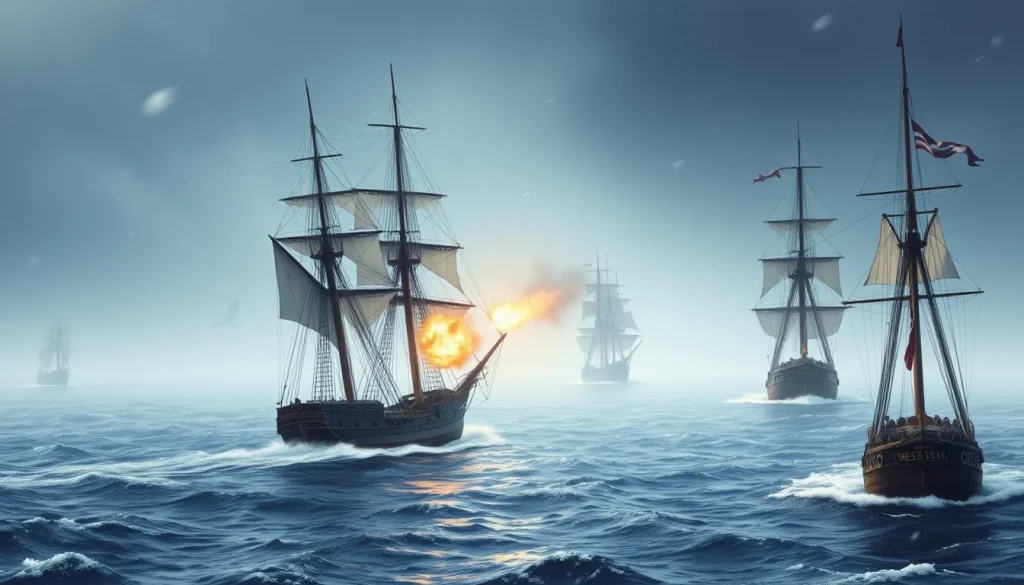
Stephen Decatur, the most celebrated U.S. naval officer of his generation, commanded the heavy frigate USS President during the War of 1812. In January 1815, Decatur tried to break through the Royal Navy blockade of New York, but the President grounded on a sandbar, and was later chased and captured by a British squadron. The action, on 15 January 1815 off the New Jersey coast, marked the final loss of a major U.S. frigate in the war and had lasting consequences for American naval strategy and national pride.
Historical Context
By late 1814, the Royal Navy’s blockade covered virtually the entire U.S. Atlantic coast. American warships were confined to port, and only occasional storms offered opportunities to slip out. Stephen Decatur, blockaded first at New London and then at New York, commanded the President, one of the original six U.S. frigates and the last heavy American frigate still fit for sea. The Navy ordered Decatur to sail to the Indian Ocean to attack British East India trade, a commerce-raiding mission intended to disrupt British commerce. The blockade, enforced by a squadron under Commodore John Hayes, included the 56-gun razee HMS Majestic and the frigates HMS Endymion, Pomone, and Tenedos.
What Happened
On the night of 14 January 1815, a winter storm dispersed the British blockaders off Sandy Hook. Decatur ordered the President to sea. As the frigate crossed the bar at the entrance to New York harbor, she struck a sandbar and pounded for nearly two hours before working free. The grounding severely damaged her hull, stripped copper sheathing, and reduced her speed. Still, Decatur continued, hoping to escape. At dawn on 15 January, the British squadron reappeared. HMS Endymion, under Captain Henry Hope, pursued the crippled President and caught her. The two ships dueled for more than two hours; the President inflicted heavy damage on Endymion but could not outrun the rest of the British squadron. When Pomone and Tenedos arrived, Decatur, with more than fifty casualties and his ship unmanageable, surrendered. British losses were relatively light. The President was taken to Bermuda and then to Britain, where she was broken up in 1817–1818.
Why It Matters
The capture was a strategic and symbolic blow to the United States. It removed the last active heavy frigate from the Atlantic theater and demonstrated the effectiveness of the Royal Navy’s blockade. For Decatur, it was a personal humiliation, though he was later vindicated by his actions in the Second Barbary War. Historians view the engagement as a confirmation of British naval supremacy and a factor in ending the war, as peace negotiations were already underway. The President‘s design was later copied by British shipbuilders, acknowledging the quality of American frigate construction.
Early Life
Stephen Decatur Jr. was born on 5 January 1779 in Sinepuxent, Maryland. His father, a naval officer in the Quasi-War, gave him an early introduction to the sea. Decatur received a midshipman’s warrant in 1798 and served in the West Indies during the Quasi-War, earning promotion to lieutenant in 1799.
Role Before the War
Decatur gained fame during the Barbary Wars. In 1804, he led a raid to destroy the captured frigate Philadelphia in Tripoli harbor, an act celebrated as extraordinarily daring. He was promoted to captain at age 25. In 1811, while commanding the President, he was involved in the Little Belt affair, a naval skirmish with the British sloop Little Belt that heightened Anglo-American tensions.
Role During the War
At the start of the War of 1812, Decatur commanded USS United States. On 25 October 1812, he captured HMS Macedonian after a close engagement, returning with the prize to New York. Blockaded in 1813 and 1814, Decatur transferred his flag to the President in 1814. His orders to raid the Indian Ocean commerce came in late 1814, setting the stage for the January 1815 escape attempt.
Major Actions
The most consequential engagement of Decatur’s war service was the final sortie of the President. After the grounding, the President was overtaken by HMS Endymion. Decatur fought a spirited battle, damaging Endymion, but the arrival of British reinforcements forced his surrender. The action cost 24 killed and 55 wounded aboard President; British casualties were 11 killed and 14 wounded, all on Endymion.
Contemporary Accounts
A firsthand account comes from Midshipman George Hollins, who served on the President and later wrote of the grounding and chase. His memoir, published in the USNI’s Naval History magazine, describes the frantic efforts to lighten the ship and the long night of pounding on the bar. British reports, such as Commodore Hayes’s official dispatch, claim credit for a well-coordinated pursuit. These accounts differ in tone, but agree on the basic facts of the pursuit and capture.
Later Life
Decatur was paroled and returned to the United States in February 1815, just after the Treaty of Ghent was ratified. He immediately commanded a squadron against Algiers, forcing the Dey to release American captives and renew treaty terms. In 1820, Decatur was mortally wounded in a duel with Commodore James Barron, dying in Washington on 22 March 1820.
Historical Legacy
Decatur’s reputation is that of a bold and aggressive officer, often viewed as the symbol of the early U.S. Navy. His capture of the President is seen as a tragic end to a brilliant career, though his earlier victories and later Barbary success cemented his place. The President itself became a trophy for the British, and its design influenced later British frigates.
Primary Sources
Key primary sources include the official U.S. Navy report by Decatur, published in Niles’ Weekly Register in 1815. British dispatches by Commodore John Hayes are held in the Admiralty papers at The National Archives (UK). Midshipman George Hollins’s unpublished memoir, quoted in Frederick C. Leiner’s article in Naval History magazine (April 2003), provides a vivid American perspective. These sources are valuable but each carries its own biases—American reports emphasize the grounding, while British reports celebrate the capture.
Further Reading
- Hickey, Donald R. The War of 1812: A Forgotten Conflict. University of Illinois Press, 1989.
- Lambert, Andrew. The Challenge: Britain Against America in the Naval War of 1812. Faber & Faber, 2012.
- Leiner, Frederick C. “Leave Them the Ashes of the President.” Naval History 17, no. 2 (April 2003).
- USNI archives for the Hollins memoir.
References
- “President.” The United States Navy Memorial, navylog.navymemorial.org/president
- Leiner, Frederick C. “Leave Them the Ashes of the President.” Naval History 17, no. 2 (April 2003), USNI.
- “Capture of USS President – War of 1812.” thewarof1812.org/battles/capture-of-uss-president/
- “Stephen Decatur.” USS Constitution Museum, ussconstitutionmuseum.org/crew/stephen-decatur/
- “USS President (1800).” Wikipedia, en.wikipedia.org/wiki/USS_President_(1800)
FAQ
Why did USS President run aground?
On 14 January 1815, as President attempted to cross the channel off Sandy Hook, New York, she struck a sandbar due to insufficient water depth and grounding on the bar. The ship pounded for nearly two hours before floating free, but the impact caused significant structural damage.
Who was Stephen Decatur?
Stephen Decatur was an American naval officer known for his exploits in the Barbary Wars and the War of 1812. He commanded USS President and was captured after an intense battle with the British squadron.
What happened to USS President after its capture?
The British took President to Bermuda, and later to Britain, where she was inspected and eventually broken up in 1817–1818. Her design influenced later British frigate construction.
Leave a Reply