
Short Answer
The Battle of the Thames (also known as the Battle of Moraviantown), fought on 5 October 1813 near present-day Thamesville, Ontario, was a major American victory in the War of 1812. The engagement was the final confrontation between American forces under Major General William Henry Harrison and a combined British–Indigenous force led by Major General Henry Procter and the Shawnee chief Tecumseh. The death of Tecumseh in this battle shattered the Indigenous confederacy he had built, fundamentally altering the balance of power on the northwestern frontier.
Historical Context
Following the American naval triumph at the Battle of Lake Erie in September 1813, the United States gained control of the lake, severing British supply lines and opening the door for an American invasion of Upper Canada. The British commander, Major General Henry Procter, faced diminishing resources and a superior American army advancing from Detroit. He decided to retreat eastward along the Thames River, much to the dismay of his Indigenous allies, particularly Tecumseh. Tecumseh argued that retreat would leave their homelands defenseless and urged Procter to make a stand. The British–Indigenous retreat, which began on 27 September, was disorderly and poorly provisioned, further eroding morale and trust between the allies.
What Happened
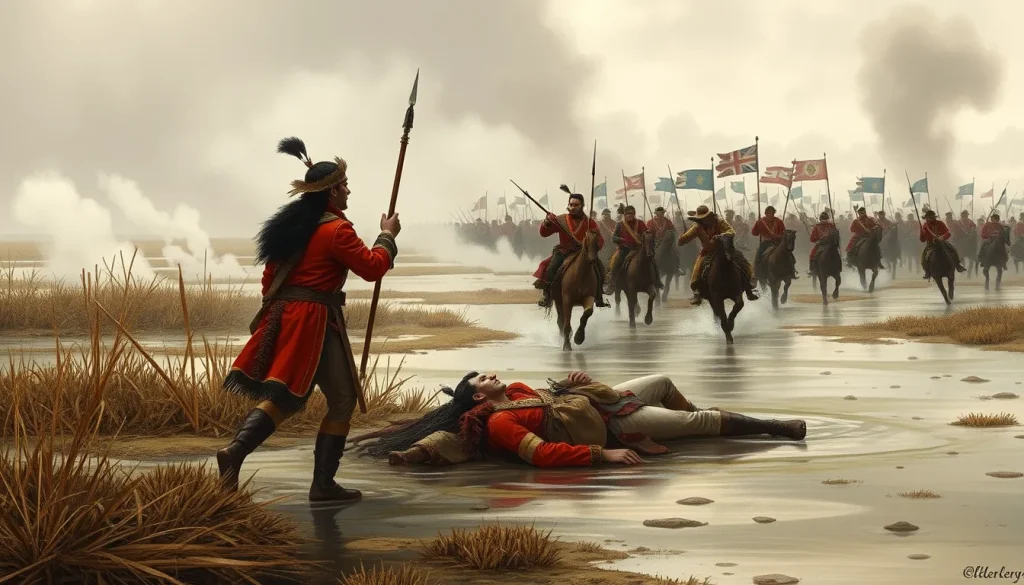
On 5 October 1813, Procter and Tecumseh halted near Moraviantown, a Lenape (Delaware) community along the Thames River. Harrison’s force, numbering about 3,760 men, caught up with them. The American attack opened with a cavalry charge against the British regulars, who broke and fled after a single volley. Procter and about 250 men escaped immediately, leaving the remaining British troops to be captured. Meanwhile, Tecumseh and his warriors, positioned in a swamp on the British right flank, fought on. The American horsemen, dismounted to enter the swamp, faced fierce resistance. During this fighting, Tecumseh was killed, and his warriors withdrew after his death. The battle was over within an hour.
Why It Matters
The Battle of the Thames was a decisive American victory that secured the Old Northwest and restored American control over Michigan. For Indigenous peoples, the consequences were catastrophic. Tecumseh’s death removed the most influential leader of the pan-Indian resistance movement, and his confederacy disintegrated. The loss ended significant Indigenous power on the Ohio–Great Lakes frontier and paved the way for American expansion. It also reinforced Indigenous distrust of British commitments, as many felt abandoned by Procter’s retreat. Historically, the battle is remembered as the moment when the dream of a strong Indigenous confederacy collapsed, shaping later treaties and the displacement of Indigenous nations.
Prelude
In the weeks before the battle, Procter’s retreat from Detroit and Amherstburg unfolded under great pressure. Harrison’s force, reinforced by Kentucky mounted riflemen, pursued the British westward. Tecumseh repeatedly protested the retreat, accusing Procter of cowardice and betrayal. He insisted that the Indigenous nations could not abandon their lands. Procter eventually promised to make a stand, and the allied force chose a position near Moraviantown, where the Thames River and a swamp offered some protection. The British line was established parallel to the road, with the swamp anchoring their right flank, where the Indigenous warriors were placed.
Forces and Commanders
The Indigenous forces at the Battle of the Thames were a coalition of several nations, including Shawnee, Wyandot, Ojibwa, Potawatomi, Odawa, and others. They were under the overall leadership of Shawnee war chief Tecumseh, with Wyandot chiefs such as Stiahta (also known as Roundhead) among the senior leaders. According to The Canadian Encyclopedia, about 500 warriors fought alongside Procter’s roughly 900 British regulars and militia. Other sources, such as the American Battlefield Trust, estimate the entire British–Indigenous force at approximately 1,400 men. The American force numbered about 3,760, including mounted riflemen from Kentucky. Key officers included Major General Henry Procter for the British and Major General William Henry Harrison for the Americans.
Battlefield and Map Context
The battlefield was situated near the Thames River, roughly two miles from Moraviantown, north of present-day Thamesville, Ontario. The terrain was flat and partially wooded, with the river protecting the British left flank and a swampy expanse covering the right. The British line ran perpendicular to the main road, with a single 6-pounder cannon positioned without ammunition. The Indigenous warriors occupied the swamp on the right, intending to fire into the flank of any American attack. Maps from the period show the road from Detroit running eastward, with the American approach from the southwest.
Battle Chronology
The battle began early on 5 October 1813. Harrison ordered a mounted charge against the British line, which had formed in open ground. The Kentucky horsemen broke through the British regulars almost immediately, and many British troops surrendered. Procter and a portion of his army fled, leaving the Indigenous contingent to fight alone. Harrison then directed his cavalry against the swamp, where Tecumseh’s warriors were engaged. The Americans dismounted and entered the swamp, engaging in close, bloody fighting. Tecumseh was killed during this phase, the exact circumstances disputed. With the loss of their leader, the Indigenous resistance collapsed, and the survivors retreated. American forces then overran the remaining British positions.
Casualties and Losses
Casualty figures for the Indigenous forces are not precisely known. The Canadian Encyclopedia reports that approximately 33 Indigenous warriors were killed, with bodies taken by the retreating survivors. The American Battlefield Trust, however, records total British–Indigenous losses at 665 (51 killed, 35 wounded, and 579 missing or captured), but does not separate Indigenous from British. American losses were about 84 total (7 killed, 22 wounded per The Canadian Encyclopedia; 27 killed and 57 wounded per other sources). The discrepancy illustrates the difficulty in establishing exact numbers for Indigenous participants and casualties.
Result
The Battle of the Thames was a decisive American victory. The British–Indigenous alliance was effectively broken, and the American army secured control of the Detroit frontier. Procter’s retreat and subsequent flight resulted in his court-martial and suspension. Tecumseh’s death was the most significant outcome, eliminating the one leader capable of uniting disparate Indigenous nations against American expansion.
Strategic Consequences
The immediate strategic consequence was the collapse of the Indigenous confederacy. Many Indigenous nations, including the Shawnee, Wyandot, Potawatomi, and others, lost their cohesion and influence. American forces under Harrison subsequently negotiated peace treaties with various tribes, effectively ending organized Indigenous resistance in the Northwest Territory. The British ability to mount a credible threat in the western theater was greatly reduced. The death of Tecumseh also had long-term implications, marking the end of large-scale Indigenous military alliances with the British in the Great Lakes region.
Primary Accounts
Contemporary accounts include Major General Harrison’s official report to Secretary of War John Armstrong, Jr., dated shortly after the battle. Harrison claimed that all American casualties were inflicted by Indigenous warriors, not British regulars. Procter also submitted a report, but he was later criticized for his conduct. No known detailed account from an Indigenous participant has survived; Tecumseh’s body was never recovered, and his death remains surrounded by conflicting testimony. Later recollections from American soldiers and settlers provide a perspective that is both vivid and biased, often reflecting anti-Indigenous attitudes of the era.
Battlefield Today
The battlefield site is preserved as part of the Thames Valley area, with a national historic plaque and interpretive markers. The site is located near modern Thamesville, Ontario, and is accessible to visitors. A cairn and a monument commemorate the battle, with particular attention to the fallen Indigenous warriors and Tecumseh’s legacy. The area’s natural features, including the swamp and river, have changed over time, but the overall topography remains recognizable. The site is one of the few War of 1812 battlefields where the memory of Indigenous involvement is explicitly acknowledged.
Primary Sources
The most directly relevant primary source is Major General William Henry Harrison’s official report of the battle, submitted to the U.S. War Department. It provides the American command perspective, detailing troop movements and casualties. Another document is Procter’s own report, which attempted to justify his actions and has been scrutinized for its accuracy. Additionally, the court-martial proceedings against Procter, held in 1814, contain testimony from British officers about the conduct of the retreat and battle. These sources offer insight into military decisions but are limited by their participants’ perspectives. No Indigenous-authored accounts are known to exist.
Further Reading
- Carl A. Christie and Jason Ridler, “Battle of the Thames (Moraviantown),” The Canadian Encyclopedia.
- American Battlefield Trust, “Battle of the Thames,” battlefields.org.
- “First Nations and Métis Peoples in the War of 1812,” The Canadian Encyclopedia.
- Canada’s History, “The Battle of the Thames: Transcript.”
References
- Christie, Carl A., and Jason Ridler. “Battle of the Thames (Moraviantown).” The Canadian Encyclopedia, 2015.
- American Battlefield Trust. “Battle of the Thames.” battlefields.org, accessed 2023.
- Canada’s History. “The Battle of the Thames: Transcript.” canadashistory.ca, accessed 2023.
FAQ
Why did Tecumseh refuse to retreat before the Battle of the Thames?
Tecumseh believed that retreating would leave Indigenous homelands west of Detroit vulnerable to American attack and considered it a betrayal of their alliance with the British. He insisted on making a stand, though Procter eventually persuaded him to retreat temporarily.
How many Indigenous warriors fought at the Battle of the Thames?
According to The Canadian Encyclopedia, approximately 500 warriors fought under Tecumseh. Other sources suggest slightly different numbers, but around 500 is the most commonly cited figure.
What happened to Tecumseh's body after the battle?
The exact circumstances of Tecumseh's death and the fate of his body are disputed. Some witnesses claimed he was killed by Americans and possibly mutilated, while others suggest his body was removed by fellow warriors and buried secretly. His grave has never been found.


Leave a Reply