
Short Answer
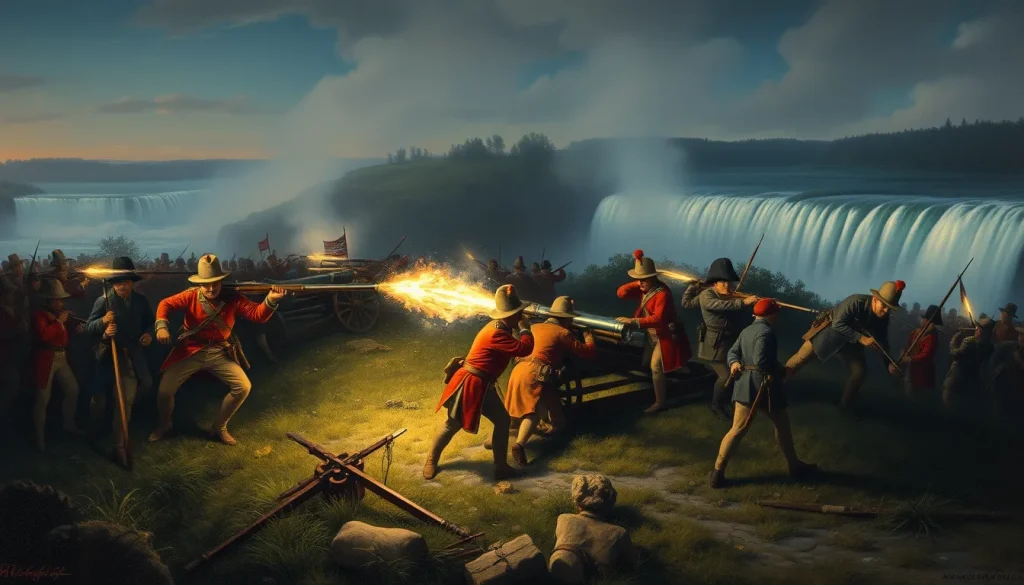
The Battle of Lundy’s Lane, fought on 25 July 1814 near present-day Niagara Falls, Ontario, was the bloodiest single engagement of the War of 1812. In a night of intense close-quarters fighting, American and British forces suffered more than 1,700 combined casualties, a staggering toll for a battlefield of fewer than 6,000 men. The battle ended the American invasion of Upper Canada and became a symbol of the war’s brutality.
Historical Context
By the summer of 1814, the War of 1812 had reached a critical phase. The United States, having struggled in earlier campaigns, had produced a professional army through rigorous training, most notably under Brigadier General Winfield Scott. In July 1814, Major General Jacob Brown led an American force across the Niagara River, capturing Fort Erie and defeating the British at the Battle of Chippawa on 5 July. Brown’s army then moved north, aiming to seize Fort George and possibly advance to Burlington. The British, under Lieutenant General Gordon Drummond, were determined to stop the American thrust. Drummond assembled a force of British regulars, Canadian militia, and Indigenous allies to block the American advance at Lundy’s Lane, a low ridge near the falls that commanded the main road north.
What Happened
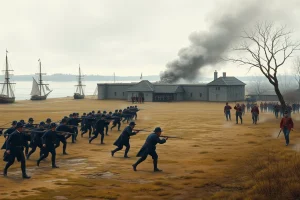
On the afternoon of 25 July, Scott’s brigade advanced up the Portage Road and encountered the British line on Lundy’s Lane. Unaware of the full British strength, Scott attacked, only to be repulsed with heavy loss. As the evening wore on, Brown fed more troops into the fight. The most famous episode came when Colonel James Miller’s 21st U.S. Infantry stormed the hill and captured the British artillery in the gathering darkness. The British counterattacked repeatedly, and the fighting around the guns became a savage melee conducted in near-total darkness. Both commanding generals—Drummond, Brown, and Scott—were wounded. By midnight, the exhausted Americans withdrew, leaving the field to the British.
Why It Matters
The Battle of Lundy’s Lane was a watershed in the War of 1812. Although both sides claimed victory, the American withdrawal ended the most serious American offensive of 1814 and marked the last invasion of Upper Canada. The strategic consequences were immediate: the Americans fell back to Fort Erie and were besieged, eventually evacuating across the river. The battle’s memory loomed large in both American and Canadian historical consciousness, representing the war’s extraordinary cost for territory that ultimately remained unchanged. Historians regard Lundy’s Lane as the bloodiest and most ferocious engagement of the conflict, with casualty rates comparable to the worst battles of the Napoleonic Wars.
Prelude
The 1814 Niagara campaign was a deliberate American effort to take Upper Canada. After the capture of Fort Erie and the victory at Chippawa, Brown’s army occupied Queenston for several weeks, but logistical difficulties and naval superiority forced him to fall back to Chippawa Creek on 24 July. As Brown withdrew, British forces under Major General Phineas Riall advanced to Lundy’s Lane to maintain contact. When Drummond arrived at Fort George on 25 July, he countermanded Riall’s orders to retreat and reinforced the position at Lundy’s Lane with additional troops. The Americans, unaware of the growing British strength, planned a northward advance to draw British forces away from Fort George, leading directly to the meeting engagement.
Forces and Commanders
The American army numbered approximately 2,800 men, organized into two brigades of regular infantry under Brigadier Generals Winfield Scott and Eleazer Ripley, plus artillery and militia. Major General Jacob Brown held overall command. The British and Canadian force numbered roughly 3,000 men, under Lieutenant General Gordon Drummond, with Major General Phineas Riall as second. British regulars included the 89th, 41st, 8th, Royal Scots, 103rd, and 104th Foot, along with Canadian fencibles and militia. Indigenous allies, including warriors under John Norton, also fought. Both sides had artillery; the British positioned guns on the hilltop, while American batteries were commanded by captains such as Thomas Biddle and James Towson.
Battlefield and Map Context
Lundy’s Lane was a dirt road running along the crest of a ridge about 25 feet above the surrounding farmland, giving a commanding view of the Portage Road and the Niagara River valley. The British placed their artillery in a cemetery at the highest point, now part of Drummond Hill Cemetery in Niagara Falls, Ontario. The battlefield was bounded by woods and orchards, with the roar of Niagara Falls audible throughout. Modern visitors can walk the site, which is a National Historic Site of Canada. The terrain favored the defender, and the hill became the focal point of the fighting.
Battle Chronology
The engagement began around 6:00 pm when Scott’s brigade emerged from woods and came under British artillery fire. Scott attacked the British line but was repulsed with heavy losses. As Brown arrived with reinforcements, he launched a series of assaults on the British position. Around 9:00 pm, a force under Colonel James Miller climbed the hill and captured the British guns. A desperate night counterattack by Drummond’s troops, often using bayonets, raged for hours. Fighting continued until after midnight, with units becoming intermingled in the darkness. By 1:00 am on 26 July, the Americans had withdrawn, leaving the British in control of the field.
Casualties and Losses
Casualty figures vary slightly by source but are consistently high. British and Canadian losses were approximately 84 killed, 559 wounded, and 235 captured or missing, totaling about 878. American losses were around 173 killed, 571 wounded, and 117 missing, totaling about 861. Combined, the two armies suffered over 1,730 casualties, representing more than 29 percent of the forces engaged. This toll was one of the highest proportional casualty rates of any battle during the Napoleonic era. The heavy losses left both armies severely weakened and contributed to the American decision to retreat.
Result
The battle itself is often described as a tactical stalemate, with both sides holding parts of the field at different times. The Americans captured the British guns but could not remove them; the British retook them. Neither army held a clear victory at dawn, but the Americans withdrew first. In strategic terms, the British claimed a defensive victory because they remained on the field and the invasion was stopped. The American withdrawal effectively ended offensive operations in Upper Canada for the remainder of the war.
Strategic Consequences
The strategic consequences were immediate and significant. The Americans fell back to Chippawa, then to Fort Erie, where they withstood a British siege until November 1814, when they evacuated the Canadian shore. The battle ended the American attempt to take Upper Canada in 1814 and led to a more defensive American posture in the Niagara region. For the British, the victory secured the province and allowed forces to be redeployed elsewhere. In the broader war, the failure of the Niagara campaign contributed to the overall stalemate that led to the Treaty of Ghent. The battle also became a symbol of Canadian perseverance and military capability, and Drummond Hill Cemetery became a shrine to the fallen.
Primary Accounts
Contemporary accounts include official reports from Major General Jacob Brown, Lieutenant General Gordon Drummond, and brigade commanders, as well as personal letters and journals of soldiers on both sides. The American report describes the capture of British guns and a disciplined withdrawal; the British report emphasizes their eventual possession of the field. These documents provide the framework for understanding the battle, but they are necessarily biased by nationality and the chaos of night fighting. Later memoirs, such as those of Winfield Scott, add retrospective detail. The most reliable casualty figures come from muster rolls and casualty returns, which are preserved in archives.
Battlefield Today
The battlefield is now partly urbanized, but the core area is preserved as Battle of Lundy’s Lane National Historic Site of Canada. The site, designated in 1937, includes Drummond Hill Cemetery, where a monument erected in 1895 honors the fallen, and plaques added in 1935 list the names of British and Canadian soldiers who died. A visitor center and interpretation panels help explain the battle. The Lundy’s Lane Historical Society maintains the site and offers programs. The location in Niagara Falls, Ontario, is accessible to the public and serves as a reminder of the war’s human cost.
Primary Sources
The most important primary sources are the official after-action reports written by the commanding officers. Major General Jacob Brown’s report, dated July 1814, details the American actions and claims a tactical advantage before withdrawing. Lieutenant General Gordon Drummond’s report presents the British version, emphasizing the repulse of the enemy. These reports were published in contemporary newspapers and later in compiled documentary histories. Other primary materials include letters from junior officers, such as those of Eleazer Ripley, and the diary of the American surgeon. Casualty returns and muster rolls provide numerical data. Each source reflects the perspective of its author and the limits of observation during night combat.
Further Reading
- Donald R. Hickey, The War of 1812: A Forgotten Conflict (University of Illinois Press, 1989)
- Jon Latimer, 1812: War with America (Harvard University Press, 2007)
- Pierre Berton, Flames Across the Border (McClelland & Stewart, 1981)
- Richard Feltoe, The Battle of Lundy’s Lane (Dundurn Press, 2003)
- Parks Canada, Battle of Lundy’s Lane National Historic Site of Canada – official site.
References
- thewarof1812.org, “Battle of Lundy’s Lane – War of 1812,” https://thewarof1812.org/battles/battle-of-lundys-lane/
- Wikipedia, “Battle of Lundy’s Lane,” https://en.wikipedia.org/wiki/Battle_of_Lundy%27s_Lane
- Parks Canada, “Battle of Lundy’s Lane National Historic Site of Canada,” https://www.pc.gc.ca/apps/DFHD/page_nhs_eng.aspx?id=428
- militaryhistory.ca, “War of 1812 – Battle of Lundy’s Lane,” https://militaryhistory.ca/war-of-1812-battle-of-lundys-lane/
- The Canadian Encyclopedia, “Battle of Lundy’s Lane,” https://prod-front.thecanadianencyclopedia.ca/en/article/battle-of-lundys-lane
FAQ
Why was the Battle of Lundy's Lane the bloodiest battle of the War of 1812?
The battle produced over 1,700 combined casualties out of fewer than 6,000 engaged, a casualty rate exceeding 29%. The intense close-quarters night fighting and repeated assaults on the hilltop artillery led to disproportionate losses on both sides.
Who won the Battle of Lundy's Lane?
The result is often described as a tactical stalemate, but the Americans withdrew the next morning, leaving the British and Canadians in possession of the field. Strategically, the British won because they stopped the American invasion of Upper Canada.
What was the strategic impact of Lundy's Lane?
The battle ended the American offensive of 1814 into Upper Canada. The Americans retreated to Fort Erie, were besieged, and eventually evacuated back to the United States, never again mounting a major invasion of Canada.


Leave a Reply