

Short Answer
The Second Battle of Fort Bowyer, fought from February 8 to 12, 1815, was the last land engagement of the War of 1812 between British and American forces. Occurring on Mobile Point, at the entrance to Mobile Bay in present-day Alabama, the battle saw a British expeditionary force under Major General John Lambert capture the fort from its American garrison. The victory, however, came two days after the signing of the Treaty of Ghent, which had already ended the war, although news of the treaty had not yet reached the combatants. The battle is historically significant as the final military action of the conflict and a demonstration of British professional siegecraft late in the war.
Historical Context
The War of 1812’s Gulf Coast theater was driven by British strategists’ desire to seize the port of New Orleans and the surrounding region. Control of New Orleans would cut off American commerce on the Mississippi River and potentially strengthen Britain’s negotiating position in the peace talks at Ghent. In April 1813, American forces under Major General James Wilkinson occupied Mobile, a Spanish possession in West Florida, and subsequently built Fort Bowyer on Mobile Point to guard the entrance to Mobile Bay. The fort, a small wood-and-earth structure, was named for Colonel John Bowyer, who oversaw its construction.
In September 1814, a British naval attack on Fort Bowyer was repulsed, marking the First Battle of Fort Bowyer. That defeat led British commanders to abandon an immediate attempt on Mobile and instead launch a direct assault on New Orleans from the sea. That campaign culminated in the disastrous British defeat at the Battle of New Orleans on January 8, 1815, which occurred after the Treaty of Ghent had been signed but before the news reached the Gulf. After the failure at New Orleans, Major General John Lambert, who had assumed command after the deaths of Major Generals Edward Pakenham and Samuel Gibbs, reverted to the original British strategy of capturing Mobile and Fort Bowyer as a precursor to isolating New Orleans by an overland approach.
What Happened
On February 7, 1815, a British squadron of thirty-eight warships arrived off Mobile Point. The next day, Lambert landed approximately 1,000 troops—mostly veterans of the New Orleans campaign—at a point about seven miles east of the fort, with more troops held in reserve on Dauphin Island. The American commander, Lieutenant Colonel William Lawrence, had been reinforced since the first battle and now commanded roughly 375 men of the 2nd U.S. Infantry, with about twenty-two guns.
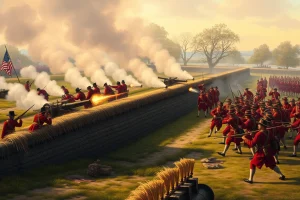
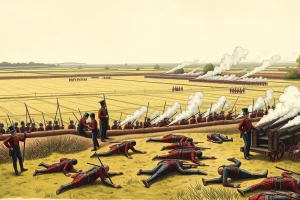
The British began a formal siege under the direction of Colonel John Fox Burgoyne of the Royal Engineers. Burgoyne identified the fort’s landward side as its weak point; the seaward bastion was strong, but the rear defenses were poorly protected. Over the next few days, British troops dug approach trenches and constructed artillery batteries within effective range of the fort, despite intermittent American fire. On the night of February 11–12, the British placed eleven guns and three Congreve rocket launchers in position. On February 12, a heavy bombardment convinced Lawrence that continued resistance was futile. Facing an enemy force outnumbering his garrison more than thirteen to one and with no prospect of relief, Lawrence accepted Lambert’s terms of surrender. The American garrison was taken prisoner.
The next day, February 13, HMS Brazen brought word that the Treaty of Ghent had been signed on December 24, 1814. Under the treaty’s terms, all hostilities were to cease. The British, therefore, did not advance on Mobile, and Fort Bowyer was later returned to American control. The battle thus became an anticlimactic footnote to the war’s conclusion.
Why It Matters
The Second Battle of Fort Bowyer is important for several reasons. It was the last land battle of the War of 1812, a fact that underscores the incomplete communication between the military forces in the field and the diplomats at Ghent. The British demonstrated that they had the capability to execute a well-planned siege, achieving their objective with professional skill. The battle also illustrates the strategic ambiguity at the war’s end: had the peace arrived even a week later, the British might have taken Mobile and potentially renewed the campaign against New Orleans. Historians such as William Coker have argued that the battle deserves recognition as the war’s final land engagement, though it is often overshadowed by the American victory at New Orleans. The differing narratives—American emphasis on New Orleans versus the British success at Fort Bowyer—reflect broader questions about how the war’s outcome is remembered.
Prelude
After the failed attack on Fort Bowyer in September 1814, Major General Andrew Jackson strengthened the fort’s defenses, adding men and guns. Jackson famously boasted that “ten thousand men cannot take it,” but Lieutenant Colonel William Lawrence remained concerned about the fort’s exposed landward side. Following the British defeat at New Orleans, General Lambert decided to resume the earlier plan of capturing Mobile and Fort Bowyer as a stepping stone to isolating New Orleans. His army, comprised of battle-hardened veterans, was reinforced and positioned for the operation.
Forces and Commanders
American:
Lieutenant Colonel William Lawrence commanded the garrison of about 375 men from the 2nd U.S. Infantry, supported by approximately twenty-two cannon. Lawrence was a capable officer who had distinguished himself in the first defense of the fort.
British:
Major General John Lambert led the expeditionary force, with Colonel John Fox Burgoyne directing the siege works. The British force numbered about 5,000 men, including the 4th, 21st, and 44th Foot, along with Royal Engineers and artillery units. (Some accounts give lower figures, such as 1,400, but the larger number is supported by multiple sources, including the Encyclopedia of Alabama.) The force had been reinforced after the Battle of New Orleans and included veterans of that campaign.
Battlefield and Map Context
Fort Bowyer stood on Mobile Point, a sandy peninsula at the eastern entrance to Mobile Bay. The fort was built of logs and sand, roughly 22,000 square feet, with a semicircular wall facing the bay and two straight walls on the landward side meeting at a bastion. Its main strength was a crescent-shaped seaward bastion mounting heavy guns. The landward approach was comparatively open and lacked sturdy defensive works, making it vulnerable to a besieging force. The fort’s location commanded the deep-water channel, denying enemy ships entry to the bay. Today, the site lies within Fort Morgan State Historic Site.
Battle Chronology
February 7: British naval squadron arrives off Mobile Point.
February 8: Lambert lands about 1,000 troops east of the fort; they begin reconnaissance and approach work.
February 8–11: British soldiers dig trenches and erect batteries under harassing fire from the fort. American resistance is determined but limited by lack of casemates to protect gunners.
February 11–12: British finish placement of guns and rocket launchers within effective range.
February 12: Heavy bombardment begins; Lawrence surrenders to Lambert after negotiating terms.
February 13: HMS Brazen arrives with news of the Treaty of Ghent; hostilities cease immediately.
Casualties and Losses
Exact casualty figures vary. The American Battlefield Trust lists total casualties for the battle as 42 (11 American, 31 British). The Encyclopedia of Alabama states British suffered about 30 killed and wounded, Americans about 10. The War of 1812 website reports American: 1 killed, about 10 wounded, and the entire garrison captured; British: about 13 killed and wounded during the siege operations. These discrepancies stem from differences in contemporary reports and later compilations. The British lost roughly 30 casualties, the Americans about 11, in the course of the bombardment and skirmishing.
Result
The immediate result was a British victory: Fort Bowyer surrendered and Mobile Bay was opened to British warships. However, the strategic value of the victory vanished when news of the Treaty of Ghent arrived the next day. The treaty provided for the restoration of all captured territory; thus, Fort Bowyer was returned to American control. The battle ended without affecting the war’s outcome.
Strategic Consequences
Had the war continued, the capture of Fort Bowyer would have allowed the British to launch an attack on Mobile, which lay about 30 miles up the bay. With Mobile, the British could have moved overland toward New Orleans, cutting off the city from the eastern United States. This was the original British plan, abandoned after the first failed assault. The fact that the British army was poised to execute that plan on February 12, 1815, underscores the precariousness of the American hold on the Gulf Coast at the war’s end. The treaty’s timing prevented a further British advance and ultimately preserved American control of the region.
Primary Accounts
Several contemporary records exist. Lieutenant Colonel Lawrence’s official report to Major General Jackson, written on February 12, 1815, details the siege and his reasons for surrender. General Lambert’s dispatch to the British War Office describes the operation and the surrender. Both documents are preserved in national archives: the American report in the National Archives and Records Administration (NARA), and the British report in the National Archives (Kew). These documents provide a firsthand view of the battle from both sides, though they are shaped by each commander’s desire to justify their actions. A modern analysis can be found in William Coker’s article “The Last Battle of the War of 1812: New Orleans. No, Fort Bowyer!” (Alabama Historical Quarterly, 1981).
Battlefield Today
The site of Fort Bowyer is now part of the Fort Morgan State Historic Site in Gulf Shores, Alabama. An interpretive marker near the visitor center highlights the fort’s role in the War of 1812. The original wooden fort has long since decayed; Fort Morgan, a massive brick fortification built in the 1830s, stands near the same location. Visitors can walk the grounds and view Mobile Point, but no above-ground remains of Fort Bowyer survive.
Primary Sources
The most important contemporary sources are the official military reports. Lawrence’s report, dated February 12, 1815, is available in the American State Papers: Military Affairs, volume 3. Lambert’s dispatch was published in the London Gazette in 1815. Also valuable is the journal of an American officer, possibly from the 2nd Infantry, which gives a day-by-day account of the siege; this is held at the Alabama Department of Archives and History. These sources are biased by their authors’ perspectives, but they provide the foundational facts of the battle.
Further Reading
- Hickey, Donald R. The War of 1812: A Forgotten Conflict. University of Illinois Press, 1989.
- Latimer, Jon. 1812: War with America. Harvard University Press, 2007.
- Coker, William S. “The Last Battle of the War of 1812: New Orleans. No, Fort Bowyer!” Alabama Historical Quarterly 43 (Spring 1981): 42–63.
- American Battlefield Trust. “Second Fort Bowyer Battle Facts and Summary.” https://www.battlefields.org/learn/war-1812/battles/second-fort-bowyer
- Encyclopedia of Alabama. “Fort Bowyer.” https://encyclopediaofalabama.org/article/fort-bowyer/
References
- American Battlefield Trust. “Second Fort Bowyer Battle Facts and Summary.” Accessed October 2023. https://www.battlefields.org/learn/war-1812/battles/second-fort-bowyer.
- The War of 1812 Website. “Second Battle of Fort Bowyer.” Accessed October 2023. https://thewarof1812.org/battles/second-battle-of-fort-bowyer/.
- Encyclopedia of Alabama. “Fort Bowyer.” Accessed October 2023. https://encyclopediaofalabama.org/article/fort-bowyer/.
- American Battlefield Trust. “Battles of Fort Bowyer in the War of 1812.” Accessed October 2023. https://www.battlefields.org/learn/articles/battles-fort-bowyer-war-1812.
FAQ
Was the Second Battle of Fort Bowyer the last land battle of the War of 1812?
Yes, it is widely considered the last land engagement between British and American forces in the war. It took place on February 8–12, 1815, after the Battle of New Orleans but before news of the Treaty of Ghent reached the Gulf.
Why did the British attack Fort Bowyer twice?
The British initially attacked in September 1814 to reduce the fort and open the way to Mobile, which would serve as a staging point for an overland campaign against New Orleans. After failing, they attacked New Orleans directly. Following their defeat there, they returned to Fort Bowyer in February 1815 to resume the original plan.
What was the outcome of the Second Battle of Fort Bowyer?
The American garrison under Lt. Col. William Lawrence surrendered to British forces under Maj. Gen. John Lambert on February 12, 1815. However, the next day, news of the Treaty of Ghent arrived, and the fort was later returned to American control.



Leave a Reply