

Short Answer
The Treaty of Ghent, signed on December 24, 1814, ended the War of 1812 between the United States and Great Britain, but its treatment of Indigenous nations was both limited and consequential. The treaty’s only direct reference to Indigenous peoples appears in Article IX, which promised to restore “all possessions, rights, and privileges” they had enjoyed in 1811, yet it contained no enforcement mechanism and the provision was never carried out. This article examines how the treaty addressed Indigenous nations, the diplomatic context that shaped its language, and the long-term impact on Native peoples who had allied with Britain.
Historical Context
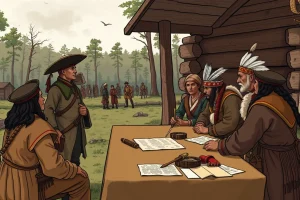
Indigenous nations were central to the War of 1812, particularly in the Northwest Territory and the Great Lakes region. Many Native communities, including Shawnee, Potawatomi, Ojibwe, and others, allied with Britain, seeking to resist American westward expansion. The leadership of Tecumseh and his brother Tenskwatawa galvanized a pan-Indian confederacy that fought alongside British forces at key battles such as Detroit and the Thames. For Britain, these alliances were critical to defending Canada against American invasion. For the United States, the war provided an opportunity to break Native resistance and assert control over the frontier. By 1814, both sides were exhausted, and peace negotiations began in Ghent, Belgium, in August. Britain initially hoped to secure a buffer state for Indigenous peoples in the Ohio and Michigan territories, but military setbacks and shifting diplomatic priorities caused the proposal to collapse.
What Happened
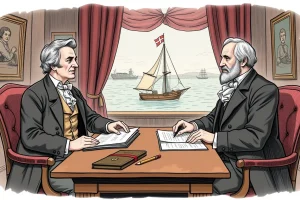
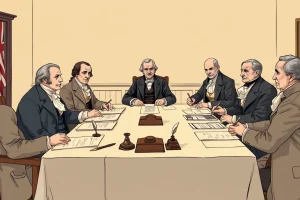
The American and British delegations met in Ghent from August to December 1814. The British demanded recognition of Indigenous claims and the creation of an independent Native state, while the Americans refused any territorial concessions. As the military situation stabilized and news of American victories at Lake Champlain and Baltimore arrived, the British dropped the buffer state proposal. The final treaty, consisting of eleven articles, restored all territories to their pre-war status (status quo ante bellum). Concerning Indigenous peoples, Article IX stated that both parties would “restore to such Indians all possessions, rights, and privileges which they may have enjoyed or been entitled to in 1811.” However, the article lacked any mechanism for implementation, and neither side took steps to enforce it. The treaty was signed on December 24, 1814, and ratified by the United States and Britain in February 1815.
Why It Matters
The Treaty of Ghent effectively abandoned Britain’s Indigenous allies. The promise of restoring 1811 rights was never honored by the United States, and Britain showed no interest in enforcement. With the war concluded, American settlers pushed further into Indigenous territories, leading to massive land losses and forced removals in the following decades. The treaty marked a turning point: Indigenous nations lost their crucial European ally and faced a more aggressive American expansion. Historians debate whether the treaty’s Article IX was a sincere commitment or a diplomatic gesture, but its practical effect was to leave Indigenous peoples without protection and accelerate their dispossession.
Definition
“How the Treaty of Ghent addressed Indigenous nations” refers to the specific provisions, or lack thereof, in the 1814 peace treaty that concerned Indigenous peoples. The primary element is Article IX, which promised to restore pre-war status for Native lands and rights. However, the treaty also omitted other Indigenous-related demands, such as a proposed buffer state, and failed to define how restoration would occur.
Background
Indigenous nations had been vital to both British and American strategies during the war. The British provided arms and military support to Native allies, who fought alongside redcoats and Canadian militia. The American government, meanwhile, saw the war as an opportunity to break British-supported Native resistance and open new lands to settlement. The collapse of Tecumseh’s confederacy at the Battle of the Thames in 1813 weakened Indigenous military power but did not end their importance in the negotiations.
How It Worked
Article IX was drafted as a mutual commitment: the United States and Great Britain each agreed to restore to Indigenous peoples the “possessions, rights, and privileges” they had held in 1811. This meant that any lands or property taken during the war should be returned, and any treaties or agreements made during hostilities were to be undone. In practice, the article had no enforcement provisions. There was no joint commission, no timeline, and no penalty for non-compliance. After ratification, the United States interpreted the article narrowly and took no action to restore lands. Britain, focused on European affairs and disengaging from North American commitments, did not press the issue.
Competing Viewpoints
American diplomats viewed Article IX as acceptable because it did not restrict American territorial expansion beyond the pre-war status. They argued that the provision merely reiterated existing treaty obligations and required no new actions. British negotiators, who had advocated for a stronger Indigenous guarantee, regarded Article IX as a face-saving compromise but recognized that it was unenforceable. For Indigenous nations, Article IX was a betrayal. They had fought for Britain in return for promises of land protection, and the treaty ignored their claims. Later historians differ in emphasis: some see Article IX as a cynical gesture, while others point to genuine British intentions undermined by geopolitical realities.
Role in the War of 1812
The treaty’s treatment of Indigenous nations reflected the broader outcome of the war. The United States failed to conquer Canada but succeeded in breaking Native resistance and securing the Old Northwest from British interference. The British, having achieved their primary goal of defending Canada, had little incentive to prolong the war for Indigenous interests. The treaty thus formalized the decline of Indigenous power that had been sealed on the battlefield earlier in the conflict.
Consequences and Historical Interpretation
The immediate consequence for Indigenous peoples was the loss of British military and diplomatic support. Article IX’s ineffectiveness allowed American expansion to proceed unchecked, leading to the removal of many Native tribes, such as the Potawatomi and Shawnee, in the 1820s and 1830s. Long-term, the treaty contributed to the doctrine of manifest destiny and the erosion of Native sovereignty. Historians like Donald Hickey argue that the treaty’s omissions were more significant than its promises, and that Indigenous peoples were “the major losers” of the war. Others, such as Alan Taylor, emphasize the agency of Native communities and their continued resistance despite treaty failures. The article remains a poignant example of how peace treaties can overlook the interests of non-signatory parties.
Primary Sources
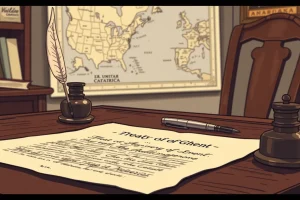
The most direct primary source is the Treaty of Ghent itself. The full transcript is available from the National Archives (https://www.archives.gov/milestone-documents/treaty-of-ghent) and the U.S. Senate (https://www.senate.gov/about/powers-procedures/treaties/treaty-of-ghent/transcript-treaty-of-ghent.htm). Article IX explicitly states the restoration of Indigenous “possessions, rights, and privileges” to the 1811 status. Additionally, the diplomatic correspondence between negotiators reveals the British proposal for a buffer state and its eventual abandonment, though such letters are less accessible. The treaty’s text is unambiguous in its wording but silent on enforcement, making it a crucial artifact for understanding the limits of Indigenous inclusion in international diplomacy.
Further Reading
- Donald R. Hickey, The War of 1812: A Forgotten Conflict (University of Illinois Press, 1989).
- Alan Taylor, The Civil War of 1812: American Citizens, British Subjects, Irish Rebels, & Indian Allies (Alfred A. Knopf, 2010).
- Richard White, The Middle Ground: Indians, Empires, and Republics in the Great Lakes Region, 1650–1815 (Cambridge University Press, 1991).
- National Archives, “Treaty of Ghent (1814),” https://www.archives.gov/milestone-documents/treaty-of-ghent.
- The Canadian Encyclopedia, “Treaty of Ghent,” https://thecanadianencyclopedia.ca/en/article/treaty-of-ghent.
References
- National Archives, “Treaty of Ghent (1814),” accessed October 2023, https://www.archives.gov/milestone-documents/treaty-of-ghent.
- U.S. Senate, “Transcript: Treaty of Ghent,” accessed October 2023, https://www.senate.gov/about/powers-procedures/treaties/treaty-of-ghent/transcript-treaty-of-ghent.htm.
- Jason Ridler, “Treaty of Ghent,” The Canadian Encyclopedia, last edited December 20, 2017, https://thecanadianencyclopedia.ca/en/article/treaty-of-ghent.
- “Treaty of Ghent – War of 1812,” accessed October 2023, https://thewarof1812.org/treaty/.
- National Park Service, “War’s End,” Star-Spangled Banner National Historic Trail, last updated June 11, 2025, https://www.nps.gov/stsp/learn/historyculture/war-s-end.htm.
FAQ
Did the Treaty of Ghent guarantee Indigenous lands?
No. Article IX promised to restore lands and rights to the 1811 status, but it lacked enforcement mechanisms and was ignored by both the United States and Britain. It did not guarantee future protection.
What did Article IX actually say?
Article IX stated that both parties would 'restore to such Indians all possessions, rights, and privileges which they may have enjoyed or been entitled to in 1811.' It was a mutual pledge with no implementation provisions.
Why did Britain drop the Indigenous buffer state proposal?
Britain abandoned the idea after military setbacks in North America, American refusal to consider territorial changes, and the desire to quickly secure peace without prolonging the war over Indigenous interests.

Leave a Reply