
Short Answer
The Battle of Horseshoe Bend, also known as the Battle of Tohopeka, was fought on March 27, 1814, near the Tallapoosa River in the Mississippi Territory (present-day Tallapoosa County, Alabama). It was a decisive engagement of the Creek War, a conflict closely tied to the War of 1812, in which United States forces and their Native American allies defeated the Red Stick faction of the Creek Nation. The battle effectively ended organized Red Stick resistance, led to the Treaty of Fort Jackson, and accelerated the career of Major General Andrew Jackson. This article addresses the 1814 battle; other uses of the term are not covered here.
Historical Context
By 1813, the Creek Nation was deeply divided. The Upper Creeks, many of whom belonged to a traditionalist faction known as the Red Sticks, resisted American territorial expansion and sought to preserve Creek cultural and religious practices. The Lower Creeks, concentrated in towns closer to Georgia and the American frontier, had adopted more elements of Anglo-American culture and generally favored accommodation with the United States. Tensions escalated after the Shawnee leader Tecumseh visited the Southeast in 1811–1812, encouraging Indigenous resistance to American encroachment. The Red Sticks also maintained ties with Spanish authorities in Florida and, later, with the British, who were at war with the United States.
In July 1813, a U.S. militia force intercepted a Red Stick party returning from Pensacola with arms, leading to the Battle of Burnt Corn. On August 30, 1813, Red Stick warriors attacked Fort Mims, a stockade in the Mississippi Territory, killing hundreds of settlers, militia, and Lower Creek allies. The Fort Mims massacre shocked the American frontier and prompted retaliatory campaigns. Because regular U.S. troops were largely committed to the war against Britain, the federal government relied on state militias from Tennessee, Georgia, and the Mississippi Territory, along with Cherokee, Choctaw, and Lower Creek allies, to suppress the Red Sticks. Andrew Jackson, a major general of the Tennessee militia, emerged as the principal American commander in the region.
What Happened
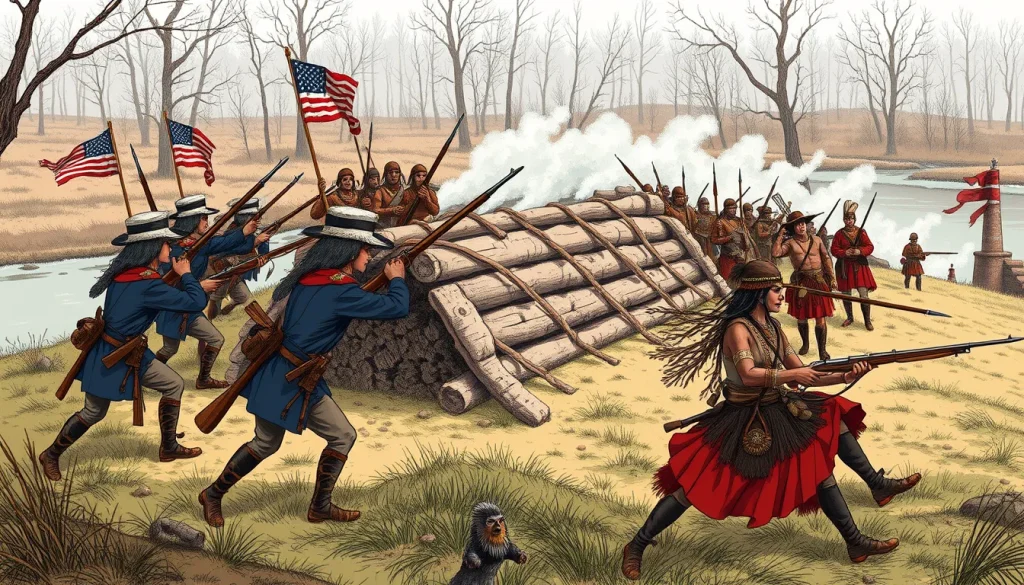
In early 1814, Jackson advanced into the heart of Red Stick territory. After a series of engagements, including the battles of Emuckfaw and Enotachopco, he moved toward a major Red Stick stronghold at Tohopeka, a fortified camp located in a bend of the Tallapoosa River known as Horseshoe Bend. The Red Sticks, led by chiefs such as Menawa and Peter McQueen, had constructed a breastwork of logs and earth across the narrow neck of the peninsula, protecting their position on three sides by the river. The camp contained roughly 1,000 warriors, along with women and children.
On the morning of March 27, 1814, Jackson divided his force of about 3,300 men. He sent Brigadier General John Coffee with mounted troops, including Cherokee and Choctaw allies, across the river to surround the camp from the south. Jackson remained north of the breastwork with the main infantry and artillery. After an artillery bombardment that proved largely ineffective against the fortifications, Coffee’s forces and the Native allies began attacking from across the river. A group of Cherokee warriors swam across the Tallapoosa, stole canoes, and ferried others over, setting fire to Red Stick canoes and structures. Seeing smoke and hearing gunfire, Jackson ordered a bayonet charge. The 39th U.S. Infantry, led by Colonel John Williams, breached the breastwork, and hand-to-hand fighting ensued. The Red Sticks fought fiercely but were overwhelmed. Many were killed, and those who attempted to escape across the river were shot by Coffee’s troops or drowned. The battle lasted several hours and ended in a complete American victory.
Why It Matters
The immediate effect of the battle was the collapse of organized Red Stick resistance. Although some scattered fighting continued, the Creek War as a major military conflict was effectively over. In August 1814, Jackson imposed the Treaty of Fort Jackson on the Creek Nation, including both Red Sticks and his Lower Creek allies, forcing the Creeks to cede approximately 23 million acres of land in present-day Alabama and Georgia to the United States. This land cession opened vast areas to American settlement and deeply affected the future of the Creek people.
The battle also had significant consequences for the War of 1812. By securing the southern frontier, Jackson’s victory eliminated a potential British ally in the region and freed American forces to concentrate on the defense of New Orleans. Jackson became a national hero, a reputation that later helped him win the presidency. Historians have debated the battle’s significance: some emphasize it as a turning point in U.S. expansion and Indigenous dispossession, while others focus on Jackson’s tactical skill and the crucial role of Native American allies. The disproportionate casualty ratio and the killing of many Red Sticks have also drawn scholarly attention, with interpretations varying on whether it constituted a massacre or a legitimate military action under the norms of the time.
Prelude
Following the Fort Mims massacre, American forces in the region launched punitive expeditions. Jackson’s first major campaign in late 1813 culminated in the Battle of Talladega, where his forces defeated a Red Stick siege of a friendly Creek town. In early 1814, Jackson faced logistical difficulties and supply shortages but pressed on. The Red Sticks, under Menawa, concentrated at Tohopeka, a site they considered defensible due to the river bend and their extensive fortifications. Jackson learned of the camp from scouts and Native allies and determined to attack.
Forces and Commanders
Jackson commanded a mixed force of approximately 2,000 U.S. infantry, including the 39th U.S. Infantry, and about 700 mounted troops. He also had roughly 600 Native American allies, primarily Cherokee, Choctaw, and Lower Creek warriors. Notable commanders included Brigadier General John Coffee, Colonel John Williams of the 39th Infantry, and Choctaw chief Pushmataha. The Red Stick force, numbering around 1,000 warriors, was led by chiefs Menawa and Peter McQueen. The Red Sticks were armed with muskets, bows, and knives, and they held a strong defensive position.
Battlefield and Map Context
The battlefield is located within a horseshoe-shaped bend of the Tallapoosa River in what is now Tallapoosa County, Alabama, near the town of Dadeville. The Red Sticks had fortified the narrow neck of the peninsula with a breastwork of logs, earth, and rocks, extending roughly 400 yards across. The river protected the other three sides, making a direct assault difficult. The surrounding terrain consisted of wooded hills and open ground. Today, the site is preserved as Horseshoe Bend National Military Park, which includes the battlefield, a visitor center, and monuments.
Battle Chronology
On the morning of March 27, 1814, Jackson deployed his forces. At about 6:30 a.m., Coffee’s mounted troops and Native allies crossed the Tallapoosa River to the south, taking positions to cut off escape. Jackson’s artillery, consisting of two cannons, opened fire on the breastwork around 10:30 a.m., but the bombardment caused little damage. Meanwhile, Cherokee warriors swam the river, captured Red Stick canoes, and transported additional allied warriors across. They began burning buildings within the camp, creating smoke. Observing this, Jackson ordered a frontal assault. The 39th U.S. Infantry and militia charged the breastwork with bayonets. After fierce hand-to-hand combat, they breached the defensive line. The Red Sticks fought desperately, but the American and allied forces overwhelmed them. By late afternoon, the battle was over.
Casualties and Losses
Casualty figures for the battle are estimates and vary among sources. According to commonly cited American accounts, over 800 Red Stick warriors were killed, and about 20 escaped wounded. American losses were reported as 32 killed and 99 wounded. Native American allies (Cherokee, Choctaw, and Lower Creek) suffered 23 killed and 47 wounded. These numbers should be treated with caution, as record-keeping was imperfect and contemporary accounts may have been exaggerated. The high proportion of Red Stick dead reflects the intensity of the fighting and the fact that many were killed while attempting to flee across the river.
Result
The battle ended in a decisive victory for the United States and its Native American allies. The Red Stick forces at Tohopeka were destroyed as a fighting unit. Menawa was wounded but escaped; Peter McQueen also survived. The defeat broke the back of Red Stick resistance and effectively concluded the Creek War. Jackson’s victory secured the southern frontier for the United States and established him as a national military figure.
Strategic Consequences
In the immediate aftermath, Jackson moved to consolidate control. In August 1814, he convened the Treaty of Fort Jackson, which forced the Creek Nation to cede vast tracts of land. This treaty was controversial even at the time because it punished the Lower Creek allies along with the Red Sticks. Strategically, the victory denied the British a potential Indigenous ally in the Gulf region and allowed Jackson to shift his attention to the defense of New Orleans, where he won a decisive battle in January 1815. The battle also opened the Alabama territory to rapid American settlement, contributing to the expansion of slavery and the displacement of Indigenous peoples.
Primary Accounts
Several contemporary accounts exist. Andrew Jackson’s official report to the Secretary of War, dated March 28, 1814, describes the fortifications, the assault, and the casualties. Sam Houston, then a lieutenant in the 39th U.S. Infantry, later recalled the battle and his wounding by an arrow. Cherokee and Choctaw participants left few written accounts, but their roles are documented in military records and later oral histories. Red Stick perspectives are largely absent from the documentary record, though some accounts were recorded by American officials and later ethnographers. These sources are filtered through the biases of the victors and should be read critically.
Battlefield Today
Horseshoe Bend National Military Park, established in 1959, preserves the battlefield and surrounding area. Located near Dadeville, Alabama, the park features a visitor center with exhibits, a driving tour, and hiking trails. Monuments commemorate the American soldiers, Native American allies, and Red Stick warriors. The site is managed by the National Park Service and serves as a place of remembrance and historical education.
Primary Sources
The most important contemporary document is Major General Andrew Jackson’s official report to Secretary of War John Armstrong, written on March 28, 1814. In it, Jackson describes the Red Stick fortifications, the artillery bombardment, the flanking movement by Coffee, and the bayonet charge. The report provides American casualty figures and claims over 800 Red Stick dead. It is a valuable but partisan source, designed to justify Jackson’s actions and celebrate his victory.
Another key source is the account of Sam Houston, who served as a lieutenant in the 39th U.S. Infantry and was wounded at Horseshoe Bend. Houston’s recollections, recorded in later interviews and biographies, offer a firsthand view of the assault but were written years after the event. Cherokee and Choctaw participants left no extensive written narratives, though their contributions are noted in military correspondence and treaty records. Red Stick voices are scarce; some were captured in later interviews by ethnographers and historians, but they remain limited. Researchers can consult The Papers of Andrew Jackson for Jackson’s reports and correspondence, and the National Archives for military records of the period.
Further Reading
- Waselkov, Gregory A. A Conquering Spirit: Fort Mims and the Redstick War of 1813–1814. University of Alabama Press, 2006.
- Remini, Robert V. Andrew Jackson and the Course of American Empire, 1767–1821. Harper & Row, 1977.
- Halbert, H. S., and T. H. Ball. The Creek War of 1813 and 1814. University of Alabama Press, 1969 (reprint).
- Hickey, Donald R. The War of 1812: A Forgotten Conflict. University of Illinois Press, 1989.
- National Park Service. “Horseshoe Bend National Military Park.” https://www.nps.gov/hobe/
- Britannica, “Battle of Horseshoe Bend (1814).” https://www.britannica.com/topic/Battle-of-Horseshoe-Band
References
- Britannica, “Battle of Horseshoe Bend (1814).” Accessed [date]. https://www.britannica.com/topic/Battle-of-Horseshoe-Band
- Wikipedia, “Battle of Horseshoe Bend.” Accessed [date]. https://en.wikipedia.org/wiki/Battle_of_Horseshoe_Bend
- Waselkov, Gregory A. A Conquering Spirit: Fort Mims and the Redstick War of 1813–1814. University of Alabama Press, 2006.
- Remini, Robert V. Andrew Jackson and the Course of American Empire, 1767–1821. Harper & Row, 1977.
FAQ
What was the Battle of Horseshoe Bend?
The Battle of Horseshoe Bend was fought on March 27, 1814, between U.S. forces under Andrew Jackson and Red Stick Creek warriors in present-day Alabama. It ended in a decisive U.S. victory.
Who fought at the Battle of Horseshoe Bend?
U.S. forces, including militia and the 39th U.S. Infantry, along with Cherokee, Choctaw, and Lower Creek allies, fought against the Red Stick faction of the Creek Nation.
What were the consequences of the Battle of Horseshoe Bend?
The battle effectively ended the Creek War, led to the Treaty of Fort Jackson and massive Creek land cessions, made Andrew Jackson a national hero, and secured the southern frontier for the United States during the War of 1812.
Leave a Reply