
Short Answer
War of 1812 veteran land grants were a congressionally authorized system of land bounties intended to encourage enlistment in the regular United States Army and to compensate soldiers for their service during the conflict with Great Britain. Initiated by legislation passed in 1811–1812 and expanded in 1814, the program promised eligible noncommissioned officers and soldiers tracts of public land, typically 160 acres, in designated western territories. Over the following decades, these grants distributed millions of acres, influenced federal land policy, and played a significant role in the settlement of the American frontier.
Historical Context
The United States entered the War of 1812 with a small regular army and limited financial resources. Congress sought to expand the army without raising taxes by relying on the nation’s vast public domain, which had been acquired through treaties and purchases. The use of land bounties as military compensation had a clear precedent: during the American Revolution, the Continental Congress had awarded land to officers and soldiers, and subsequent acts in 1788, 1803, and 1806 provided bounties for Revolutionary War veterans. For the War of 1812, the federal government again turned to land grants as an inducement to enlistment, particularly for the five-year terms required of regulars. The availability of public lands in the Northwest and Southwest territories made this a practical, if not always efficient, method of payment.
What Happened
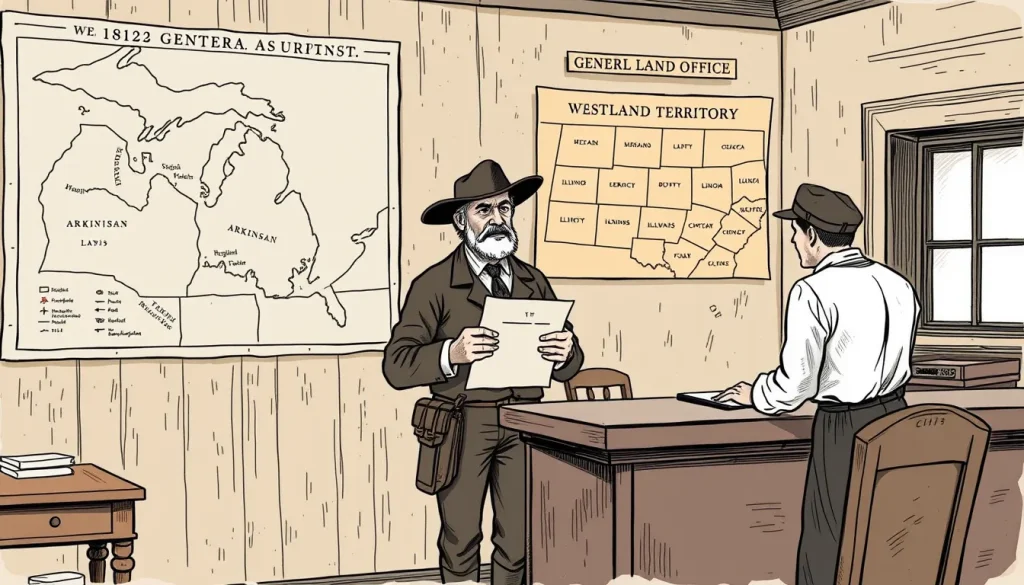
The first War of 1812 bounty land legislation was enacted on December 24, 1811, with supplementary acts on January 11, 1812, and May 6, 1812. These laws granted 160 acres of public land to every noncommissioned officer and soldier who enlisted for five years or until discharged sooner, or to their heirs if they died in service. To fund the program, Congress reserved six million acres, divided equally among the Territories of Michigan, Illinois, and Louisiana (the latter now comprising present-day Arkansas). A later act of December 10, 1814, known as the “Double Bounty” act, raised the grant to 320 acres for soldiers enlisting after that date. These warrants were dubbed “Double Bounty Warrants.”
Because surveyors reported that much of the Michigan reservation was unsuitable for cultivation, Congress in 1816 replaced the Michigan allocation with 1.5 million acres in Illinois and 500,000 acres in Missouri, keeping the total at six million acres. Throughout the administration of the program, warrants were issued by the War Department (later the Pension Office, which transferred to the Department of the Interior in 1849) and were redeemable at local General Land Office (GLO) offices. Veterans received a notification that a warrant had been issued in their name; the actual warrant was retained by the GLO. Warrants were not assignable to others except by inheritance, a restriction that remained until 1852.
Land selection initially had to be made within one of the designated reservations. In 1842, Congress removed this restriction, allowing veterans to locate their warrants on any public lands open to private entry. The 1842 act also continued the prohibition on assignment, which was finally rescinded in 1852. A more expansive act in 1855 awarded 160 acres to any veteran (or his widow or minor children) of any U.S. war since 1790 who had served at least fourteen days or had fought in a battle, regardless of rank. Over 260,000 claims were made under this act. The bounty land program was terminated in 1858, with a five-year period allowed for claims; no warrants were to be issued after 1863.
In practice, many veterans never claimed their land, either because they were unaware of the process or because they sold their warrants to land speculators at a fraction of their value. The General Land Office records and the National Archives preserve the detailed documentation of these warrants, including the veteran’s name, rank, regiment, warrant number, and location of the land patented.
Why It Matters
The land grant system had immediate and long-term consequences. It helped fill the regular army’s ranks during the war and provided a form of deferred compensation to soldiers, though its effectiveness was limited by administrative delays and the often poor quality of the reserved lands. Over time, the grants contributed to the settlement of the old Northwest and Southwest, bringing thousands of acres into private hands and spurring the development of frontier communities in Michigan, Illinois, Arkansas, and Missouri. The program also facilitated large-scale land speculation, as many veterans sold their warrants for cash, allowing investors to accumulate vast holdings. This process dispossessed Native American peoples who had long inhabited these lands, a consequence that historians now emphasize as a central aspect of the land-grant legacy. The bounty land system set a precedent for later federal land policies, including the Homestead Act of 1862, which shifted from rewarding military service to encouraging general settlement.
Definition
War of 1812 veteran land grants were public land bounties awarded to regular soldiers of the United States Army who served in the War of 1812. The grants took the form of military bounty land warrants—certificates entitling the bearer to a specified number of acres in the public domain. The initial grants comprised 160 acres; those enlisting after December 10, 1814, qualified for 320 acres under the “Double Bounty” provisions.
Background
The practice of granting land to soldiers as military compensation dated to the American Revolution. By the War of 1812, the federal government had extensive holdings of public land in the west, acquired through cessions from states and treaties with Native American nations. Land bounties allowed the cash-poor government to meet its obligations without immediate expenditure. The War of 1812 acts were part of a broader pattern of using land as a fiscal resource, a tradition that continued through the Mexican War and ended only with the Homestead Act.
How It Worked
A veteran or his heir had to apply for a warrant by providing evidence of service, such as a discharge certificate. The War Department processed applications and issued a warrant, which was recorded in the General Land Office. The veteran received a notification of the warrant but not the physical document. To obtain title to land, the veteran or assignee had to select a specific parcel within the designated reservations or, after 1842, anywhere in the public domain open to entry. The warrant was then submitted to a local GLO office, which issued a patent conveying legal title. Warrants were non-assignable until 1852, meaning they could not be sold or transferred, a restriction intended to protect veterans from speculators but which often created practical difficulties.
Competing Viewpoints
Contemporary and historical assessments of the land-grant system vary. Supporters argued that it was a fair and practical way to compensate soldiers without straining the treasury, and that it encouraged enlistment at a time of national need. Critics noted that the land was often far from settlements, that administrative delays discouraged claimants, and that the prohibition on assignment forced some veterans to sell indirectly or abandon their claims. Later historians have debated whether the system functioned as an effective recruitment tool or primarily benefited speculators and wealthy investors. Others have emphasized the negative impact on Native American peoples, who were displaced as land was transferred to white settlers through the bounty system. The 1855 act, which expanded eligibility to all veterans since 1790, reflected both growing political pressure from veterans’ groups and a recognition that earlier restrictions had left many deserving soldiers without benefits.
Role in the War of 1812
The land-grant acts were passed before and during the War of 1812, with the first authorization in December 1811, just prior to the declaration of war. The promise of land was intended to attract recruits for the regular army, which was small and underpaid. The initial 160-acre grant applied to those enlisting for five years, a long commitment, and the 1814 doubling of the bounty aimed to stimulate enlistment after early military setbacks. While the regular army never reached its authorized strength, the land bounties likely contributed to the enlistment of thousands of soldiers, particularly after the American victories at sea and in the Great Lakes restored confidence. The program also served as a model for later conflicts, establishing a precedent for using public lands as a means of military remuneration.
Consequences and Historical Interpretation
The land-grant program had profound consequences for both the veterans and the nation. It distributed over six million acres in the first phase alone, and later acts increased that total significantly. The program facilitated the settlement of Arkansas, Missouri, Illinois, and Michigan, and contributed to the clearing of Native American title to these lands, often through treaties that were coerced after military defeats. Historians now interpret the bounty land system as a central element of the federal government’s westward expansion policy, linking military service to the dispossession of Indigenous peoples. The end of the bounty system in 1858 and the passage of the Homestead Act in 1862 marked a shift away from military-specific land grants toward general settlement, but the memory of the War of 1812 grants persisted, and many veterans’ descendants used the warrants to obtain land. The administrative records of these grants, preserved in the National Archives, provide a rich source for genealogists and historians studying the war and its aftermath.
Primary Sources
The principal primary sources for War of 1812 veteran land grants are the federal statutes themselves: the acts of December 24, 1811 (2 Stat. 669), January 11, 1812 (2 Stat. 672), May 6, 1812 (2 Stat. 729), December 10, 1814 (3 Stat. 147), and subsequent amendments. The National Archives and Records Administration holds the original warrants and notifications in the Records of the Bureau of Land Management (Record Group 49), and has microfilmed them as War of 1812 Military Bounty Land Warrants, 1815–1858 (M848). The General Land Office’s Abstracts of Military Bounty Land Warrant Locations provide chronological records of land patents. A House of Representatives report from the 25th Congress (1838) offers a contemporary discussion of the claims of militiamen and rangers who were initially excluded from the bounties. The Encyclopedia of Arkansas entry on military land grants provides a state-level perspective on how the program operated in Arkansas. For veterans’ experiences, the 1855 act’s application files contain affidavits and other documentation, though many are held by the National Archives.
Further Reading
- Julius Wilm, Settlers as Conquerors: Free Land Policy in Antebellum America (Franz Steiner Verlag, 2018).
- National Archives and Records Administration, War of 1812 Military Bounty Land Warrants, 1815–1858 (microfilm publication M848), introductory pamphlet.
- Carolyn Yancey Kent, “Military Land Grants,” Encyclopedia of Arkansas, https://encyclopediaofarkansas.net/entries/military-land-grants-6978/.
- Robert R. Logan, “Notes on the First Land Surveys in Arkansas,” Arkansas Historical Quarterly 19 (Autumn 1960): 260–270.
- David A. Smith, “Preparing the Arkansas Wilderness for Settlement: Public Land Survey Administration, 1803–1836,” Arkansas Historical Quarterly 71 (Winter 2012): 381–406.
- Veterans Benefits Administration, “Bounty Land Warrants,” https://department.va.gov/history/object-2-bounty-land-warrant/.
References
- National Archives and Records Administration, War of 1812 Military Bounty Land Warrants, 1815–1858, M848, introductory pamphlet, https://www.archives.gov/files/research/military/army/dc/m848.pdf.
- Jeffrey Seiken, “Object 2: Bounty Land Warrant,” U.S. Department of Veterans Affairs, https://department.va.gov/history/object-2-bounty-land-warrant/.
- Carolyn Yancey Kent, “Military Land Grants,” Encyclopedia of Arkansas, https://encyclopediaofarkansas.net/entries/military-land-grants-6978/.
- “Military Bounty Lands (1812),” COSL Historical Documents, https://cosl.org/History/MilitaryBountyLands.
- U.S. House of Representatives, “Lands to organized militiamen, &c.,” Report No. 756, 25th Congress, 2nd Session (1838), http://hdl.handle.net/11244/36260.
FAQ
Who was eligible for War of 1812 bounty land grants?
Initially, regular army noncommissioned officers and soldiers who enlisted for five years or until discharged were eligible, as were their heirs. Later acts in 1855 expanded eligibility to any veteran of any U.S. war since 1790 who served at least 14 days or fought in a battle, regardless of rank.
Could veterans sell their land warrants?
No, until 1852, the law prohibited the assignment or transfer of bounty land warrants. This restriction was intended to protect veterans from speculators, but it was often circumvented. The 1852 act finally allowed assignment.
Where was the land located?
The original reservations were in the Territories of Michigan, Illinois, and Louisiana (present-day Arkansas). Due to poor reports on Michigan land, in 1816 Congress replaced that allocation with additional land in Illinois and Missouri. After 1842, veterans could use warrants to acquire any public land open to private entry.



Leave a Reply