Short Answer
The War of 1812 ended with the Treaty of Ghent on December 24, 1814, leaving the fundamental issues of impressment, trade restrictions, and Indian policy unresolved. Yet the decades that followed witnessed a remarkable transformation in Anglo-American relations, moving from suspicion and occasional confrontation to a stable, cooperative peace that shaped the North American continent. This article examines the diplomatic, political, and strategic rapprochement between the United States and Great Britain from 1815 to roughly 1823, a period that saw the negotiation of key agreements, the settlement of boundaries, and the articulation of the Monroe Doctrine.
Historical Context
The War of 1812 arose from long-standing grievances over British maritime practices, including the impressment of American sailors, restrictions on neutral trade, and British support for Indigenous resistance to American expansion. The conflict, viewed by Britain as a secondary sideshow to the Napoleonic Wars, was fought to a stalemate, with both sides eager for peace by late 1814. The Treaty of Ghent restored pre-war boundaries but omitted any mention of impressment or neutral rights, leaving those issues to future negotiation. Britain emerged from the war exhausted by Napoleon, while the United States experienced a surge of nationalist pride despite military setbacks. The postwar period presented an opportunity to redefine the relationship, as both governments faced the practical need to manage territorial disputes, trade, and the future of the North American continent.
What Happened
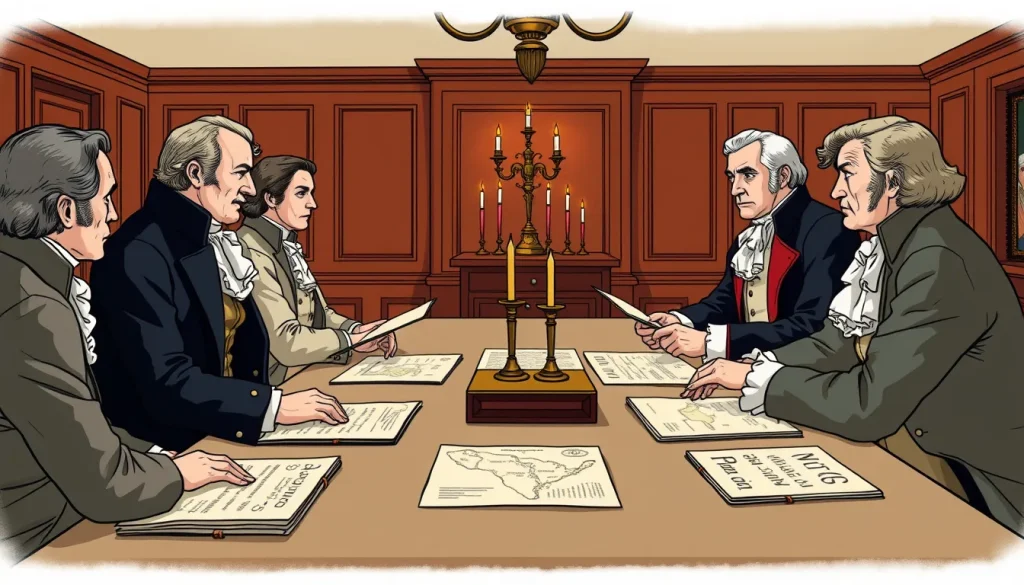
Beginning in 1815, American and British diplomats initiated a series of bilateral negotiations to address outstanding issues. The first major step came with the Rush-Bagot Agreement of 1817, which limited naval armaments on the Great Lakes and Lake Champlain, effectively demilitarizing the U.S.–Canadian border. In 1818, the two nations signed a convention that established the boundary along the 49th parallel from the Lake of the Woods to the Rocky Mountains, resolved fishing rights off Newfoundland and Labrador, and agreed to a joint occupation of the Oregon Territory. The Anglo-American border from the Great Lakes to the Rockies thus became peaceful, though the Oregon question remained unresolved. In 1819, the Adams-Onís Treaty with Spain, negotiated by Secretary of State John Quincy Adams, ceded Florida to the United States and defined the boundary with Spanish Mexico; this treaty also had implications for British interests, as it clarified American territorial claims. The most famous expression of the new relationship came in 1823 when President James Monroe, in his annual message to Congress, declared the Western Hemisphere closed to further European colonization. The British foreign minister, George Canning, had proposed a joint Anglo-American declaration, but Adams convinced Monroe to issue a unilateral statement, relying on British naval power to enforce it. This diplomatic maneuvering reflected the growing convergence of interests between the two nations, even as they competed for influence in the Americas.
Why It Matters
The transformation of U.S.–British relations after 1815 had immediate and long-term consequences. It secured the northern boundary of the United States, allowing for westward expansion without the fear of British attack. It also facilitated trade and economic growth, as Britain became the United States’ most important trading partner. Historians credit the postwar diplomacy with laying the groundwork for the twentieth-century “special relationship.” The period also marked the United States’ emergence as a regional power, confident enough to assert its own policy in the Monroe Doctrine, even as it depended on British naval superiority for enforcement. The shift from confrontation to accommodation—debated among scholars—reflects a critical moment when two nations chose negotiation over war, setting a precedent for peaceful resolution of international disputes.
Definition
U.S.–British Relations After the War of 1812 refers to the political, diplomatic, and economic relationship between the United States and the United Kingdom from the ratification of the Treaty of Ghent in 1815 to the early 1820s. This period is characterized by a series of negotiated settlements that resolved disputes over boundaries, military presence, and trade, culminating in the Monroe Doctrine of 1823, which implicitly acknowledged a shared interest in the exclusion of European powers from the Western Hemisphere.
Background
The war itself left a legacy of bitterness, but both nations recognized the futility of continued conflict. In Britain, the government of Lord Liverpool, with Foreign Secretary Viscount Castlereagh, sought to mend fences to focus on European stability. In the United States, President James Madison and later James Monroe, with Secretary of State John Quincy Adams, pursued a policy of national expansion and international respect. The unresolved issues from the Treaty of Ghent—particularly border demarcation, naval disarmament, and access to fisheries—demanded immediate attention. The British also sought to protect their trade interests in Latin America and the Pacific Northwest, which required a cooperative relationship with the United States.
How It Worked
The diplomacy of the period operated through formal treaties and informal exchanges. The Rush-Bagot Agreement (1817) was an exchange of notes between Secretary of State Richard Rush and British Minister Charles Bagot, limiting warships on the Great Lakes. The 1818 Convention was a more comprehensive treaty addressing boundaries and fishing. John Quincy Adams, as American foreign minister and later Secretary of State, played a pivotal role, as did Henry Clay and other commissioners. The British side moved from Castlereagh to George Canning as Foreign Secretary in 1822, with Canning favoring a more assertive but cooperative approach. The Monroe Doctrine, issued unilaterally, was nonetheless crafted with British interests in mind—Britain supported it because it aligned with its own desire to limit European intervention and promote its commercial opportunities in the hemisphere. Thus, the relationship functioned through mutual recognition of overlapping interests, even when the two nations did not act jointly.
Competing Viewpoints
Historians debate why Britain chose to accommodate American expansion rather than contain it. Some, like Bradford Perkins, emphasize that Britain’s strategic priorities in Europe and the cost of projecting power across the Atlantic made reconciliation inevitable. Others, like Stacie Goddard, argue that Britain deliberately reassessed American intentions, concluding that the United States was a benign rising power whose goals could be incorporated into the international order. There is also disagreement about the effectiveness of the Monroe Doctrine: while Americans celebrated it as a unilateral assertion of hemispheric power, critics note that it relied on British naval power and had little immediate practical effect. These interpretations highlight the complexity of the relationship and the multiple factors that shaped it.
Role in the War of 1812
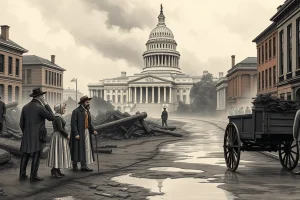
The War of 1812 itself was the catalyst for the postwar reorientation. The war demonstrated the costs of unresolved disputes, including trade disruption, military expenditures, and the burning of Washington. It also ended impressment in practice, as the Royal Navy no longer needed American sailors after Napoleon’s defeat. The Treaty of Ghent created a framework for peace by reaffirming the prewar status quo, which allowed both sides to claim victory and move forward. The war also solidified American national identity and convinced British leaders that the United States was a permanent and potentially powerful nation that was better dealt with through negotiation than conflict.
Consequences and Historical Interpretation
The immediate consequences included the demilitarization of the Great Lakes, the settlement of the boundary from the Atlantic to the Rockies, and the opening of Oregon to joint occupation. More broadly, the period set the stage for the eventual expansion of the United States to the Pacific and its rise as a continental power. The diplomatic success also influenced American foreign policy, as exemplified by the Monroe Doctrine, which became a cornerstone of American foreign relations. Later historians have seen this era as the birth of the Anglo-American “special relationship,” but also as a time when the United States asserted its independence from British influence. The peaceful resolution of disputes in this period contrasted sharply with the tensions of the prewar years and provided a model for international arbitration that would be used in later crises.
Primary Sources
The most important primary sources for understanding U.S.–British relations after the War of 1812 include the Treaty of Ghent (1814), which ended the war; the Rush-Bagot Agreement (1817); the 1818 Convention; and President Monroe’s annual message to Congress of December 2, 1823, which contained the Monroe Doctrine. Diplomatic correspondence between American and British officials, such as the letters of John Quincy Adams and Viscount Castlereagh, offers insights into the negotiating process. The Library of Congress exhibition “From Enemy to Ally” summarizes the period and provides access to related documents, including the British burning of Washington and the survival of a copy of an official account from the Capitol fire. These sources show the range of issues that were resolved and the changing tone of relations.
Further Reading
- Perkins, Bradford. Castlereagh and Adams: England and the United States, 1812–1823. University of California Press, 1964.
- Goddard, Stacie E. “America’s Ambiguous Ambition: Britain and the Accommodation of the United States, 1817–23.” In When Rights Become Wrongs, Cornell University Press, 2021.
- Library of Congress. “From Enemy to Ally.” Exhibitions, John Bull and Uncle Sam.
- National Park Service. “Summer 1814: Americans and British Open Peace Negotiations at Ghent.”
References
- Perkins, Bradford. Castlereagh and Adams: England and the United States, 1812–1823. University of California Press, 1964. Accessed via University of California Press.
- Goddard, Stacie E. “America’s Ambiguous Ambition: Britain and the Accommodation of the United States, 1817–23.” In When Rights Become Wrongs, Cornell University Press, 2021. DOI: 10.1515/9781501730313-005.
- Library of Congress. “From Enemy to Ally.” John Bull and Uncle Sam: Four Centuries of British-American Relations. Accessed at https://loc.gov/exhibits/british/brit-3.html.
- Digital History. “The Era of Good Feelings.” Accessed at http://www.digitalhistory.uh.edu/disp_textbook.cfm?psid=3530&smtid=2.
- National Park Service. “Summer 1814: Americans and British Open Peace Negotiations at Ghent.” Accessed at http://www.nps.gov/articles/treaty-of-ghent-1.htm.
FAQ
What issues were left unresolved by the Treaty of Ghent?
The treaty said nothing about impressment, neutral trade rights, or American disputes with Indigenous nations. These issues were addressed through subsequent negotiations and the end of the Napoleonic Wars.
How did Britain and the U.S. settle the Oregon boundary?
The 1818 Convention established joint occupation of Oregon for ten years, later extended indefinitely. The boundary was finally set at the 49th parallel in 1846.
Why did Britain support the Monroe Doctrine?
British interests in Latin American trade and opposition to European intervention aligned with the doctrine's principles, so Britain was willing to enforce it with its navy even though it was issued unilaterally.



Leave a Reply