
Short Answer
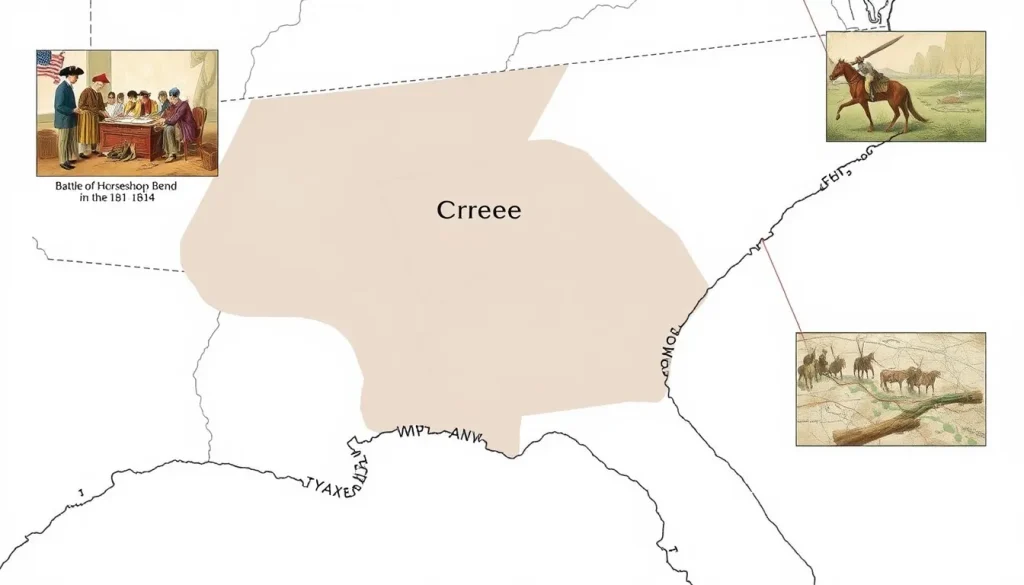
The Creek War (July 27, 1813 – August 9, 1814) was a multi-sided conflict among the Muscogee (Creek) Nation and between the Creeks and the United States, fought largely in present-day Alabama and Georgia during the War of 1812. It began as a Creek civil war between the traditionalist Red Sticks and the National Council, but escalated into an American military campaign that destroyed Creek power. The war’s outcome—the cession of over 20 million acres and the collapse of Creek independence—profoundly changed the American South by removing the region’s largest Native nation and accelerating white settlement and cotton agriculture.
Historical Context
By the early 1800s, the Creek Confederacy, the largest Native American polity in the Southeast, faced severe pressures from expanding white settlement, economic dislocation, and internal cultural divisions. The deerskin trade had collapsed, leaving many Creek towns deep in debt to European and American traders. Federal Indian agent Benjamin Hawkins, under Presidents Washington and Jefferson, promoted a “civilization” program that encouraged private landholding, herding, and cotton cultivation, which favored wealthy mixed-race elites but alienated traditionalists. The Creek National Council, a newly empowered governing body, cooperated with these policies, but many Upper Creek towns resented the loss of clan authority and the growing gap between rich and poor. In 1811, the Shawnee leader Tecumseh, accompanied by prophets, urged the Creeks to resist American expansion and return to ancestral ways. Tecumseh’s message, combined with earthquakes and comets, inspired a nativist movement among the Upper Creeks, who became known as Red Sticks. The War of 1812 further raised fears of British-backed Indian attacks, and American officials watched Creek unrest with alarm.
What Happened
The conflict began as a civil war. In 1812, the National Council ordered the execution of several Creek warriors who had killed white settlers along the Federal Road, a move that violated traditional clan prerogatives and sparked outrage. In July 1813, a party of Red Sticks, returning from Spanish Pensacola with arms, clashed with Mississippi militia. On August 30, 1813, Red Sticks attacked Fort Mims, a stockaded settlement in present-day Baldwin County, Alabama, killing hundreds of white settlers and Creek allies. The massacre, widely publicized in the American press, brought the United States into the war. General Andrew Jackson of the Tennessee militia led a punitive campaign with state troops and Cherokee, Choctaw, and Creek allies. Jackson defeated Red Stick forces at the Battles of Tallushatchee, Talladega, and Emuckfaw, though his supply lines were strained. The decisive engagement occurred on March 27, 1814, at Horseshoe Bend on the Tallapoosa River, where Jackson’s troops killed over 800 Red Sticks. The war ended with the Treaty of Fort Jackson, signed on August 9, 1814, which forced the entire Creek Nation—including allies—to cede some 23 million acres to the United States.
Why It Matters
The Creek War had immediate and long-term consequences. It destroyed the military and political power of the Creeks, leaving most Upper Creeks homeless or refugees. The land cessions opened present-day Alabama and a large part of Georgia to white settlement and speculation, fueling the cotton boom. The war also made Andrew Jackson a national hero and propelled him to the presidency. For the Creeks, the loss of land and sovereignty led directly to their forced removal along the Trail of Tears two decades later. Historians consider the Creek War a foundational event in the expansion of the American South and the dispossession of its Indigenous peoples.
Definition
The Creek War, also known as the Creek Indian War or the Muscogee War, was an armed conflict from July 27, 1813, to August 9, 1814, fought primarily in the region that would become Alabama. It pitted the Red Stick faction of the Muscogee Nation against the Creek National Council and American military forces. The term “Red Sticks” derived from the red war clubs carried by the militants. The war changed the American South by ending Creek territorial dominance and facilitating US expansion.
Background
The roots of the Creek War lay in deep economic and social transformations. The collapse of the deerskin trade and the increasing reliance on imported goods left many Creek towns impoverished. American land speculators and settlers pressed relentlessly into Creek territories, ignoring treaty boundaries. The introduction of market agriculture and slaveholding created a wealthy mixed-race elite, while many traditionalist Creeks lost access to resources. The National Council, acting under Hawkins’ influence, accumulated power and used US annuity payments to settle private debts, angering many communities. Tecumseh’s visit in 1811 and the subsequent religious revival provided ideological justification for resistance. The execution of Creek warriors by the council in 1813 split the nation and precipitated the civil war.
How It Worked
The war was characterized by militia expeditions, fortified stockades, and brutal reprisals. American forces, drawn primarily from Tennessee and Georgia, operated with Cherokee, Choctaw, and Creek allies who opposed the Red Sticks. Jackson’s strategy involved destroying Red Stick towns, food supplies, and refugees, forcing surrender through attrition. The Treaty of Fort Jackson, negotiated by Jackson, required all Creeks—including those who had fought for the United States—to cede vast territories. The treaty’s terms were severe: the US claimed over 20 million acres, which included land belonging to the Cherokee and other allies, despite their contributions to the American cause. This punitive settlement stripped the Creek Nation of any unified land base and opened the region to survey and sale.
Competing Viewpoints
Historians interpret the Creek War through several lenses. Some emphasize Creek agency, seeing the conflict primarily as a civil war that the United States exploited. Others stress American expansionism, viewing the war as a deliberate conquest to seize Native lands. A third perspective places the war within the broader War of 1812, arguing that the Red Sticks’ potential alliance with Britain threatened US security. The Treaty of Fort Jackson is particularly controversial: contemporaries such as Benjamin Hawkins and some Creek leaders protested its harshness, while Jackson defended it as necessary. Modern scholars often note the treaty’s betrayal of loyal Creeks and its role in normalizing forced removal. These differing interpretations reflect broader debates over US–Indigenous relations and the nature of antebellum expansion.
Role in the War of 1812
The Creek War was a significant but often overlooked theater of the War of 1812. American officials believed that the Red Sticks were receiving arms from British agents in Spanish Florida, and they feared coordinated attacks on the southern frontier. Jackson’s campaign, while autonomous, diverted troops and resources that could have been used against the British in the North. The defeat of the Red Sticks at Horseshoe Bend eliminated a potential British ally and secured the southern flank. Afterward, Jackson’s victory boosted American morale and contributed to his later triumph at the Battle of New Orleans. The Creek War thus influenced the larger conflict by shaping military strategy and political outcomes.
Consequences and Historical Interpretation
The consequences of the Creek War were transformative. The land cessions opened the region to rapid white settlement, leading to the admission of Alabama as a state in 1819 and the expansion of cotton cultivation that relied on enslaved labor. The war also facilitated the removal of the Five Civilized Tribes, as the precedent of coercive land cessions weakened Native title. For the Creeks, the war brought catastrophic population loss—an estimated half of the Upper Creek population died or fled—and permanent displacement. Historians view the Creek War as a turning point in American westward expansion, comparable to the later Indian removals. It also elevated Andrew Jackson, whose military reputation became the foundation of his political career. In the longer term, the war’s consequences contributed to the sectional tensions over slavery that led to the Civil War.
Primary Sources
Key primary sources for the Creek War include the Treaty of Fort Jackson (1814), which formally cedes Creek lands; Andrew Jackson’s official correspondence and orders, which reveal his strategic intentions; and the reports of Benjamin Hawkins, the US Indian agent, who documented the internal Creek divisions. The Fort Mims massacre was widely reported in contemporary newspapers, such as the Niles’ Weekly Register, and shaped public opinion. Red Stick perspectives are less directly documented, but oral histories and later Native accounts, such as those collected by John R. Swanton, provide insight. Each source must be read critically: American military reports often exaggerated casualties and justified harsh policies, while later Creek accounts recall the war as a betrayal.
Further Reading
- Cozzens, Peter. A Brutal Reckoning: Andrew Jackson, the Creek Indians, and the Epic War for the American South. New York: Knopf, 2023.
- Braund, Kathryn E. Holland. “Creek War in the Southeast: A civil war and an enemy occupation.” National Park Service, 2017. Available at nps.gov.
- Holmes, Will C. “American Expansionism and the Creek War of 1813-1814.” Vulcan Historical Review 3 (1999).
- “Creek War of 1813-14.” Encyclopedia of Alabama. Available at encyclopediaofalabama.org.
References
- Braund, Kathryn. “Creek War in the Southeast: A civil war and an enemy occupation.” U.S. National Park Service. https://www.nps.gov/articles/creek-war-in-the-southeast-1.htm.
- Cozzens, Peter. “Brutal Reckoning in the Creek War.” American Heritage 69, no. 1 (2024). https://www.americanheritage.com/brutal-reckoning-creek-war.
- “The Creek War of 1813-14.” Encyclopedia of Alabama. https://encyclopediaofalabama.org/article/creek-war-of-1813-14/.
- Holmes, Will C. “American Expansionism and the Creek War of 1813-1814.” Vulcan Historical Review 3 (1999). https://digitalcommons.library.uab.edu/vulcan/vol3/iss1999/9.
- Melton, Maurice K. “Creek War.” EBSCO Research Starters, 2023. https://ebsco.com/research-starters/history/creek-war.
FAQ
Was the Creek War part of the War of 1812?
Yes, the Creek War occurred during the War of 1812 and was influenced by British–Native alliances. It diverted US forces and, after victory, secured the southern frontier, though it was largely an independent campaign.
How did the Creek War change the American South?
The war destroyed Creek military power, forced the cession of vast lands, opened Alabama and Georgia to white settlement, and accelerated the cotton economy and the removal of Indigenous peoples.
What was the Battle of Horseshoe Bend?
The Battle of Horseshoe Bend, fought on March 27, 1814, was the decisive engagement of the Creek War, in which Andrew Jackson's forces defeated the Red Sticks, leading to the end of Creek resistance.



Leave a Reply