Short Answer
Fort Mackinac, perched on a limestone bluff overlooking the Straits of Mackinac, was among the most strategically vital posts in the War of 1812. Its location commanded the maritime and fur-trade routes linking Lake Huron and Lake Michigan, and its influence over Indigenous nations made it a linchpin of the northwest frontier. The fort’s bloodless capture by British forces on July 17, 1812, sent shockwaves through the American command, helped precipitate the surrender of Detroit, and kept the upper Great Lakes under British control for most of the war.
Historical Context
The Straits of Mackinac, a narrow waterway separating Lake Michigan and Lake Huron, had been a strategic center for the fur trade and Indigenous diplomacy since the French colonial era. The original fortification on the mainland, Fort Michilimackinac, was replaced by Fort Mackinac on Mackinac Island in 1780–1781 because the island offered a more defensible position and a natural harbor (Haldimand Bay). Control of the fort meant control of the lucrative trade routes and, critically, the allegiance of Anishinaabe and other Indigenous peoples who dominated the region.
After the American Revolution, the Treaty of Paris (1783) ceded the area to the United States, but the British did not transfer Fort Mackinac until 1796 under the Jay Treaty. The British then established Fort St. Joseph, about 50 miles to the east in the St. Mary’s River, as a new post closer to their Great Lakes supply lines. In the years before 1812, Fort Mackinac was a small, isolated American garrison, poorly supplied and far from any major army headquarters. Its commander, Lieutenant Porter Hanks, commanded only about sixty-one regular artillerymen.
When the United States declared war on Britain on June 18, 1812, orders were slow to reach the remote post. The British, meanwhile, received word quickly and acted with speed and determination.
What Happened
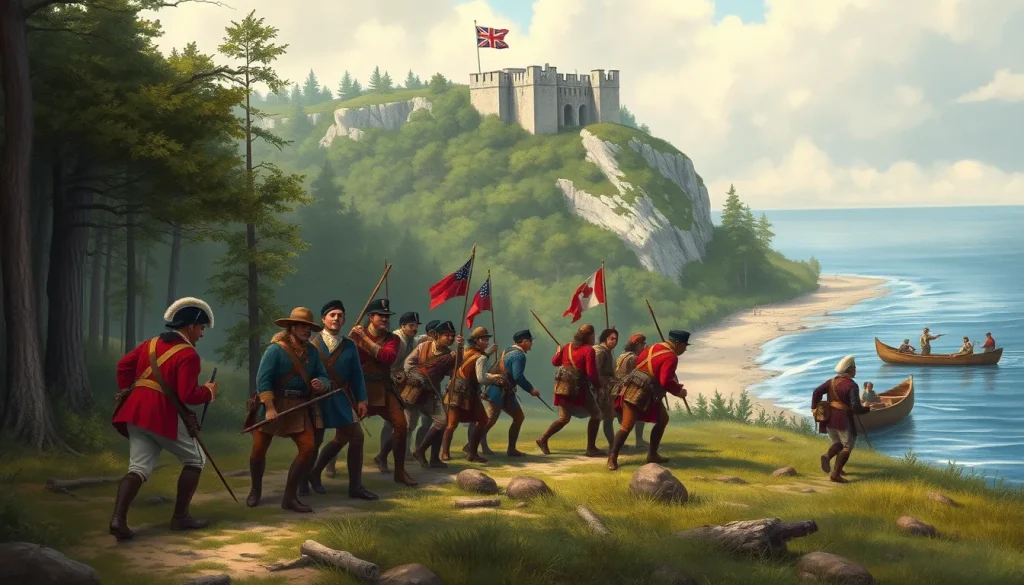
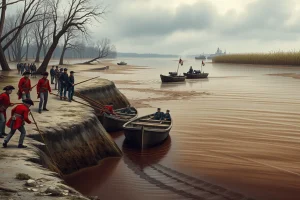
News of the declaration of war reached Captain Charles Roberts, British commander at Fort St. Joseph, on July 8, 1812. Although initial orders to attack were conflicting, Roberts finally was authorized to use his discretion. He assembled a force of 45 regulars from the 10th Royal Veteran Battalion, about 180 Canadian and North West Company voyageurs, and roughly 400 Indigenous warriors, principally Ottawa, Ojibwe, and Menominee. This contingent departed St. Joseph Island on July 16, landing on the north end of Mackinac Island before dawn on July 17.
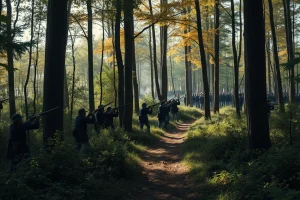
The British hauled a 6-pounder cannon through thick woods to a ridge overlooking the fort. At about 10 a.m., Roberts fired a single shot and then sent a flag of truce demanding surrender. Lieutenant Hanks, realizing his garrison was hopelessly outnumbered and that the fort’s guns could not effectively reply, accepted the terms. The fort surrendered without a single casualty on either side. Hanks and his men were taken prisoner but later paroled. The capture was a bloodless masterpiece, but its consequences were enormous.
The Americans did not recover Mackinac until after the war. In the summer of 1814, an American expedition under Captain Arthur Sinclair and Colonel George Croghan attempted to retake the island. They landed on August 4, but the British garrison, now reinforced and commanded by Lieutenant Colonel Robert McDouall, repulsed them at the Battle of Mackinac Island. The Americans withdrew after suffering losses of 19 killed and 45 wounded; the British reported no casualties. The Treaty of Ghent (1815) restored the fort to U.S. possession.
Why It Matters
The capture of Fort Mackinac transformed the military and diplomatic situation in the northwest. Immediately, it gave Britain control of the Straits and the trade routes, and it signaled to Indigenous nations that the British would fight for their claims. Within weeks, the news reached Brigadier General William Hull, who had invaded Canada at Detroit. The fall of Mackinac helped convince Hull that his supply lines were threatened and that a massive Indigenous rising was imminent. Hull abandoned his invasion and surrendered Detroit to Isaac Brock on August 16, 1812, without a fight. This string of defeats dashed American hopes for a quick conquest of Upper Canada.
The fort’s capture also ensured that the British could maintain their network of alliances with Indigenous peoples throughout the region. For the rest of the war, the northwest remained a simmering frontier of raids and counter-raids. The American failure to retake Fort Mackinac in 1814 left the British in control of the upper lakes until the end of the war. Strategically, the small fort had an outsized impact, shaping the course of the conflict in the West.
Definition
Fort Mackinac was a U.S. military post on Mackinac Island, Michigan, that controlled the Straits of Mackinac. In the War of 1812, its strategic importance rested on its command of maritime and fur-trade routes and its influence over Indigenous peoples in the region. The fort was also a symbol of sovereignty: whoever held it claimed influence over the upper Great Lakes.
Background
The fort was constructed by the British between 1780 and 1781 to replace Fort Michilimackinac. It was built on a high limestone bluff overlooking Haldimand Bay, which offered a defensible position and a safe anchorage. After the Jay Treaty, the U.S. took possession in 1796. Despite improvements, the garrison remained small and undersupplied, making it vulnerable to the sort of rapid, aggressive action Roberts launched in 1812.
How It Worked
The fort functioned as a military garrison, a fur-trade depot, and a center for Indigenous diplomacy. Its guns, though limited in range, protected the harbor and the adjacent civilian settlement. The commanding officer managed relations with Indigenous nations, distributing gifts and negotiating alliances. Because the fort was often the only major European-American presence in the region, its control directly influenced loyalties. The British had long used such posts to maintain Indigenous alliances; the Americans sought to do the same but with far less success due to isolation and lack of resources.
Competing Viewpoints
Historians generally agree that Fort Mackinac was strategically important, but they differ on the precise degree. Some emphasize its role in fostering Indigenous alliances, which were vital to British defense. Others stress its control of trade and communications, which affected both sides’ supply lines. American historians often view the fort’s capture as a critical early blow that demoralized U.S. forces and contributed to Hull’s surrender at Detroit. British and Canadian historians tend to highlight the initiative and cooperation of British officials, fur traders, and Indigenous warriors. Indigenous historians note that the fort’s significance lay in maintaining Indigenous autonomy and trade connections, which the war disrupted.
Role in the War of 1812
Fort Mackinac’s capture on July 17, 1812, was the opening military action on U.S. soil. It gave the British control of the straits and the strategic initiative in the northwest. The fall of the fort precipitated a wave of Indigenous support for the British, convinced Hull to retreat, and ultimately hastened the fall of Detroit. The fort remained a British base for the remainder of the war, from which raids were launched against American posts such as Fort Dearborn. In 1814, a determined American expedition to retake it failed at the Battle of Mackinac Island, leaving the fort in British hands until the Treaty of Ghent.
Consequences and Historical Interpretation
The long-term consequences of Fort Mackinac’s role were felt in the postwar settlement. The Treaty of Ghent restored the fort to the United States, but the war had reshaped the region. The fur trade declined, and Indigenous peoples lost ground as the United States asserted greater control. Historians interpret the fort’s importance as a microcosm of the larger war: it showed how a small post, combined with Indigenous alliances and bold leadership, could tip the balance on a distant frontier. The bloodless capture of 1812 stands as a classic example of how strategic position and psychological effect can outweigh raw numbers.
Primary Sources
Contemporary accounts of the capture of Fort Mackinac include Captain Roberts’s official report to Major General Isaac Brock, dated July 17, 1812, which describes his force and the surrender. Lieutenant Hanks’s correspondence, while limited, also exists. The American Battlefield Trust and the Canadian Encyclopedia provide modern summaries drawing on these reports. Additionally, the diaries and letters of British officers mention the impact of the news on Hull. No full transcript of the surrender demand is known to survive, but its contents are referenced in later correspondence.
Further Reading
- Hickey, Donald R. The War of 1812: A Forgotten Conflict, University of Illinois Press, 1989.
- Lambert, Andrew. The Challenge: Britain Against America in the Naval War of 1812, Faber & Faber, 2012.
- Latimer, Jon. 1812: War with America, Harvard University Press, 2007.
- Stagg, J.C.A. The War of 1812: Conflict for a Continent, Cambridge University Press, 2012.
- Berton, Pierre. The Invasion of Canada: 1812–1813, McClelland & Stewart, 1980.
References
- American Battlefield Trust. “Fort Mackinac Battle Facts and Summary.” Accessed 2025. https://www.battlefields.org/learn/war-1812/battles/fort-mackinac
- Grodzinski, John R. “Battle of Mackinac Island.” The Canadian Encyclopedia, 2012 (updated 2022). Accessed 2025. https://thecanadianencyclopedia.ca/en/article/battle-of-mackinac-island
- Hele, Karl S. “Fort Mackinac.” The Canadian Encyclopedia, 2025 (updated 2026). Accessed 2025. https://thecanadianencyclopedia.ca/en/article/fort-mackinac
- “Capture of Fort Mackinac – War of 1812.” The War of 1812 Resource, 2019. Accessed 2025. https://thewarof1812.org/battles/capture-of-fort-mackinac/
- Rickard, J. “Battle of Mackinac Island, 17 July 1812.” HistoryofWar.org, 2006. Accessed 2025. https://www.historyofwar.org/articles/battles_mackinac_island_1812.html
FAQ
Why did the British want to capture Fort Mackinac?
Fort Mackinac controlled the Straits of Mackinac, the vital waterway linking Lake Huron and Lake Michigan. Its possession allowed control of the fur trade and, more importantly, maintained British influence over Indigenous nations of the northwest, which they needed to defend Upper Canada.
How did the fall of Fort Mackinac affect the American war effort?
The capture demoralized General William Hull, who feared an Indigenous uprising and a severed supply line. Within a month, Hull surrendered Detroit on August 16, 1812, an embarrassing defeat that gave Britain control of the Michigan territory.
What happened at the 1814 battle on Mackinac Island?
An American force under Arthur Sinclair and George Croghan landed on August 4, 1814, to recapture the fort. The British, led by Robert McDouall, repulsed them with the help of Indigenous allies. American losses were 19 killed and 45 wounded; the British suffered none.

Leave a Reply